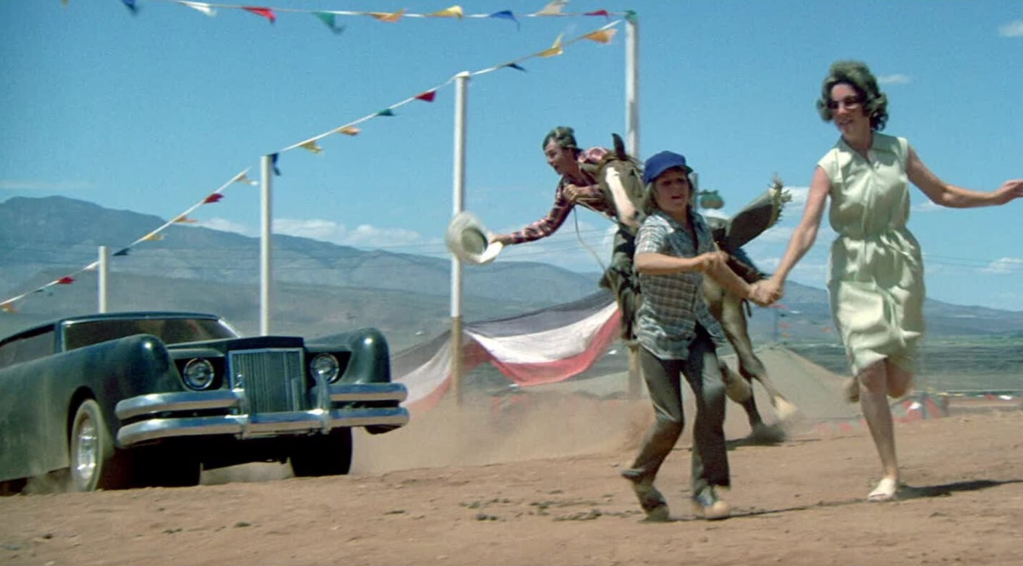
In proto-Christine (1983) fashion, The Car (1977) is about a car driven by no mortal being going on a murderous rampage. Stephen King made it a point in his book to say that his car from Hell, a 1958 Plymouth Fury the color of red lipstick, wasn’t doing what it was doing just because: the spirit of its previous owner possessed it. The Car, though, provides no such explanations. All we know is that its matte-Black, 1971 Lincoln Continental Mark III barrels into a dusty, sparsely populated California town called Santa Ynez one afternoon and starts running people over, warming itself up for its spree by knocking a couple of wholesome teenagers riding bikes together off a cliffside road. The car apparently cannot be destroyed; it also need not worry about things like a fuel or engine light turning on. The few townspeople, led by a cop played by James Brolin, try to stop it while trying not to be the next person on its hit (-and-run) list.
The Car is lumped in, on the few occasions that it’s brought up at all, with the big group of the very worst Jaws ripoffs to emerge post-1975. I don’t disagree. But I’m also moved to add that The Car is at least well made in ways its cash-ins in arms typically are not. (It was directed by Elliot Silverstein, who worked mostly, and steadily, in TV, his biggest cinematic success his work on the 1965 Western comedy Cat Ballou.) Such is both a blessing and a curse. It’s a blessing because it ensures the film gets in some good set pieces: the car stalking a group of kids practicing for a town parade in the style of its great-white inspiration (though the sequence altogether reminds me more of this scene from The Birds); the car, like it was breakdancing, making itself flip over and over so that it can roll over some police cars that had, moments before, been hotly pursuing it.
But it’s a curse in how it sets you up early expecting more from it than you ultimately get. The Car has the sort of decent production quality that inspires hope that it will transcend a silly premise; I was surprised at how long it took me to give up. It only lives up to what it promises.
I still liked the few idiosyncrasies it gave me: a drifter character who carries around not much more than a French horn, the large painting of her boyfriend a woman keeps in her living room. But my favorite of them is the kooky Kathleen Lloyd performance that at one point finds her flirtatiously doing a James Cagney impression and in another unhesitantly supporting a young student (she’s a teacher) drawing nude photos of her when an authority at the school questions it. I would have loved a movie about her, but she’s a character in a film about a car that kills people.
 Peterson Reviews