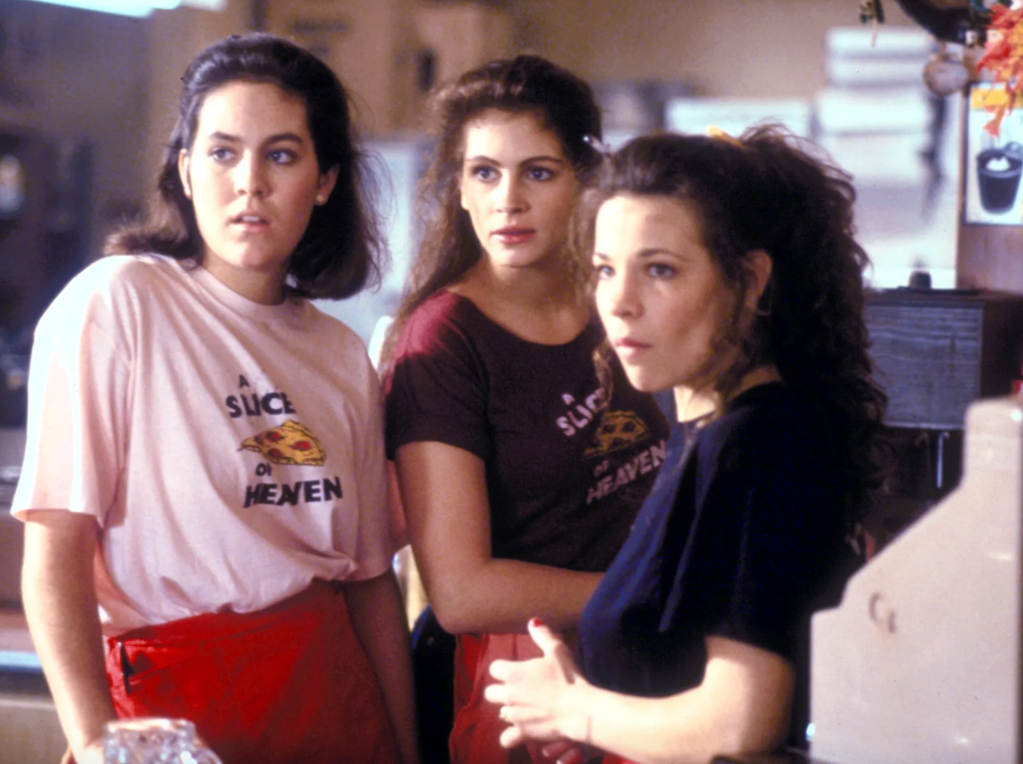
Mystic Pizza (1988), directed by Donald Petrie, is set in a sleepy Connecticut coastal town sometime in the fall, and introduces us to its three leads — sisters Kat and Daisy (Annabeth Gish and Julia Roberts) and their friend Jojo (Lili Taylor) — at an all-too-familiarly tricky-to-navigate time of life: the intersection of childhood and adulthood, where anxiety about and excitement for the future constantly volley.
Kat, often seen as the smartest and most “promising” of the group, is due to head off to Yale soon to study astronomy. Jojo was supposed to marry her abstinent, God-fearing fisherman boyfriend Bill (Vincent D’Onofrio), but at the wedding, which opens the film, she faints, overwhelmed with thoughts of herself in a decade fat and pestered by children she doesn’t want. (Their nuptials are thereafter temporarily called off.) Best at playing pool and knocking back beers, Daisy has no idea what she’s going to do with her life, prone to self-deprecating that she’s the type to prompt “what went wrong?” questions when compared to her more straight-edged and ambitious sister.
Until the next “chapters” of their lives materialize, the girls bide their time working at the eponymous restaurant, a hot, busy Portuguese-American establishment run by a woman (Conchata Farrell) so protective of culinary tradition that she’ll neither ever tweak the menu nor share her sui-generis recipes. They also pursue romance, Jojo with the fiancé still learning to trust her (and still trying to pressure her into a lifelong commitment she’s still not sure she’s ready for), Daisy with an upper-class boy recently kicked out of law school for cheating (Adam Storke), and Kat with a handsome — and married — architect (William R. Moses) she’s been babysitting for to earn some money for school.

Adam Storke and Julia Roberts in Mystic Pizza.
What becomes of these romances has a certain life-lesson thrust, and, depending on where they end up, promote the old-fashioned idea that if you’re a woman, you’re practically doomed if you don’t find a man to provide for you if your career prospects aren’t hot, either. It’s retrograde; you wish the screenwriters, a packed lineup made up of Amy Holden Jones, Perry Howze, Randy Howze, and Alfred Uhry, wouldn’t limit these smart and ebullient young women to such a binary. (It’s easy to wonder how the movie might have differed had Jones, who was originally slated to direct before being usurped by first-timer Petrie, helmed the film, though Jones has said the biggest difference between her original script and the revised one was that there used to be four girls as opposed to three.)
Some of that disappointment is also a testament to how good the script, and the movie’s three then-up-and-coming leads, is at making its central trio and their chemistry feel lived-in. (Mystic Pizza is at its greatest when they’re together and having fun, no one else able to interrupt.) You want the best for them because you come to love them, and can feel so lucidly the youthful trepidations anybody who’s been that age knows in some way or another: Daisy’s chronic certainty that she isn’t good enough for anything bigger than her current life; Kat’s naïve bid for maturity through “mature” romance; Jojo’s conviction that one wrong decision could ruin her life forever.
In his review of the movie, Roger Ebert now-famously said that he had a hunch that Mystic Pizza would one day be known for showcasing movie stars before they became such. That mostly became true. Unequivocally so for Roberts, who’d be Oscar-nominated in just a couple years; less for Taylor and Gish, who remained nonetheless prolific and prone to interesting projects. The sensation of being thrilled seeing talented young performers on the cusp of something still surges through the movie, behind-the-scenes auspiciousness complementing the promise of fictional characters whose potential feels larger than the realities they’ve been dealt.
 Peterson Reviews