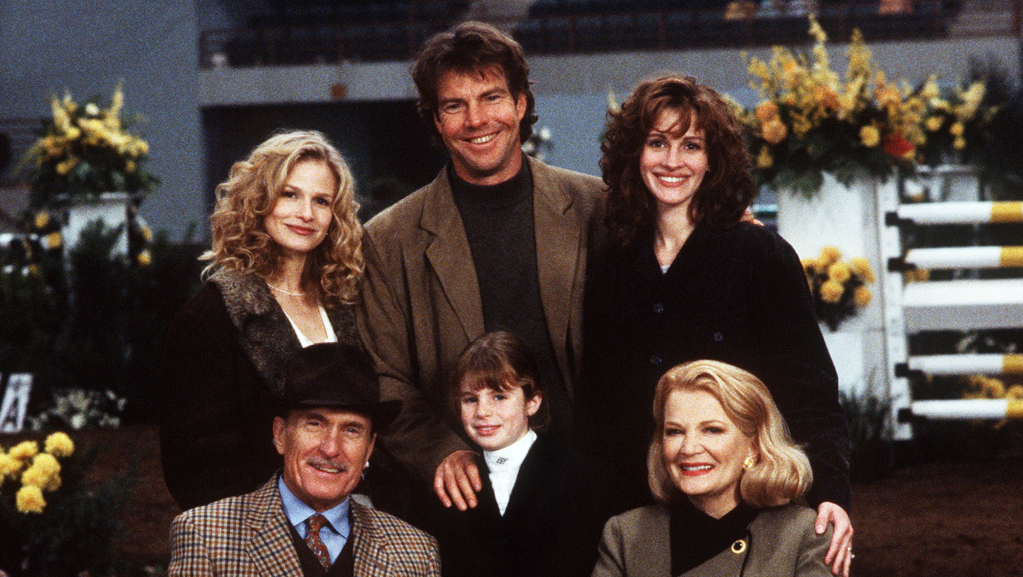
Watching Lasse Hallström’s Something to Talk About (1995) is akin to eating a piece of meat prepared without seasoning, the opportunity to accentuate flavors never tapped into in favor of something easier — more unsatisfying. It’s about a young woman named Grace (Julia Roberts) who discovers early in the movie that her husband, Eddie (Dennis Quaid), is cheating on her with an only peripherally seen blonde woman — a development that first inspires her to publicly confront him, in a nightgown and comfy boots, while he’s at a work dinner, then take their little daughter, Caroline (Haley Aull), and herself to her parents’ (Gena Rowlands and Robert Duvall) house to give herself space to decide what to do next.
Grace’s uncertainty isn’t matched by her strong-opinion family members. Her spitfire sister, Emma Rae (a fantastic Kyra Sedgwick), sees no other option besides divorce; she’s so mad at Eddie that when he shows his face early in the separation she doesn’t hesitate to knee him in the balls. (Although Emma Rae isn’t exactly sympathetic to her sister, either: “You married a guy whose college nickname was Hound Dog — what did you think would happen?”) Grace’s parents, Georgia and Wyly, think Grace is being dramatic — “he slipped; it’s up to you to pick him up,” Georgia says with a shrug — though one cannot hear what they have to say in complete good faith because Wyly is hoping to close a business deal with Eddie’s dad. (Georgia and Wyly own a successful horse farm.)
I do like how much of its runtime Something to Talk About spends not trying to that obviously push Grace in any one direction. It would rather loiter in post-separation messiness and confusion, implicitly cheering her on while she disrupts a society-women meeting to clear the air on who else might have given into Eddie’s unfaithful propositions or while she tries to figure out whether she’d like to try out a no-strings-attached one-night stand with an employee of her father’s (Brett Cullen) who’s nice to her. Charmingly, they decide it would be better to eat some warm apple pie and cold milk together at the dining-room table.
It also has the good sense to take a decent amount of advantage of the formidable talents of Rowlands, giving her a showy scene where she’s sloshed and finally confronts Wyly about his own newly uncovered marital transgressions. (You can tell, based on the way the scene is directed, that Hallström probably appreciates the emotionally raw work for which Rowlands is acclaimed with her filmmaker husband John Cassavetes.)
But the closer Something to Talk About gets to its denouement — which is boringly, and I suppose not that surprisingly, conservative — you can’t help but realize how little anything it has done has been particularly compelling or daring by way of the marital-slash-family drama. Any goodwill it inspires is more based on the uniform greatness of its cast. There is no real wit or edge to the writing; it only allows its women characters to be chaotic to a point, ultimately preferring it if they would avoid making too bold of choices and adequately atone for the ones they have. (Callie Khouri, who wrote the movie, is almost outrageously sympathetic to Eddie in the meantime.) That’s why the movie, I think, strikes such a resounding chord of disappointment: it seems on the cusp of turning over a new leaf for so long, only to turn back to the old one. This isn’t a movie with the happy ending it seems to think it has. It’s an ending suggesting the beginning of a long and painful cycle.
 Peterson Reviews