
Lara Croft: Tomb Raider (2001) wisely introduces itself with one of its silliest set pieces. The fabulously wealthy archeologist the movie is named for (Angelina Jolie) is deep inside the bowels of an ancient Egyptian tomb, fending off a giant robot programmed to kill her while she searches for a priceless relic. The scenario poses a big question (why would a huge, hyper-intelligent robot be here?) whose answer (this actually is happening in the colossal Croft family manor, and this is just a training exercise) does not suddenly better ground things in reality. It’s a good early litmus test of how much you’re going to enjoy the movie to come. Either you’re going to take it on its own preposterous terms, or you’ll be so fixated on its unabating implausibilities that you might only be able to greet everything it throws at you with an eye roll.
It isn’t impossible to eventually find yourself in that first group even if you were initially in the second. The brio and slickness with which the director, Simon West, shoots the movie’s generous offering of action sequences helps. It also helps to have Jolie, a born action heroine who, through subsequent movies like Mr. & Mrs. Smith (2005), Wanted (2008), Salt (2010), and Those Who Wish Me Dead (2021), would only get more comfortable in the position with time.
In Lara Croft, Jolie authoritatively handles voluminous guns and knives and calmly revs her decked-out motorcycles and Range Rovers precisely when it’s the unwisest to. She’s commandingly cool swaggering around in her character’s preferred garb: aviator sunglasses, bodycon tank tops and short shorts, and wintry white trench coats with fur-lined hoods. It isn’t hard to believe that, behind the scenes, Jolie purportedly got so committed to the sometimes bruise-and-cut-making physical arduousness of the role that West sometimes reminded her that it would not be a bad thing to tone it down a little. Jolie is well-suited here to the point that you don’t even think — or at least I didn’t — that her English accent is bad.

Daniel Craig and Angelina Jolie in Lara Croft: Tomb Raider.
As Croft, Jolie’s sexiness is inextricable from her toughness; in the cocksure way she carries herself, she recalls Terminator 2: Judgment Day (1991)-era Linda Hamilton. (Jolie trained for the part for two and a half months.) West gets that Jolie’s appeal doesn’t come only from how she looks; it’s also contingent on the nebulous “vibe” she represents, which, circa 2001, was at its unafraid-of-anything wild-child peak.
West pointedly capitalizes on the different facets of Jolie’s allure less through overt physical ogling and more by simply watching Croft be confident in her power and intelligence, dependably besting the men against whom she races to find the movie’s much-sought-after treasure. The movie does not let the early scene where we watch, in sultry slow motion, Croft take a shower pass by for long without implicitly poking fun at itself for giving into the temptation to pander to the straight male gaze: it’s later “corrected” by the same thing happening with the chiseled Daniel Craig, whose glistening body is paraded around for what feels like even longer. Croft, who stops by to visit him unannounced herself, joins us in the leering. (West wasn’t above grossly complying in some way with complaints from the proto-incel crowd that Jolie wasn’t hot enough for the part, though: the actress was pushed to wear extra padding in her bust to better “match” the cartoonishly buxom proportions of her video-game counterpart.)
In Lara Croft, a stylishly shot colonialist fantasy, Craig plays one of many rival treasure hunters who want what Croft is after: a triangular talisman found somewhere in a tomb in Cambodia said to be able to control time, though only when its disconnected pieces are fused to each other during a solar eclipse where all the planets are also all aligned. In addition to Craig’s archeologist character, Croft also has to face the Illuminati, led by an evil-looking Iain Glen never that clear about why the organization desperately needs to control time besides just wanting to.
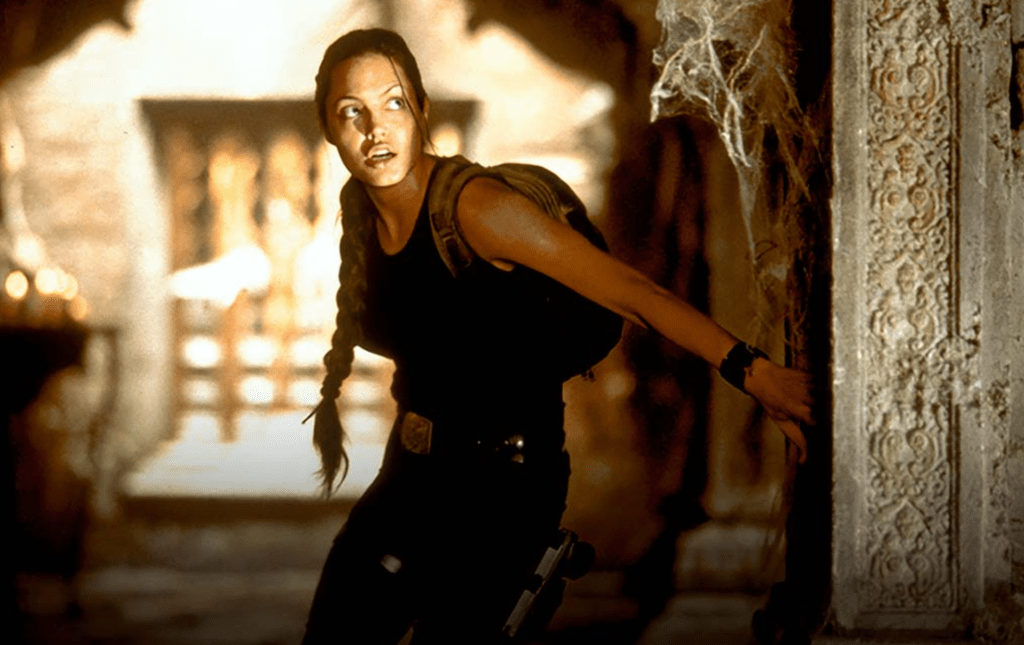
Angelina Jolie in Lara Croft: Tomb Raider.
Croft has more concrete motivations. She wants to save her explorer father (Jon Voight), who was, according to his gravestone, “Lost in the Field, 1985.” He’s the reason why Croft is in her current line of work. He’s also responsible for the movie’s arguably most vexing narrative strand, not because it’s wrong for Croft to still grieve, but because of the vague condescension with which her “daddy issues” are portrayed, the suggestion that the work she devotes her life to is less for herself than for him.
Lara Croft thankfully doesn’t dwell there too long. It’s too busy trotting the globe, too busy thrillingly pitting Croft against the dangers that lurk within the movie’s many handsomely designed temples. Statues come to life to act as built-in security guards. A massive orrery might split you into halves if you aren’t methodical while navigating its spinning body. Jolie, only 25 when the movie was shot, is a sturdy anchor throughout it all, magnetic even when the film’s twists and lapses in logic threaten to destabilize it.
I haven’t played the video game Lara Croft is based on, but I imagine it and the movie function similarly. When you have an engaging enough lead character holding everything together, it makes being game to go on a ridiculous ride easier. And nearly 25 years after the movie’s original release, there’s something newly invigorating about watching an action blockbuster free of superheroes, where the sets and set pieces more often feel tangible than they do byproducts of CGI, and where the lead has a surfeit of movie-star charisma to spare.
 Peterson Reviews