Midway through Pulp Fiction (1994), gun moll Mia Wallace reminisces about her 15 minutes of fame — the time she was cast in a TV pilot following the exploits of a group of female secret agents called Fox Force Five — across from listening companion Vincent Vega while seated at the 1950s-themed diner Jack Rabbit Slim’s. “Fox as in we’re a bunch of foxy chicks, force as in we’re a force to be reckoned with, and five as in there was one, two, three, four, five of us,” she explained. Wallace was to play a knife expert with a yen for dad jokes; the series, tragically, was not picked up.
Ted V. Mikels’ The Doll Squad (1973) is what I imagine the DOA Fox Force Five pilot to have possibly been like: blessed with a fun premise but executed with the kind of cheap ineptness that makes it clear why it became a pilot-season casualty. Its eponymous group, a crackerjack team of female agents apparently not employed regularly enough to not need blue-collar day jobs, is pushed to gather after a senator-blackmailing madman with obscure plans blows up a rocket at Cape Canaveral. The group is led by the ace Sabrina Kincaid (Francine York), whose chief attributes are that she is skilled at combat and has a mane so red that it begs to be called “signature.” Other members, whom she spends most of the film’s first act recruiting, are not much better developed, set apart mostly for their hair color and varying styles of dress. Tura Satana, so forceful and dynamic in Russ Meyer’s Faster, Pussycat! Kill! Kill! (1965), is relegated the most criminally to a near-wordless part where she does not have to do more besides be sexy and superficially diversify (she has Japanese and Native American heritage) an all-white cast of nobodies laughably touted as “all-star” in the credits.
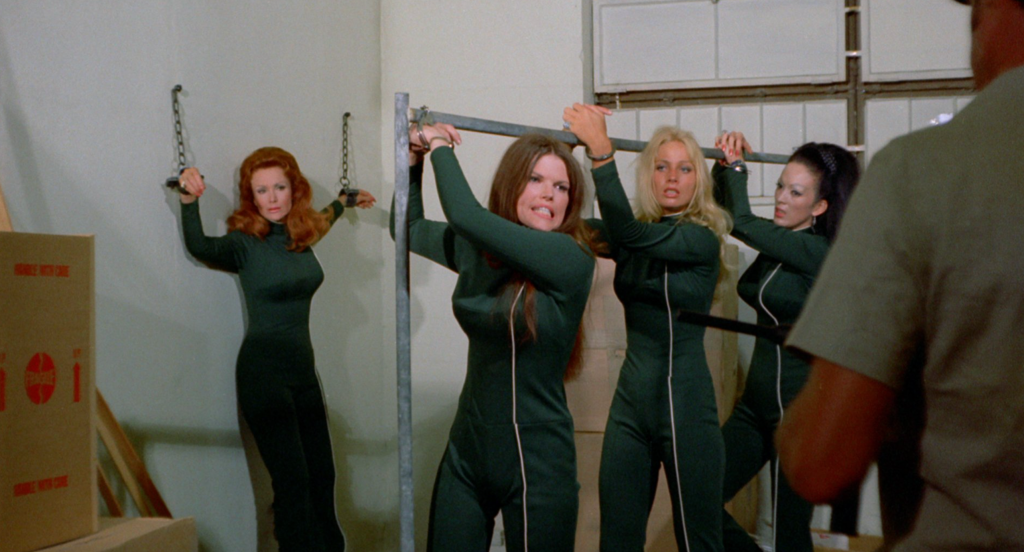
The Doll Squad limply kills time before its titular team descends on the castle-like compound of the villain, whose motivations convolutedly involve reintroducing the bubonic plague to the world with the help of some injected rats. The women do not have much of a plan or very much equipment in their arsenal — just a few guns and grenades. Most important, to the film’s eye, is how they look in their matching bodycon black jumpsuits with a single stylish white stripe. Naturally they cannot come with any bulletproof protection for fear of unflattering bulkiness.
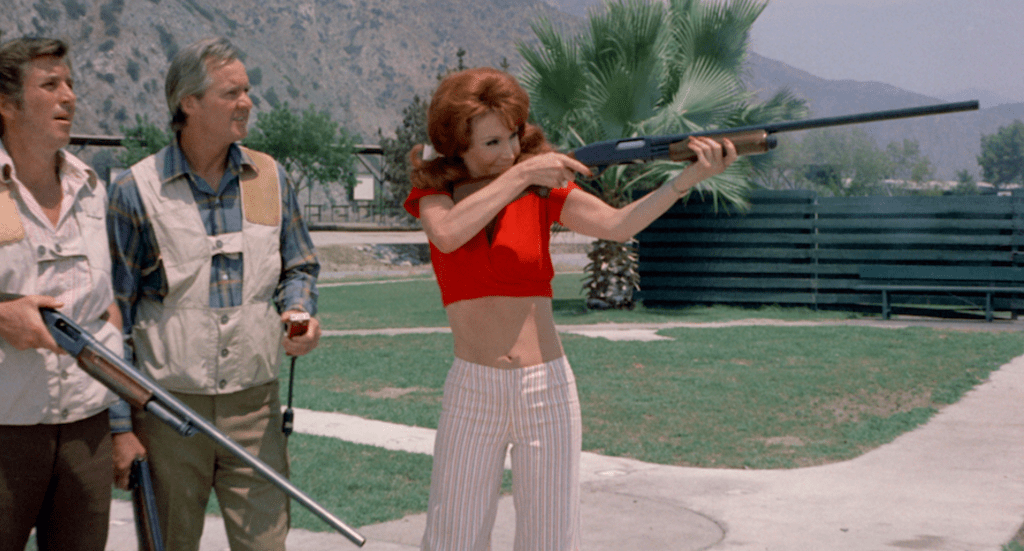
Sabrina Kincaid (Francine York) outshooting her male superiors in The Doll Squad.
Mikels is hopeless at shooting a compound raid in a way that invites any sense of suspense, so the music works overtime to remind us that something exciting is happening. The film did not have to egg me on very hard, though, to be delighted by a moment during said raid where Sabrina cleverly douses a bad guy with a cocktail before throwing a lamp plug at him, her fingers crossed for an electrocution death that will unfortunately not come.
The Doll Squad is not good, reinforced by choppy transitions and a budget so low that it cannot even afford explosives for key moments during the action sequences. (It opts to superimpose red smears onto its images where the fire should be.) But it has an undeniable vision, functioning as a largely rare action movie of its era not merely led by one woman but several. It is, of course, not averse to appreciating the beauty and bodies of its woman characters in the sort of straight male gaze-y way you’d expect from a director who owned the castle featured in the climactic sequence and had women over at a Playboy Mansion-like rate. But it also makes it a point, particularly when Sabrina is with male higher-ups, to always have her and her squad treated not as equals to their masculine peers but superiors, called in specifically because they’re better at accomplishing the work at hand than the men.
The Doll Squad is said to have helped set the stage for Charlie’s Angels, which successfully premiered three years later. (Maybe creator Aaron Spelling, who purportedly was invited to The Doll Squad’s premiere, was inspired enough to also have one of his show’s key characters also be named Sabrina.) It also set the stage for later action movies built on woman ensembles, from DOA: Dead or Alive (2006) to Sucker Punch (2011). Those, too, have some interesting imagery and ideas thwarted by straight male directors who struggle to conceive of women having power without specious suggestions of behind-the-camera sexual fantasies.
 Peterson Reviews