
Hurt people hurt people — a much-repeated platitude I’m tired of hearing that nonetheless still buzzed around in my head while watching The Boys in the Band. Tensely directed by William Friedkin three years before he helmed The Exorcist (1973), the film adaptation of Mart Crowley’s acclaimed 1968 stage play often feels like the movie equivalent of rubbing salt into a wound, emotional sores treated less like things deserving of room to heal than to prod at and scratch with a rigorousness usually reserved for a bad itch.
The occasion for all the cruelty is a birthday party for a man approaching middle age named Harold (Leonard Frey). The host for the evening is his good friend Michael (Kenneth Nelson), a struggling actor who, in addition to a dearth of auditions, worries about his receding hairline and worsening dependence on alcohol. The seven guests are all closer with Harold than Michael; exceptions are found in stranger-to-everyone Cowboy Tex (Robert La Tourneaux), a hustling himbo hired to smooch Harold when he walks in through the door, and Alan (Peter White), a straight man from Michael’s past in town. He’s the only person here who wouldn’t tell you if you asked that he was gay. He’s so desperate to see his old friend for reasons undisclosed that you wonder if the “straight” qualifier he lives by might be the reason for what seems like a cresting personal crisis.
Things are pleasant for a while. But much like Who’s Afraid of Virginia Woolf? (1966), another movie-cum-fighting session with theatrical origins, niceties are fragile against the current of self-loathing and bones to pick everyone in the apartment inadvertently creates. (One can’t help but wonder, as the night progresses: are all meet-ups between this decidedly toxic friend group like this?) Perhaps egged on by Harold’s tardiness and Alan’s painful self-denying squirminess, the former and Michael turn the night into an occasion not to revel in their long-standing friendships but an opportunity to make their self-hatred manifest, sometimes through dark confessions of their own and sometimes by humiliating someone else.
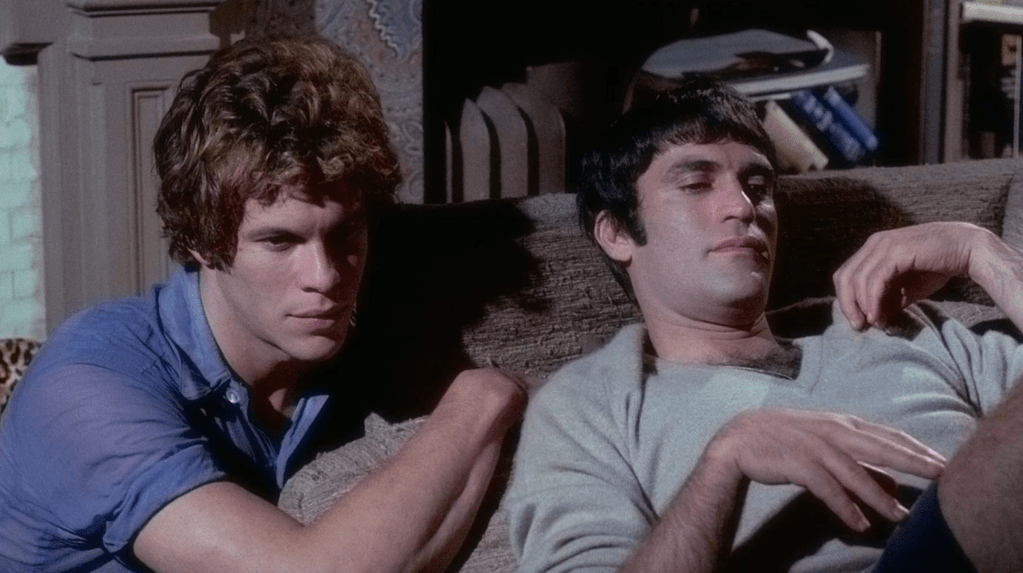
Robert La Tourneaux and Cliff Gorman in The Boys in the Band.
Harold and Michael take turns being the head bully, but Michael soon emerges as the alpha. At one point he persuades his friends to partake in a vulnerable game where they’re challenged to telephone the one man they’ve ever loved and confess their feelings. And at another, he tries berating Alan into coming out, to no avail. Either Alan simply isn’t ready — a group of stink-eyed strangers already not particularly pleased you’re there is hardly the ideal audience for something so sensitive, anyway — or Michael is misconstruing the roots of the increasing homophobic hostility Alan exhibits over the course of the night.
The Boys in the Band is sharply written by Crowley and restlessly acted by an ensemble that would, tragically, almost all fade into obscurity before dying prematurely of AIDS. The lived-in exchanges of dialogue between this friend group hit our ears not dissimilarly from little needles pricking exposed patches of skin slowly, one at a time. Almost everyone in the apartment uses their years of closeness as a vector to toxically relieve the self-resentment they’ve amassed in their years of survival in a homophobic society that only makes the inadequacy of their personal and professional lives hurt more.
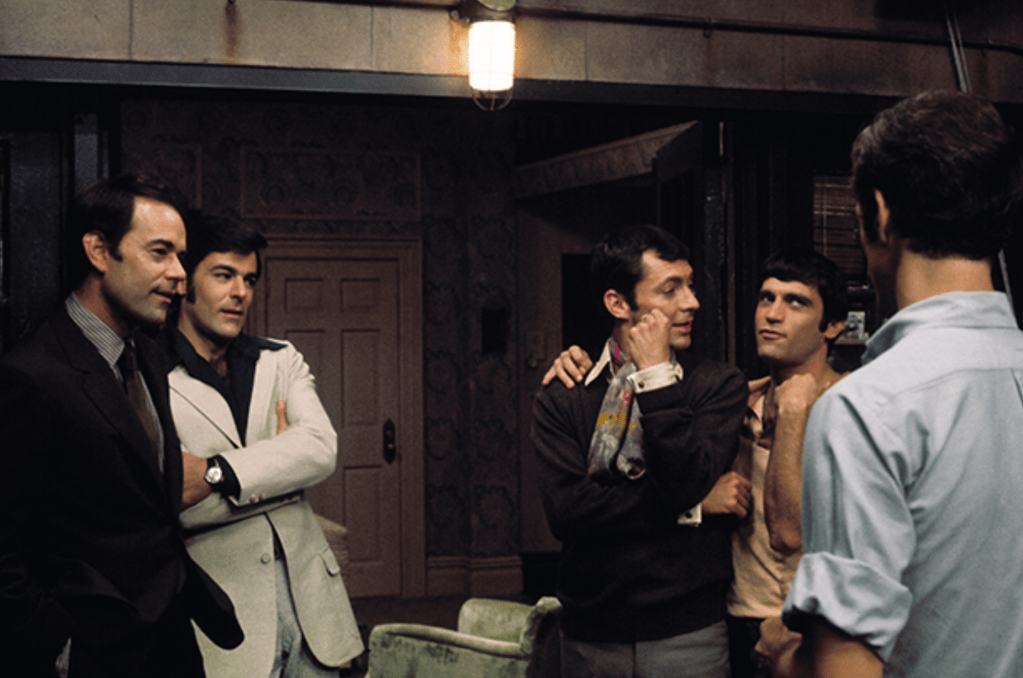
From The Boys in the Band.
Friendship is one of few reliable remedies for life’s pains. The Boys in the Band sees that commiseration warping into something ugly, tastes of emotional power over another proving too tasty to stop indulging in for characters who rarely feel like they have the upper hand. The night’s emotional brutality isn’t made equal among members, though. Forced to bear the most callous strain of it is Bernard (Reuben Greene), who is the friend group’s sole Black member — everyone else is white — and is confronted with some racist insults that instantaneously make you disbelieve a friendship with people who either attack him directly or don’t intervene when someone else does.
One of the first mainstream American movies to focus exclusively on gay male characters, The Boys in the Band is an intense, frequently searing portrait of a group of men nakedly showing the toll of living in a world typically inclined to greet you with hatred, insistently and unsolicitedly picking on differences and insufficiencies. It’s still powerful to see a movie about gay men where insecurities and frustrations are laid so bare, where there is no deference to a straight gaze concerned with whether a character is likable or not. It still is difficult not to be frustrated, as a modern viewer, by a movie that largely concludes that homosexuality is more so a miserable life sentence than something worth embracing. It inadvertently, or maybe not, vindicates old-fashioned notions of the gay man as an object of, above all else, pity — someone who would give anything not to be who he is and is seen as more human because of that recognition of wrongness.
The frustrations The Boys in the Band might inspire have a silver lining. That the film might have lost some of its immediate identification with some modern gay viewers only speaks to how much times have changed. It’s a good thing that The Boys in the Band today feels more like a vivid glimpse into the past than a document doomed to feel eternally of the present; now it can be seen as part of a tapestry of gay cinema showing different facets of LGBTQ+ life, not something that stands alone.

