
The person who could be Mona’s savior comes out of nowhere astride a white horse. Her name is Tamsin, and she’s a rich girl back home for the summer after getting kicked out of an all-girls boarding school for being a bad influence. Played, respectively, by Emily Blunt and Natalie Press, Tamsin and Mona don’t have to talk long before they might consider each other best friends. That isn’t quite because their bond is so strong: it’s more because, without the other person, you could say they don’t have anybody.
Mona’s dad has split; her mom died of cancer; and her ne’er-do-well brother (Paddy Considine), whom they left their bar behind to, has pretty much foregone all his entrepreneurial responsibilities to devote himself to born-again Christianity, in which others in town join him like they were a couple degrees away from full-blown Wicker Man (1973) hysteria. Tamsin’s father is distracted by an affair with a much-younger bombshell in the suburbs, her mother has run off to pursue a late-in-life acting career, and her sister has recently died of anorexia. (The latter’s presence seems to hover in many scenes like a ghost, and not just the one where the girls fiddle with a Ouija board.)
Mona and Tamsin’s dependence on each other only gets unhealthier in the course of My Summer of Love (2004) — suicide pacts and murder attempts and all. Co-written (with Michael Wynne) and directed by Paweł Pawlikowski, the movie will see their relationship teeter into the romantic, though what they’re experiencing doesn’t seem so much like love than mutual infatuation, turned stronger because they don’t especially have anyone else on whom to focus their attention, mistaken for it. It’s a classic teenage impulse, yet you watch Mona and Tamsin together nervously, not how you would other young people navigating a fling in a different coming-of-age movie.
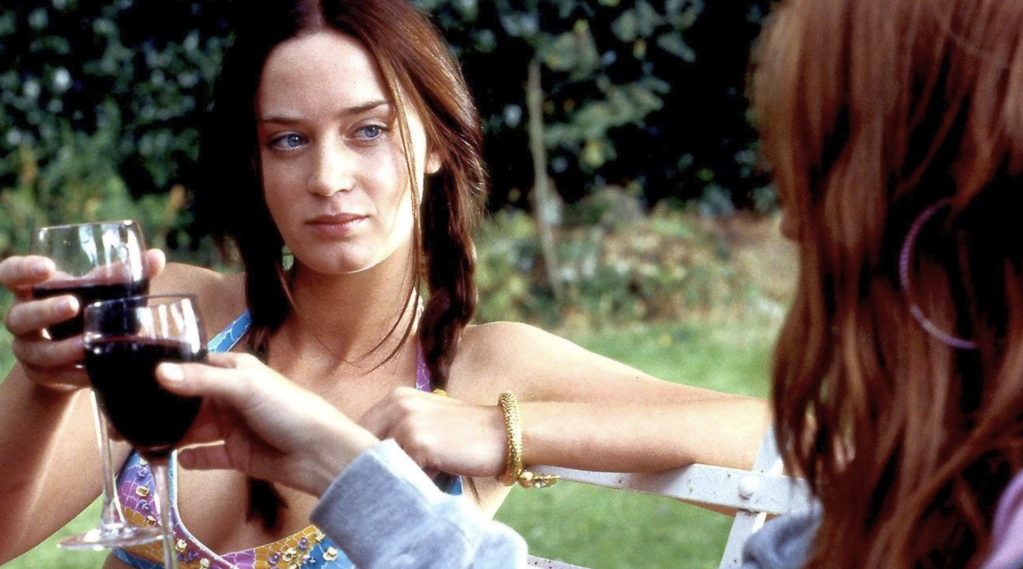
Emily Blunt and Natalie Press in My Summer of Love.
My Summer of Love tonally has more in common with Peter Jackson’s frightening tale of eventually homicidal codependence, Heavenly Creatures (1994), than it does something from the nostalgic-on-impact factory of John Hughes. You sense that one or both these girls is being dishonest with the other. One naturally becomes particularly prone to suspiciousness around the one proclaiming that God is dead or that, if the other person leaves her, she’ll have to kill them. The shortness in her voice suggests someone who isn’t kidding.
My Summer of Love doesn’t move into life-ruining catastrophe the way Heavenly Creatures does; it’s more content to be a slippery, intense study of the one-track-minded strength with which teenagers are able to emote and how things can go awry without enough of a foundation to help them safely land back on earth. The blindingly sunny, bucolic setting (the film is set in the Yorkshire countryside) doesn’t help matters: its sense of isolation and near-otherworldliness seems to only encourage the girls to further retreat into their two-against-the-world fixations, drastic means considered when the haven they’ve created for themselves is threatened. (My Summer of Love reminds me of 1967’s tragic-love masterpiece Elvira Madigan in more ways than one.)
Press is very good, even touching as a girl used to retreating inward enjoying the fruits of being “seen” (or so she thinks). But Blunt runs away with the movie. It was her first — something that feels almost unbelievable because of how masterfully she toys with our perceptions of a character whom we can go from being sympathetic to in one moment and a little frightened of in another. You’d think she’d been acting for years. Tamsin always seems ulteriorly up to something; the inscrutability of her inner life only draws us to her more, not unlike the young woman who spends almost all of My Summer of Love with her. Movie stardom would unsurprisingly come next for Blunt — it’s the kind of performance that couldn’t result in anything else — and My Summer of Love still contains one of her best performances, showcasing her in a slithery, hard-to-make-sense-of mode I wish she’d operate in more often.
 Peterson Reviews