Performance (1970) — notable, among other things, for giving Rolling Stones frontman Mick Jagger one of his first acting roles — excites before it exhausts. Co-directed by Donald Cammell and Nicolas Roeg from a script written by the former, the movie begins amid what feels like a sugar rush, if only because of how it’s visually presented. We’re thrust into the world of Chas (James Fox), a bloodthirsty, impulsive enforcer for a local gangster (Johnny Shannon), but without the kind of straightforward narrative cohesion or linearity that cares about us getting our bearings. The editing, by Antony Gibbs and Brian Smedley-Aston, lassos us from the present to the near-past and -future, usually abruptly. Rarely are the images captured by Roeg, who also was the film’s cinematographer, held on to for very long. Sometimes we’ve moved on to the next one so quickly that it’s like we’re watching a slideshow programmed to progress in the span of a nanosecond.
Performance’s formal franticness is, for most of its first act, exhilaratingly unpredictable, and effectively gives us a taste of the nightmarishness of Chas’ existence — frequently pulled in several directions at once, loyalties susceptible to shifting on a dime, the threat of violence omnipresent but never not jarring and explosive when it manifests. The movie’s first act, though, is mostly just scene-setting, laying the foundation for why Chas, whose tendency for damagingly hotheaded decision-making was bound to catch up with him sooner or later, eventually gets to a place where he no longer has any solid ground to walk on. He’s forced into hiding.
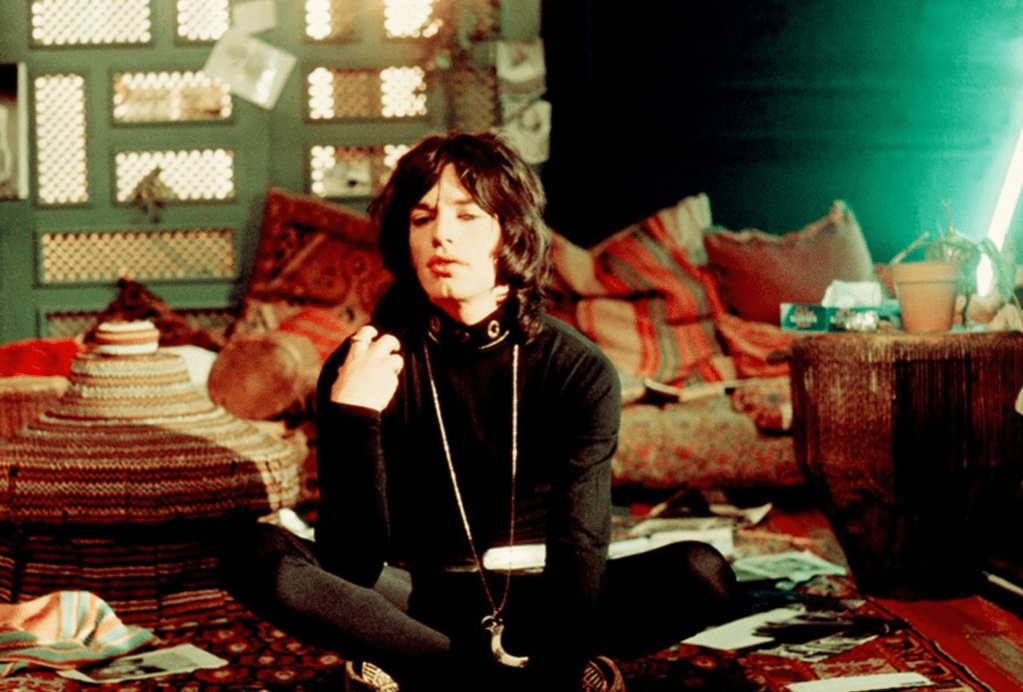
His new digs, part of a shabby boarding house in Notting Hill Gate, come to him by chance. He overhears while at a train station a financially struggling musician talking about the room he’s just been kicked out of for owing several months’ worth of back rent. The property is lorded over by a man we only know as Turner (Jagger), a popular rock star with “three No. 1s and two No. 2s and a No. 4” who has mysteriously retreated from public life. He lives listlessly, always accompanied by a pair of sylphlike women (Anita Pallenberg and Michèle Breton) who often take psychedelics with him in a space liberally blanketed in centuries-old Turkish rugs and Orientalist ephemera.
Turner and Chas’ relationship is testy before it’s replaced by some drug-induced mutual fascination, complete with optical illusions that give the impression that Fox’s and Jagger’s faces have morphed into one. Roeg and Cammell seem only half interested in making Performance a Persona (1966)-like exploration of the slipperiness of identity; the movie is so lacking in anything else besides its style that it doesn’t feel like much more than an exercise in how good Roeg and Cammell are at evoking restlessness.
Performance is finest at capturing Jagger’s once-in-a-generation magnetism. The images that have stayed with me most have nothing to do with one of the film’s many visual tricks but the recurring closeups of Jagger’s face. His cat eyes are dark with proto-glam-rock kohl; his bee-stung lips seductively part halfway. Nothing he’s ever made to do — actually, nothing the movie does at all — is as thrilling to watch as the unexpected musical number mid-film, where Jagger, his hair slicked back and a clean suit hanging off his skinny frame, performs the swaggering song “Memo from Turner” in a gangster’s guise. The room is lit only by a hanging lamp that swings around like a pendulum. When the light crosses Jagger’s path, the room might as well glow.
 Peterson Reviews