
The characters Audrey Hepburn and Peter O’Toole play in How to Steal a Million (1966), William Wyler’s puff pastry of a caper movie, meet-cute inauspiciously. Her eyelashes still thickly kohled like a puma’s, Hepburn’s Nicole is in bed for the night, dozing with the latest issue of Alfred Hitchcock’s Mystery Magazine. O’Toole’s Simon, a stranger, slinks around in the dark downstairs, his eyes trained on a golden-framed dupe of one of Van Gogh’s many tree-foregrounding paintings. Nicole first lays eyes on Simon when he’s plucking an excess glob of color from the canvas and plopping it into a plastic bag. She’ll find out, thanks to a vintage gun in close reach she doesn’t know how to use that she points anyway, that he’s a career thief, and also, after some air-defusing conversation that makes the ethereal blue of Simon’s eyes twinkle, that she’s attracted to him. She decides to let him go, albeit not with the painting, but some accidental gunfire obligates her to chauffeur him in his stolen sand-colored convertible to the ritzy hotel where he’s staying.
Why is Nicole’s house a target? It’s a rather palatial one, in an always-buzzing segment of Paris, that she lives in with her father, a man named Charles (Hugh Griffith) with ski-slope eyebrows and a fondness for theater-usher red velvet and cough-inducing cologne. (Griffith, with his expressive eyes and grandly dramaturgic speaking style, steals every scene he’s in.) It’s just them there; the movie, averse to backstory in general, makes it hard not to wonder why this charismatic woman nearing 40 lives like this, and whether she has any friends to break up the time with and other family members she can turn to. The pair can afford living here because Charles is a renowned art collector. He’s built his reputation precariously, though. He pads out his expensive hoard with expert forgeries he proudly creates in an art studio in a hidden room one can only find by crawling through his bedroom’s wardrobe. The Van Gogh Simon was trying to steal is among his treasured fakes.
In How to Steal a Million, Nicole and Simon will keep bumping into each other, and we’re glad about it: Hepburn and O’Toole have good chemistry. The sexy friction is built in: Simon potentially poses danger, but it’s made palatable because of the smoothness with which O’Toole speaks and the discordant warmth in his wildcat eyes. Hepburn is playing a character type that, by 1966, was familiar for her: a sheltered, glamorous woman who becomes more quote-unquote alive because a dashing man forces her out of her comfort zone with some thrilling rule-breaking. The shtick is a little more labored in How to Steal a Million, but because Hepburn knows how to play it, and because it works well against O’Toole’s suave thief, you don’t feel the need to resist it.

Hugh Griffith and Audrey Hepburn in How to Steal a Million.
How to Steal a Million’s caper-movie transition makes Nicole’s reading of the Hitchcock magazine feel like foreshadowing. Like one of that director’s favorite character types — an ordinary person suddenly navigating potentially life-changing circumstances — Nicole turns to Simon to help her spearhead a heist. She obscures her motives to him, but they’re made clear to us. Her father has just loaned the nearby Kléber-Lafayette Museum his pristine counterfeit of a Venus statuette to serve as the centerpiece of a new collection. He doesn’t realize until after he’s signed the museum’s insurance policy that that signing requires the work to be forensically tested to verify its originality.
Nicole has been complicit in her father’s schemes out of love. It’s also out of love that she’s asking Simon to help her steal the supposedly worth-millions statuette. She keeps it to herself that she wants it so that the museum can’t find out the truth about her father. She also doesn’t think to probe Simon’s background much more than she does during their first meeting — a vagueness that is, we’ll learn, intentional in order to give the movie’s climax a twist.
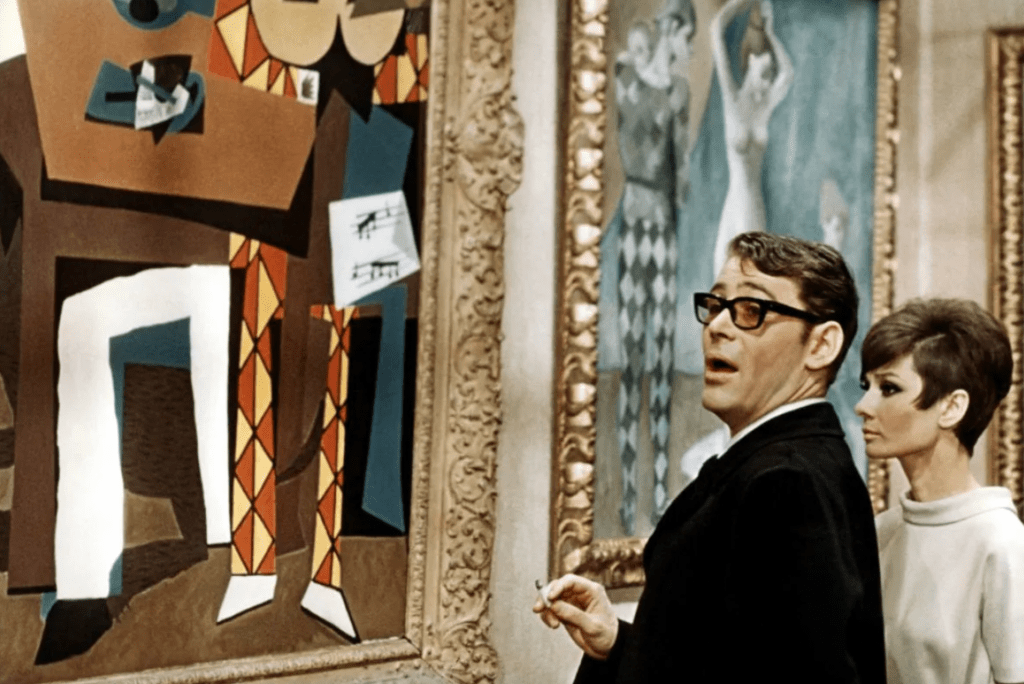
Peter O’Toole and Audrey Hepburn in How to Steal a Million.
A gasp-inducing surprise becomes valuable in How to Steal a Million, whose unflagging pleasantness eventually starts congealing into what increasingly feels like blandness. Harry Kurnitz’s writing is better at enticing smiles than laughter. The only chuckle the film might inspire is likely to come from a French actor named Moustache who plays a security guard. He never speaks; he curls his mustache either up or down to fit the mood in lieu of words.
Wyler’s direction is mostly perfunctory. It strikes you as odd that this amply budgeted movie set in Paris wouldn’t explore the City of Lights nearly at all, keeping most of the action confined to Nicole’s grandiose family home and the museum where the central heist takes place. The majority of its stylishness and exploration is found in Hepburn’s Givenchy fetish. Some of the pieces I most fondly remember are an all-white number whose centerpieces are a bubble-shaped hat and pair of ovular, insect-like sunglasses; a sheer, black-lace mask; and a gorgeously boxy magenta jacket. All the jewelry Hepburn wears is by Cartier; the movie makes it a point to add in a blingy sound effect whenever a diamond ring she wears catches the light just right.
If the aforementioned twist is valuable in How to Steal a Million, then the heist sequence is its crown jewel. It takes up nearly all of the film’s second hour; its simplicity proves beneficial. It’s just Nicole and Simon quietly outsmarting the museum’s crew of bumbling security guards with ingeniously used magnets and sticks and precisely thrown helixes. They destress during this slow burn of a heist by finally doing something about the romantic tension that’s been tightening between them all film long. Hepburn and O’Toole, who became friends during the shoot, seem to enjoy being around each other, and it’s that evident sense of fun that saves the film. It’s a pleasure in itself to spend time with movie stars in a project that uses them well. One of a few things How to Steal a Million truly excels at is doing just that.
 Peterson Reviews