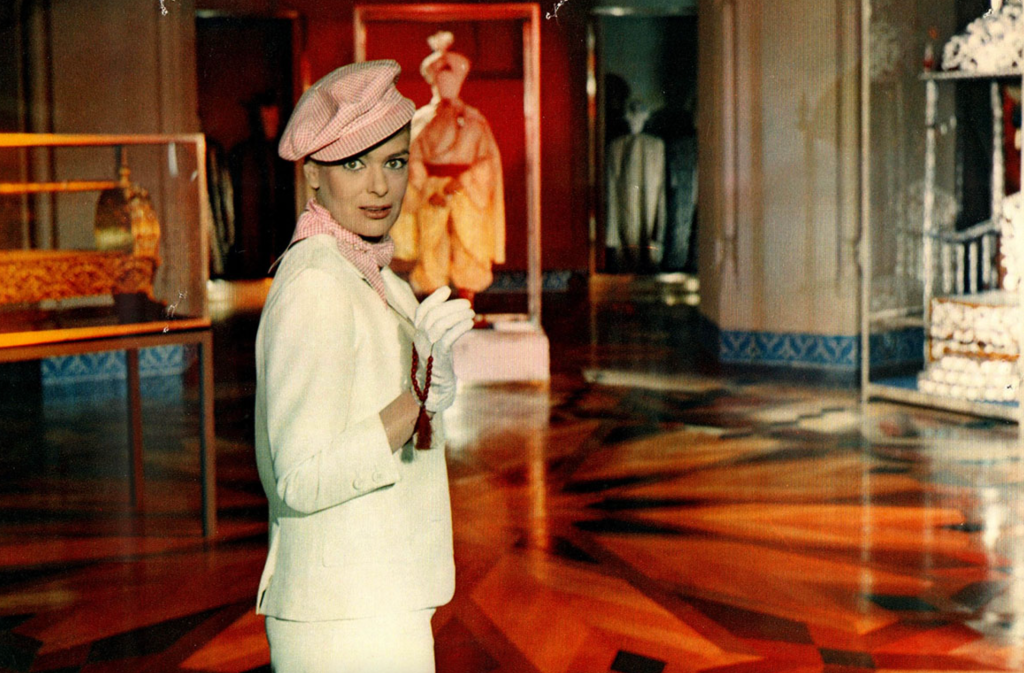
She wasn’t born Elizabeth Lipp, but it would be more convenient if you called her that while she partakes in the activity she devotes her life to: jewel robbery. Played by Melina Mercouri, a blonde with mischievously flickering earth-toned eyes and a wide mouth amenable to fits of delight, the backstory of the only woman character of Jules Dassin’s breezy Topkapi (1964) is almost entirely murky to us. All that’s clear is that she is inordinately wealthy; has an impressive stockpile of priceless gems pilfered from around the world at home; and, as Topkapi opens, is most recently obsessed with Sultan Mahmud I’s lucent-with-emeralds dagger, which sits ultra-protected in Istanbul’s treasure-rich Topkapı Palace.
Elizabeth looks at the jewels — “the four greatest emeralds the world has ever known,” she purrs in Topkapi’s fourth-wall-breaking opening — so hungrily that she gets to a near-orgasmic moment for which she comically excuses herself. We might not be looking at Mercouri quite like how she does these jewels, but much like how she can’t stop thinking about having the gems in her possession, we can’t keep our eyes off her while watching Topkapi. The actress who most closely resembles her is Eartha Kitt, another performer whose look and immediately recognizable way of speaking takes the “cat-like” descriptor to a place to which it rarely goes in the acting world. But Mercouri is a true original with eyes we like to watch glint and whose ashen laugh we like to hear rise into what can only be described as a full-throated cackle. (In Topkapi, it will become something of a trademark.)
In Topkapi, Mercouri is part of an ensemble that includes Peter Ustinov, Maximilian Schell, Robert Morley, Jess Hahn, Akim Tamiroff, and Gilles Ségal. Except for Schell, who plays Mercouri’s on-again-off-again lover who is largely responsible for organizing the jewel thefts she requests, everyone is playing a regular guy with no criminal record. They’ve all been enlisted by Schell’s character to participate in the heist precisely because of their amateurishness. (With a job as high-stakes as this one, it’s wisest to pick people the police won’t be double-checking the whereabouts of first, Schell’s Walter reasons.)

Peter Ustinov, Gilles Ségal, and Maximilian Schell in Topkapi.
Each actor regularly steals scenes. Doing it most is Ustinov as an always-sweaty, almost improbably inept hustler pulled off the street who turns clumsiness into an art form. You’d probably find a lesser actor than him making the doofusey shenanigans he’ll get into feel strained. But with Ustinov, who won the Best Supporting Actor Oscar for his work in the movie, you don’t notice him acting to the point that you could uncharitably think he was playing a variation of himself. A moment where Ustinov sneaks around in the middle of the night and is scared by his own reflection in a mirror garners one of the film’s biggest laughs, and the character’s reaction takes up only maybe a split-second of screen time.
Still, nobody is quite as fun to watch as the always-immaculately-tailored Mercouri — something that becomes more admirable the more you notice that she is neither very substantially written nor given that much to do. You miss her when she isn’t on screen, which isn’t nearly as much as we’d like in a sometimes dallying movie that pushes past the two-hour mark.
The only time you don’t mind her absence is during the climactic heist. As it was in Dassin’s other iconic robbery-centric movie, Rififi (1955), the sequence wisely does away with music so that all you can hear is the anxious precision of the people trying to avoid triggering alarms and the beads of sweat that pour from their faces. (You can see the influence, with its use of a DIY rope-pulley system, on one particular trademark sequence from the first Mission: Impossible movie.) It goes on so long that you can feel your skin crawl; Dassin rather miraculously makes it feel like we were watching something real and not something he’s prudently engineered. Topkapi is elsewhere his long-term lover and soon-to-be-wife Mercouri’s film. But it’s during the heist sequence that the movie is unquestionably Dassin’s.
 Peterson Reviews