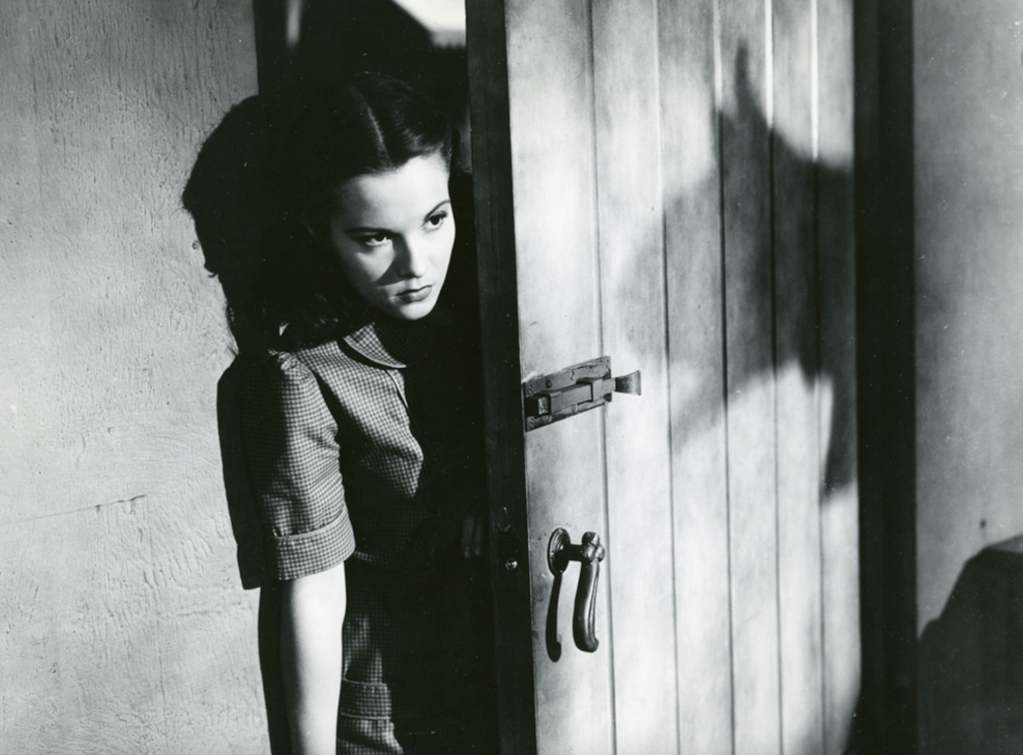
The world of Jacques Tourneur’s The Leopard Man (1943) is suffocated by shadow — a type of landscape that is not, it goes without saying, ideal for a set of characters prone to looking over their shoulders. The movie’s villain, or so everybody thinks, is a black leopard. It’s on the prowl in a small New Mexico border town, unaccounted for after a local nightclub owner (Dennis O’Keefe) misguidedly tries to spruce up his performer girlfriend Kiki’s (Jean Brooks) ailing act by having her publicly try walking around with it on a leash. The creature darts after Kiki’s co-worker Clo-Clo (a wonderful Margo), whose own shtick involves vamping around the club with rhythmic castanets, clacks her instrument of choice too closely to the leopard’s face for comfort.
The cat leaves a nasty scratch on a waiter’s hand on the way out — a mark that seems like a soft kiss compared to what it will do later that night. After locking eyes with her in a tunnel, it lethally stalks a young woman (Margaret Landry) coming home from a misguided grocery-store visit demanded by her domineering mother. The attack is unquestionably the work of the disturbed animal. But whether subsequent killings — all of young women belonging to the town’s Mexican community — are also the work of a creature unusually more homicidal than hungry isn’t as clear.
The Leopard Man isn’t much longer than an hour; narratively, it doesn’t overly complicate the murder mystery it establishes. But like much of the other horror handiwork from the men responsible for it — director Tourneur and producer Val Lewton — it nonetheless distinguishes itself from other throwaway genre fodder. Its sensitivity and quality-mindedness put it in league with movies of the era that had been bequeathed with more resources and prestige. Like Tourneur and Lewton’s other collaborations, Cat People (1942) and I Walked with a Zombie (1943), The Leopard Man makes you overlook its lack of budget by generating pulse-quickening thrills through a canny use of shadow, paucity of music, and surprising amount of compassion.
The way The Leopard Man approaches its stalk-and-slash sequences foreshadows the slasher movies that later peaked in popularity in the 1980s. But unlike how its spiritual successors tended to, the movie sees its victims as something more than disposable, going to great lengths to establish its doomed roundelay of women as people who, in life, had the sorts of desires and anxieties that are often cast aside in victim narrativizing. We see one wake up on her birthday morning, lit angelically by the sun that streams in through her bedroom windows. Her family awakens her with a bouquet of fresh flowers; she can hardly contain her excitement to meet up with her boyfriend later. Another, drawn with a lovable personality and appreciable talent, is frank about her financial anxieties and unmoving loyalty to the lower-class family that relies on her to get by.
Lewton’s work in horror wasn’t confined to his collaborations with Tourneur. His run in the 1940s producing genre movies more broadly is now legendary. He used look-at-me titles like The Body Snatcher (1945) and Isle of the Dead (1946), less-than-$150,000 budgets, and followed through with beautifully made works whose stories consistently could be read allegorically for larger societal problems — a trait that is, of course, discernible in the horror genre’s most lasting products. (The Leopard Man, whose setting is explicitly acknowledged to have an ugly colonial history and which sees real-time deaths of people of color as both directly and obliquely the fault of self-interested white people, evokes white supremacy’s corrosiveness.) Lewton died, prematurely, of a heart attack only a few years after his years-long stint in horror faded; the seriousness with which he took a regularly disrespected genre ought to be continually aspired to.
 Peterson Reviews