
The first movie Vondie Curtis-Hall made after the infamous Mariah Carey vehicle Glitter (2001) couldn’t be more different from its predecessor: it’s a crime drama acutely in a state of emergency. At the beginning of Waist Deep (2006), former convict turned security guard Otis (Tyrese Gibson) is taking his son home from school when, in the middle of a traffic jam, some strangers throw him out of his car and drive off, unaware that his kid is napping in the backseat.
Otis is already on edge enough as is. He’s desperate to keep this job he’s only just gotten, and like many other South L.A. residents, he’s ill at ease even when doing nothing at all because of a recent uptick in crime and the onset of the worst heat wave the area has seen in 27 years. But he can be crafty when thrown into a tricky situation. Back when he was a career criminal, many called him O2 because of how quickly he could flee a crime scene. The one Waist Deep soon throws at him — his son’s captors will demand $100,000 in fewer than 24 hours — might be the most stressful he’s ever been dealt, and also turns out to be, we’ll learn, not quite the wrong-place-at-the-wrong-time nightmare it at first seems to be.
Otis forces a woman, Coco (Meagan Good), who was at the scene of the crime playing a small but crucial role in the kidnapping, to help him. She doesn’t have much allegiance to the perps — her affiliation was borne of desperation rather than unmoving belief in a cause — and so it’s not long before she and Otis are essentially equals, going around town hastily emptying safe deposit boxes to secure the money needed to free Otis’ son.
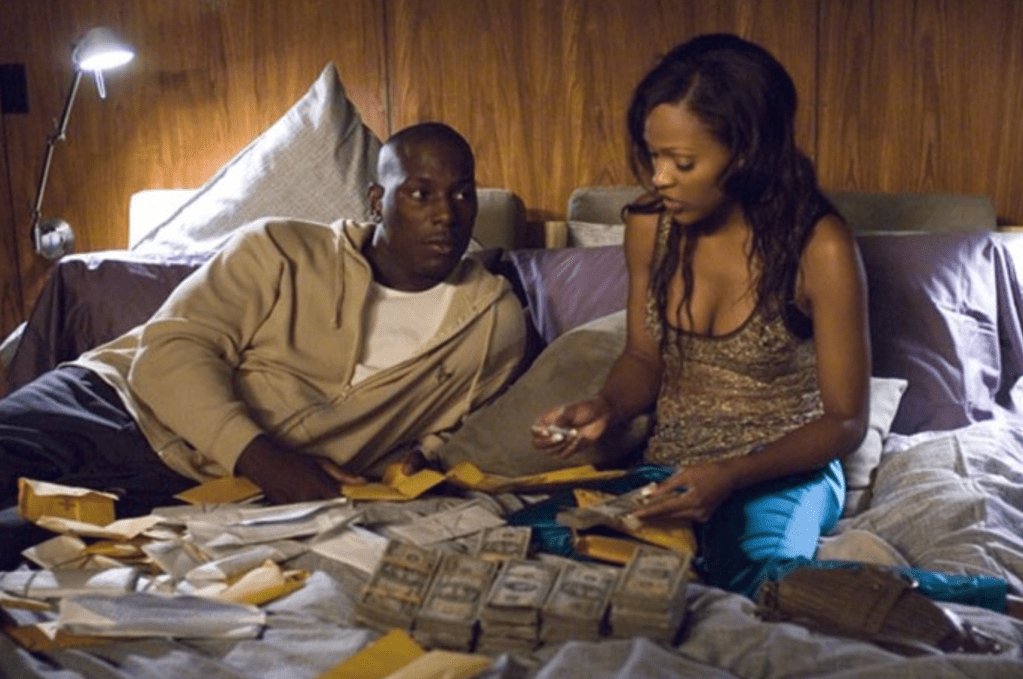
Tyrese Gibson and Meagan Good in Waist Deep.
Gibson and Good’s chemistry is what keeps this very formulaic, very straightforward movie compelling. They inevitably couple up, but before that their characters persuasively bond over a shared frustration: trying to set their lives straight but encumbered by pasts and present-day circumstances that make their desire feel out of reach. (Editor Terilyn A. Shropshire puzzlingly mangles what might be the film’s most emotional scene — a heart-to-heart marking a rare slow-down in the film’s quick, pressure-cooked tempo — with abrupt, unflattering close-ups that undermine the scene’s power and Gibson’s and Good’s convincing work.)
The stakes always feel high, but Waist Deep is regularly splashed with easy humor that keeps it from getting too grave as an escapist race-against-time thriller. Most of the best bits come from Good, who in one scene deescalates two suspicious cops with some confident flirtatiousness and in another distracts bank tellers by play-acting as a loudmouth customer from hell pissed off that she simply cannot cash a sweepstakes slip the way she would a normal check. A recurring use of Nate Dogg’s swaggering “Dolla Dolla Bill” seals in that levity where it counts; the soundtrack — executive-produced by Leroy “Tony” Austin and the since-disgraced Russell Simmons — elsewhere is reliably efficient at encapsulating a scene’s mood just a few notes in.
You never expect Waist Deep to go anywhere too dark, which might be its biggest flaw: you never doubt that all its key characters will survive the everywhere-all-at-once dangers that come not only from a crime syndicate but also, eventually, the police. But the firmly drawn lines between the good guys and the bad guys, plus the sense of optimism hanging over everything, also reinforces something immediately clear: you could see a version of this movie being made during the golden age of film noir, where it was common for wronged men to be shoved into precarious, potentially life-ruining situations without much time to find a resolution. Waist Deep can’t totally get rid of the built-in sense of deflatedness that’s unavoidable when you’re working with a tried-and-true formula, but that it’s solidly made and entertaining gets it decently far.
 Peterson Reviews