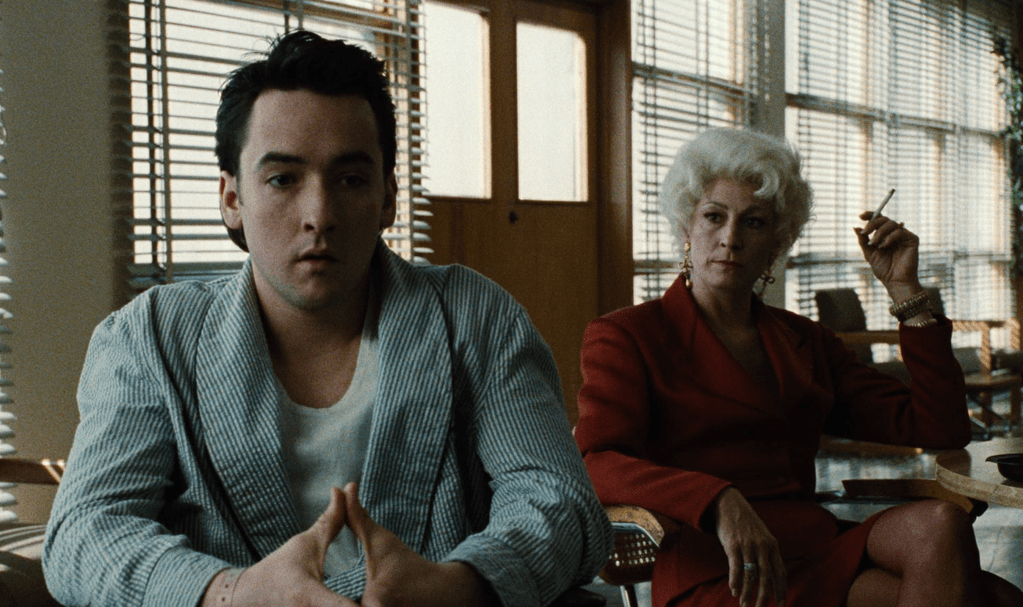
“Grifters got an irresistible urge to beat a guy who’s wise.” So says a con artist in a wide-brimmed hat (Eddie Jones) who appears in one scene midway through The Grifters (1990), a movie that rests its gaze on three other people who cheat for a living. There’s Roy (John Cusack), a baby-faced 25-year-old who scrapes by with small cons involving nickels and quarters and quickly switched-out bills when requesting change; Myra (Annette Bening), his wild-haired girlfriend who puffs up her sexuality with Marilyn Monroe-esque coos and girlish smiles to get out of paying rent and reap higher rewards at pawn shops; and Roy’s mother, a cool blonde named Lilly (Anjelica Huston) who works for a brutal mob bookmaker (Pat Hingle) who will not refrain from, say, burning the dorsal side of her hand with a cigar if he thinks she’s stepped out of line.
Directed by Stephen Frears and adapted from the 1963 Jim Thompson novel by another great crime writer, Donald E. Westlake, The Grifters’ plot is set into motion by chance. Lilly, who hasn’t seen the son she had at 14 in eight years, happens to be in Los Angeles, where he lives, en route to a race in La Jolla she’s covering for her boss. Her arrival comes in the aftermath of a con gone wrong: Roy tried something on a quick-eyed bartender and got so badly beaten up that by the time Lilly meets up with him, he can barely speak, his guts pummeled enough that it’s triggered some internal bleeding that could kill him if untreated.
Lilly and Roy have never been close — he makes it a point to chiefly call her by her first name, and so often that it can feel like the verbal equivalent of something keeping their arms raised to soften a physical blow — but Lilly wants her son to listen when she tells him that he needs to quit conning and move into a straight life. She would know. Her life, whose professional prospects are dim without ever having worked a legal job, is defined by fear and money. Roy probably has good reasons not to trust his mother. (The Grifters doesn’t get too much into their past beyond alluding to that he was maybe enlisted by her for her own grifts.) But Huston, giving an engrossing performance that’s by turns steely and scared, makes you want him to. It’s fitting for a character who’s been able to make a living gaining people’s confidence and then betraying it; you’re never so sure that there’s nothing sneakily lurking beneath Lilly’s intones to Roy.
Lilly pulls Roy on one side. Myra, whom The Grifters will eventually reveal is much more cunning and deft a con artist than she very methodically would like you to believe, pushes him on another. She’s desperate for him to become something of a professional partner after discovering exactly what he’s meant when he’s vaguely told her, throughout their time dating, that he’s a salesman. Cusack’s performance doesn’t leave much of an imprint, but his flatness also feels right for a character defeated by supposedly loving relationships for which he has to brace himself for an ulterior motive. It makes sense that he primarily carries himself in a sulk. The Grifters isn’t ultimately weighed down by Cusack: it has charged performances from Huston, always prim in monotone suits, and Bening, whose shrewd character is always in control even when she’s seemingly surrendered it, to make up for his downer presence.
Capturing these characters just as all the consequences of their corner-cutting lives are about to catch up with them, the movie is bound to feel a little dissatisfying. It’s easy to want The Grifters to offer a few more twists — to push the film-noir evocations of its anachronistic aesthetic (it’s set in the present-day but doesn’t entirely look like it) further. It’s dutiful and manicured, but it might have better jibed with the material if it had a similar tendency to upend expectation in the way the characters’ decision-making might. (Frears’ direction altogether feels slightly too polished for material this overheated and sometimes prepared to give in to its sleazier instincts.) But there’s also something invigorating about that dissatisfaction. It leaves the nightmare in which these characters are living go unresolved, the torment accompanying their ultimate fates — some live, some don’t — stay with you. Darkness snuffing out the light is classic Thompson.
 Peterson Reviews