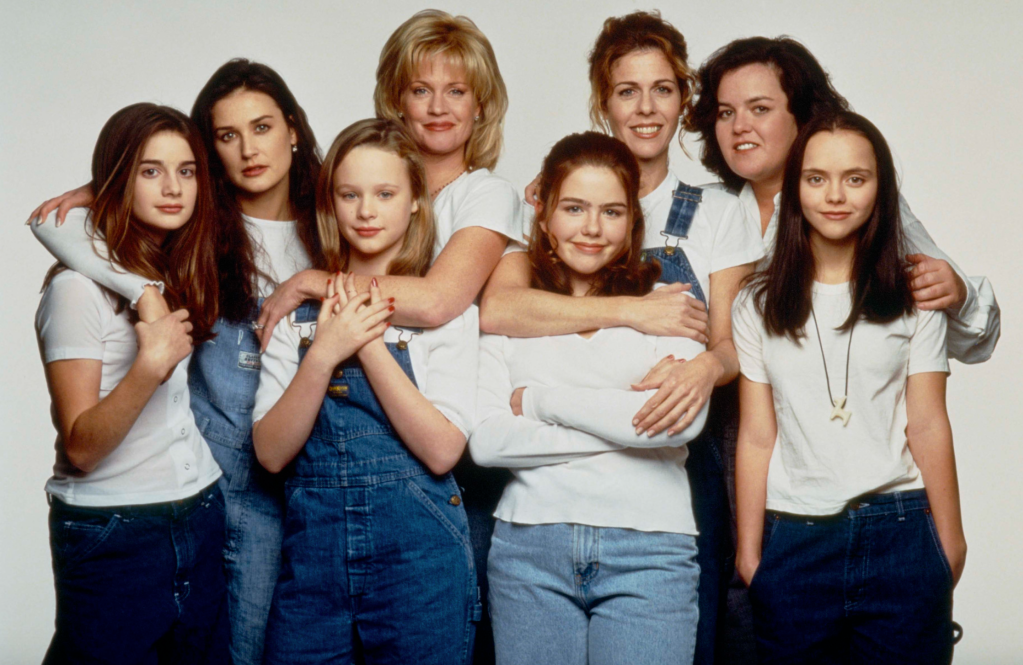
Not long into Lesli Linka Glatter’s Now and Then (1995), you realize that its starry quadrant of lead actresses — Demi Moore, Melanie Griffith, Rita Wilson, and Rosie O’Donnell — has probably only been cast to secure funding and an audience. They only really appear in the movie’s frame story, which is returned to just twice over the course of this 100-minute film that almost entirely takes place in flashbacks. But you end up not really minding the misleading bait-and-switch. Working from a script by I. Marlene King, Glatter offers such a touching, perceptive coming-of-age movie that you almost forget Moore, Griffith, Wilson, and O’Donnell were in the film at all.
Now and Then’s plot is set into motion by a hometown reunion between four childhood friends. The occasion is the pregnancy of Chrissy (Wilson), the group’s resident goody-two-shoes and now-housewife, who’s due to pop any minute. As it is with most people, moving out of town and professional obligations have made the friends drift apart. Roberta (O’Donnell) is an in-demand gynecologist. Tina (Griffith) is a successful actress who’s recently covered the likes of TV Guide and People and arrives in a tooth-white limo. Samantha (Moore, who also narrates the movie) is a prolific science-fiction author who chain-smokes and seems most at ease when wearing sunglasses.
Now and Then mostly takes place inside of a reminiscence: the summer of 1970, when the girls were 12 and transitioning from childhood naïvete into self-discovering, newly cynical tweendom. Chrissy’s, Roberta’s, Tina’s, and Samantha’s younger selves are played, respectively, by the late Ashleigh Aston Moore, Christina Ricci (who doesn’t put on the Long Island accent O’Donnell doesn’t obscure), Thora Birch, and Gaby Hoffman. The latter in particular has such a wise-beyond-her-years gaze that I sporadically had to remind myself that she was only around 13 when the movie was shot.
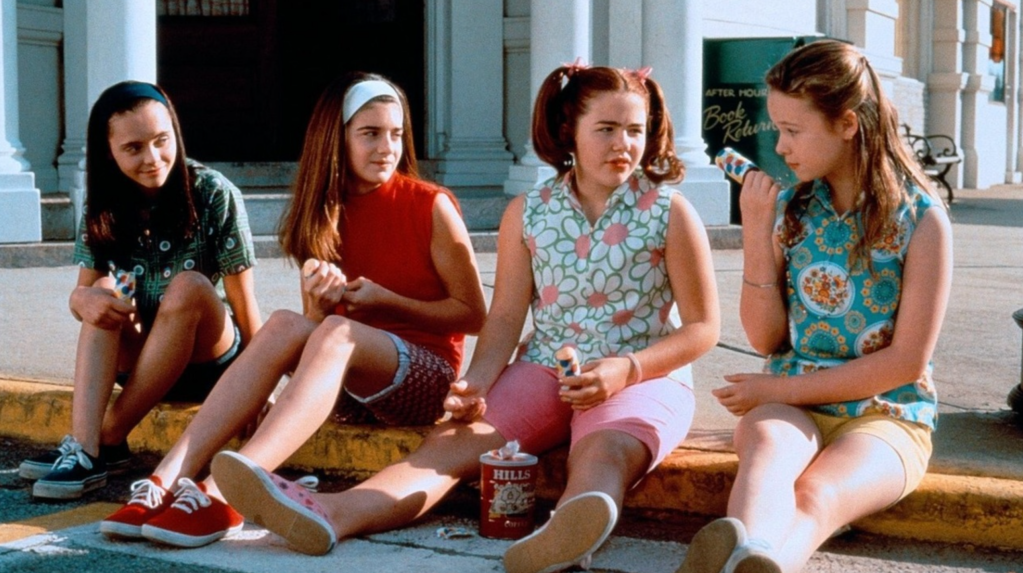
Christina Ricci, Gaby Hoffman, Ashleigh Aston Moore, and Thora Birch in Now and Then.
There are plenty of coming-of-age films where female friendships are central to the story; Where the Boys Are (1960), Strike! (1998), Dick (1999), or Thirteen (2003) first come to mind off the top of my head. But there are few, like Now and Then (2019’s Booksmart is a more recent example), where that element supersedes everything else about the movie. Romances or other narrative obligations consistently fall to the periphery in favor of bonding moments that, whether big or small, are presented with an even sense of momentousness: aimless bike rides in the sun while group-singing to the latest radio hits, misguided séances in the local graveyard, counting everyone’s on-hand savings at the local diner to figure out if there’s enough collectively to buy a $129 Sears-catalog treehouse. I loved the little, undwelled-on details foreshadowing who these girls will become: Tina sitting on her roof, alone, to catch a movie-in-the-park screening of Love Story (1970) from afar; Samantha staying up late, her reading glasses on and her little sister snug under her arm, so that she can dive into the next few chapters of her latest book.
Some dramatic developments inevitably intrude on the summer fun being reflected on. Samantha’s parents are divorcing. Roberta accidentally learns that her mother’s car-accident death, which happened years ago, might not have been as painless as she’d been led to believe. But the movie’s unwavering conviction that young female friendship is worth making a movie about, without much to dress it up, is a moving aspiration on its own. That, of course, wouldn’t feel like enough of a driving force were there not such lived-in chemistry between its young leads and an overheard — or, that is, taken-from-personal-experience — quality in King’s dialogue.
Now and Then ends by returning to the present, and feels slightly facile in how tidily it wraps things up. But I appreciate its low-stakes ambitions the more I think about it. Friendship-focused movies are frequently inextricable from climactic tragedy. Now and Then elevates a humble goal to simply be better about staying in touch with people who were once important to you — something that likely will inspire a twitch of bittersweet recognition from a lot of viewers who sometimes wonder longingly where the time went.
 Peterson Reviews