
The self-discovery dramedy Last Holiday (2006) is unabashedly schmaltzy — the type of engineered-to-be-uplifting movie to almost inevitably feature one of Michael Franti’s mawkish empowerment anthems prominently on the soundtrack. But it’s made with such good humor and warmth by its director, tearjerker doyen Wayne Wang, that even its most contrived plot points felt earned rather than emotionally manipulative on the day we crossed paths.
Its premise also wouldn’t work nearly as well if you didn’t have such immediate affection for the character Queen Latifah plays. When we first meet her, Georgia is living the sort of unfulfilling, hemmed-in life recognizable to anyone who’s gotten stuck in the kind of rut only a cyclical everyday routine could create. Single and with a young next-door neighbor she looks after like a family member (Jascha Washington), she works in the cookware department of a big-box store but dreams of parlaying immense cooking talents sharpened by years dutifully watching Emeril Live to open her own restaurant. But because she’s so mild-mannered and used to the idea of her dreams being not much more than fantasies, Georgia has come to habitually defer the pleasures of her life as if she were waiting to be somehow more deserving of them. She coupons to an unnecessary extreme during grocery hauls and never eats her own tasty-looking dishes to ostensibly maintain a Lean Cuisine-aided figure for currently nowhere-in-sight romantic prospects.
Georgia tries spicing up her job by offering unsolicited cooking demonstrations to always-rapt customers. But they’re discouraged by her aggressively penny-pinching, busybody manager, even though he and her colleagues know that it’s been a boon for sales. She can only look forward to catching up with her best work friend (Jane Adams, whose rapport with Latifah manages to feel lived-in in just the few moments it takes up in the film) and discreetly lustful glimpses of Sean (LL Cool J), a handsome, introverted coworker she’s developed such a crush on that she keeps edited photos of them happily just-wed in a cute, goals-oriented scrapbook charmingly labeled the “Book of Possibilities.”
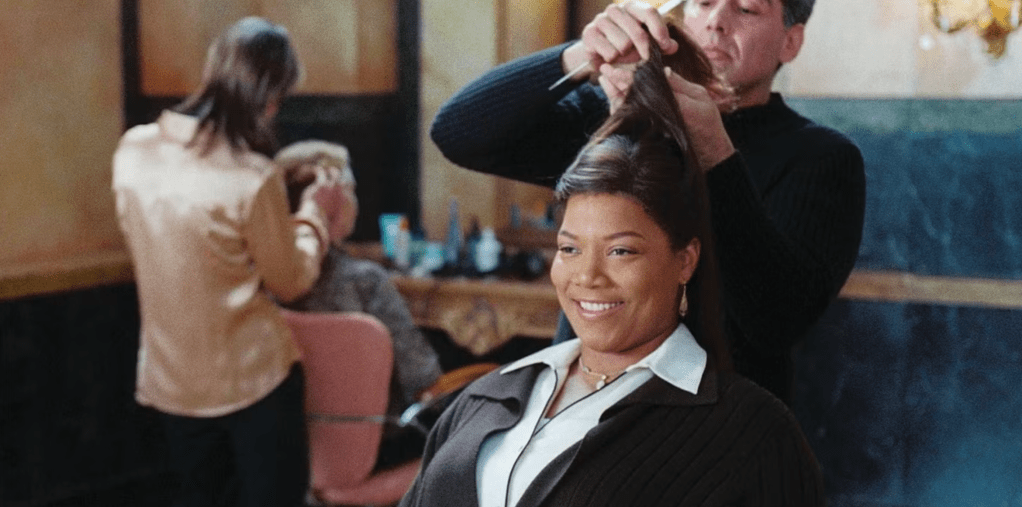
Queen Latifah in Last Holiday.
Georgia’s modest life is one day overturned by a work accident. A bump on the head leads to a precautionary CT scan, which next leads to a nightmare. The doctor (Ranjit Chowdhry) announces that she has a rare neurological disorder, Lampington’s Disease, that’s gotten to a point that, without emergency surgery — which will cost her $340,000, not including anesthesia, because her health insurance doesn’t cover it — she’ll have a little less than a month to live.
None of this comes across as particularly grave as presented by the film’s screenwriters, Jeffrey Price and Peter S. Seaman. Last Holiday tacitly assures us that this will undoubtedly be revealed as a medical gaffe, with the musical cues remaining sitcom-bouncy and the doctor portrayed with Chowdhry with such jumpiness that it feels impossible that he hasn’t made a big mistake. Subsequent moments where Georgia, now figuring she has nothing to lose, tells her manager off and emotionally takes center stage during a church-choir performance garner laughs, too. Last Holiday in general has the amiable tone of a comedy to come out of the 1930s or ‘40s starring an actress like Carole Lombard or Jean Arthur. (It’s especially reminiscent of the 1937 Lombard vehicle Nothing Sacred, where the latter plays a young woman who is erroneously led to believe she’s dying of radium poisoning.) What sets the movie’s plot into motion might be grim, but it’s more about the genial hijinks that will ensue and the sunny appeal of its lead, not anything as dire as the conceit would suggest.

Queen Latifah and LL Cool J in Last Holiday.
Preferring to live out her final days to the fullest than stew in her bad fortune, Georgia decides to take out all the money she has to her name to go on a trip she’s always dreamed of: to the Czech Republic’s overwhelmingly tony, spa- and snow-centric Grandhotel Pupp, at whose white-tablecloth restaurant a culinary idol of hers is the head chef (Gérard Depardieu). She immediately turns the heads of guests by arriving in a private helicopter (it would have taken too long for a taxi driver being careful of the icy roads, she reasons) and only continues to approach her once-in-a-lifetime vacation as lavishly as possible. She makes another early statement by ordering everything on the menu on her first night while dressed in a flowing rose-red dress with a diaphanous pashmina to match.
Georgia becomes something of an aspirational figure to moneyed guests who already could be said to have it all, but not Kragen (Timothy Hutton), the joyless, avaricious businessman who founded the store where she wasted so many years and who happens to be on a trip, too. He doesn’t know who she is or where she comes from, but he’s immediately suspicious that “someone like Georgia” could be as financially unworried and presumably successful as he is. Many of Last Holiday’s comic set pieces involve her making him look foolish, whether on the ski slopes or during a whirlwind free-diving excursion, while endearing herself to the crew of people he came with. It’s consistently satisfying to see someone from whom Kragen has unknowingly stolen so many years stomp on his ego while not doing that much to intentionally harm him besides standing tall as this newly unself-conscious version of herself.
Last Holiday so much doesn’t want you to worry about Georgia that, after she’s spent so much money that you wonder about the possibility of a card’s decline, it throws in a fleeting scene where she wins ungodly amounts of money gambling, her instinct to pick the same lucky number thrice almost unbelievably the right one. She’ll get a grand romantic gesture worthy of her, too. It’s nice sometimes to see a lovable movie character get everything they deserve, regardless of if it’s happening under incredulous circumstances. Last Holiday made me wish that Latifah, often sidelined to big-gestured, scene-stealing supporting performances in the movies she’s appeared in, got more roles like the one she does here, where she’s able to play up her romantic-lead bonafides and underscore her oft-overlooked tenderness as an actress.
 Peterson Reviews