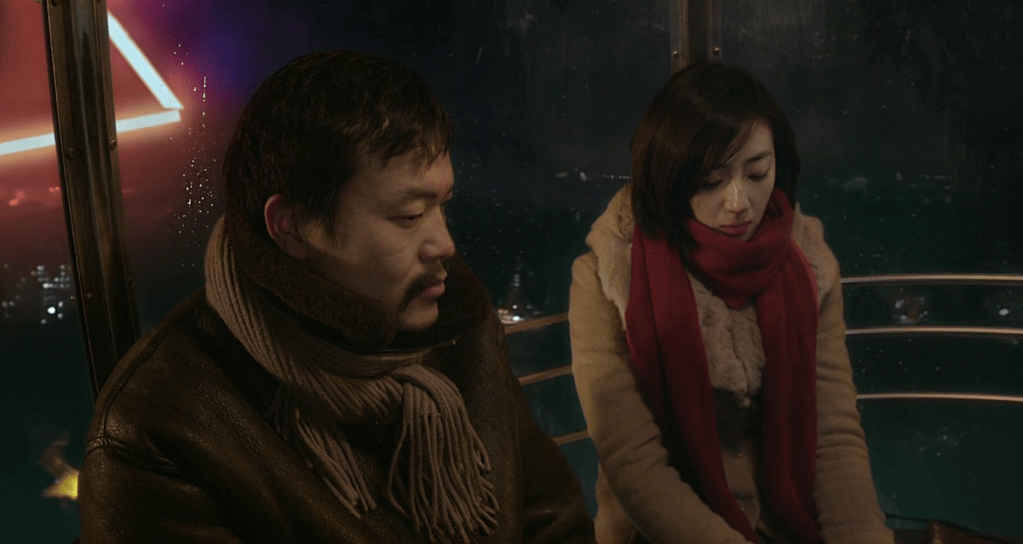
Black Coal, Thin Ice (2014), Chinese filmmaker Diao Yinan’s third directing effort, is so cold that you swear your bones could feel the chill of its setting. Though a brief, 1999-set prologue takes place during an unbearably balmy summer, this detective noir otherwise unfurls during a severely frigid winter in Heilongjiang, so nippy that you worry about a character’s eyeballs hardening if too much time has elapsed between blinks.
That iciness complements Diao’s writing and directing style, which has a quasi-deadpan, stylized stoniness that recalls the likes of Jim Jarmusch or Aki Kaurismäki, and the movie’s central murder mystery. Black Coal, Thin Ice’s narrative springs from the 1999 discovery of countless dismembered body parts scattered across 15 coal factories in the province in which the movie unfolds. The investigation is headed by a temperamental, freshly divorced detective named Zhang (Liao Fan), but an early shootout involving some prime suspects both quells whatever progress had been made and heralds a new life as an alcoholic for Zhang, who’s injured in the gunfire.
Black Coal, Thin Ice’s action picks up five years later, with Zhang long off the force but eventually drawn back in by his old partner, Wang (Yu Ailei), who updates him on a series of subsequent murders that were almost certainly committed by the same person responsible for the mysterious 1999 killings. The victims all had a connection to the now-dead main suspect’s hard-to-read widow, Wu (Gwei Lun-mei), whose general inscrutability only makes her more and more of an object of fascination, then lust, for a detective as rash and irresponsible as Zhang. Gwei’s ice-maiden performance is the film’s best asset, captivating because of how intriguingly unclear it is whether her general blankness is a symptom of a malevolent lack of feeling or if she’s a woman simply trying to hold it together in front of detectives responsible for life-altering tragedy. Gwei masterfully toys with our paranoia without appearing to do much at all.
Because of its tantalizing setup, one could reasonably expect the story to go in potentially juicy directions. But the coolness of its presentation, whether we’re talking about the literal environment or Diao’s own aloof style, augurs that this is not a movie that will move into narratively overheated places for its third act. It’s more disposed to frostier truths: that the grounds for evildoing can be rather mundane, that undue projection onto someone or something is bound to lead to the kind of personal disappointment that can feel not dissimilar from betrayal. When one character realizes as much, he can only respond with one of Black Coal, Thin Ice’s rare extreme gestures: a herky-jerky fit of dancing, alone, on a sparsely populated dancefloor, his body unable to keep this onslaught of bad feelings pent up.
 Peterson Reviews