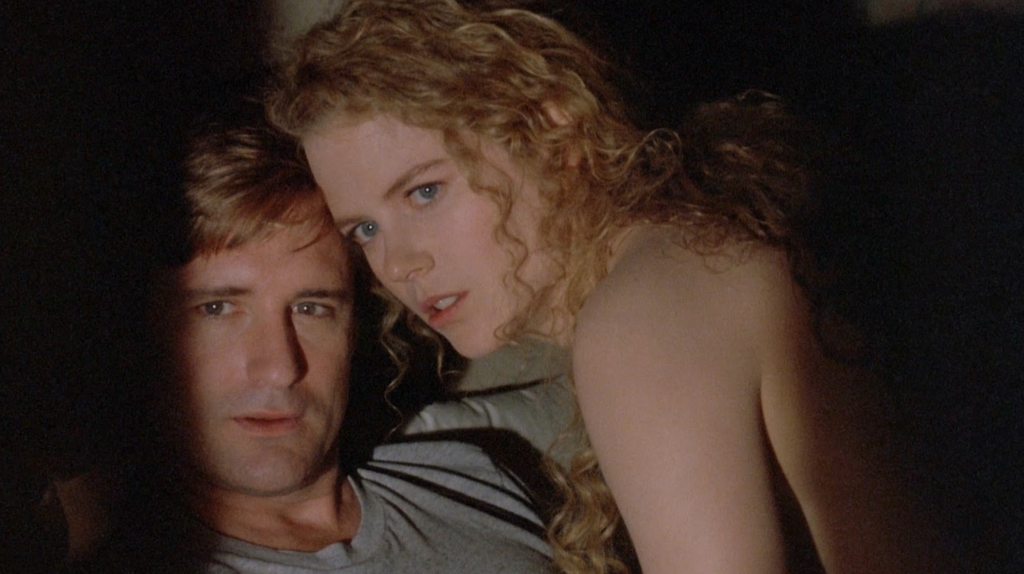
Early on in Malice (1993), its mild-mannered protagonist, Andy (Bill Pullman), remarks to himself that he married a funny woman. He says so with a chuckle as his wife, Tracy (Nicole Kidman), walks away from him after offering one of the many sardonically funny lines written for her by the film’s amused-with-themselves screenwriters, Scott Frank and Aaron Sorkin.
Andy’s observation will come to haunt Malice, its meaning changing with every passing minute. This domestic thriller is a “who the fuck did I marry” sort of movie, but it’s packed with so many twists that it doesn’t reveal itself as such until well into the second act. First it seems like it’ll be a garden-variety serial-killer-centric murder mystery. College-aged women are being sexually assaulted and then murdered around the campus where Andy works as an associate dean, and he’ll come to be viewed as a suspect when, ever the good teacher, he goes to visit the home of one of his more troubled, and predictably doomed, students (a baby-faced Gwyneth Paltrow) when she doesn’t show up for an after-class appointment.
Then it seems like it will be a tenant-from-hell movie à la Pacific Heights (1990) when an old high-school friend of Andy’s, Jed (Alec Baldwin), gets a job working in town as a doctor and claims to not yet have a concrete place to stay. At first having Jed move in seems like it will solve Andy and Tracy’s preeminent financial problem — they’re having plumbing issues whose $14,000 bill is far too much for a dean and a Kindergarten teacher to pull together — until it brings more headaches. Many a sleepless night is ushered in by Andy and Tracy’s new roommate’s propensity to, for instance, loudly have sex with women about town, his radio cranked in an attempt to drown out all the grunting and moaning.

Nicole Kidman in Malice.
All this proves to merely be appetite-whetting for other narrative developments, from an unwanted surgery to a soon-to-be-revealed long con devised by a character or two. The majority of Malice’s twists are truly dumb, something that becomes clearer the more you really think about the particulars of some of the sacrifices that earlier mentioned long con requires. But you can feel that dumbness being relished by Sorkin and Frank, who keep the dialogue as snappy as their bodies of work would make you expect but never suggest that they’re trying to cook up anything particularly smart.
Malice has the fun, labyrinthine quality of a finely tuned soap opera toeing the line between being too ludicrous to be believed and too compelling to not be seriously enjoyed. It’s intelligently made trash. Pullman is exactly right — which is to say a little boring — as the movie’s one reliable character. He wisely cedes the spotlight to Baldwin and Kidman, designated scenery-chewers who are respectively luxuriantly obnoxious and superbly snaky. (Anne Bancroft, in a one-scene appearance, is delightfully hammy, too, swilling scotch and smoking cigarettes as her seen-it-all character happily dumps exposition.)
Kidman is the utmost reason to revisit this movie you ultimately will only remember years down the road for being cuckoo. I wouldn’t be surprised if the noted cinephile-cum-actress had done some prep work that involved watching scores of femme fatale-forward films noirs from the 1940s and ’50s to get in the proper zone. Especially resplendent with long and golden Raphaelite curls you wish she’d never straightened, Kidman is a worthy successor to her deadly–women ancestors.
 Peterson Reviews