
Gary Sherman’s Lisa (1990) is like if a Lifetime movie were actually good, sensitively written and well-performed despite a sensational conceit. It sometimes uneasily and sometimes persuasively fuses two narratives. In one, a florist single mother, Katherine (Cheryl Ladd), and her 14-year-old daughter, Lisa (Staci Keanan), are going through a rocky period. Lisa desperately wants to date, but Katherine, openly regretful of her own premature start in “the real world,” forbids it until she’s 16, reasoning that her daughter ought to enjoy her last gasps of childhood free of romantic drama. In another, a serial killer, known in splashy headlines as the Candlelight Killer, is slinking around town murdering beautiful young women, breaking into their homes and decking out their bedrooms in candles, rose petals, and wine beforehand as part of a date-from-hell modus operandi.
Known to the oblivious staff of the tony restaurant he manages as Richard (D.W. Moffett), Lisa’s villain comes into the title character’s life by chance. She’s out one night grabbing a few items for dinner when she bumps into him on the street, the groceries dropped and spilled across the sidewalk. This objectively handsome man — he could be the cover model of some yellow-paged romantic pulp — makes Lisa go puppy-eyed. She scribbles his license-plate number down, thinking that if she manages to find his phone number, he’ll definitely be romantically interested in this girl he politely says could pass for 16.
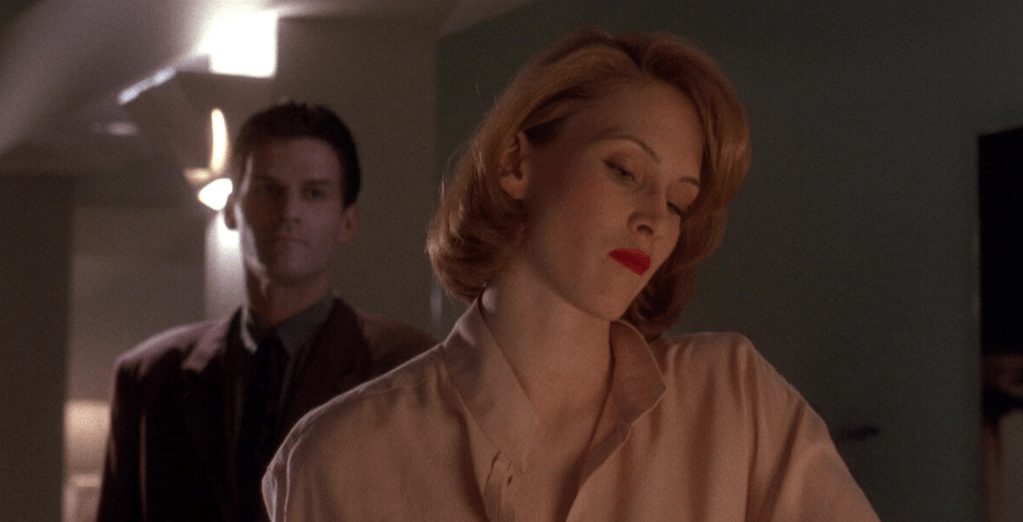
D.W. Moffett and Frankie Thorn in Lisa.
Lisa starts calling Richard regularly, deepening her voice like Lauren Bacall and pretending to be a long-lost romantic interest while he humors her. (The phone calls, which only heighten the uneven power dynamic, are never sexualized.) Lisa is at first egged on by her comparatively outgoing best friend, Wendy (Tanya Fenmore), but the latter’s stranger danger-related worries eventually kick in. Beyond just not wanting her friend to get in trouble with her strict mom, one can’t be too sure of the intentions of the man on the other end of the line. “How could a guy who looks like that be a pervert?” naïvely wonders Lisa, who’ll only get more reckless. Galvanized by her mounting frustration at home and her jealousy over Wendy’s own romantic prospects, she starts stalking this man who’s mastered the art himself. She reaches a pinnacle when she breaks into his car and meekly hides in the backseat while he makes a trip to the dry-cleaners. George Thorogood & The Destroyers’ “Bad to the Bone” hilariously plays from his car’s cassette player as he drives around, his well-coiffed head bopping cockily to the beat.
Lisa’s decision-making is consistently infuriating, which only speaks to how effective the movie, co-written by Sherman and Karen Clark, is at translating the kind of feelings-first, irrational thinking that’s inescapable when you’re 14 and can think of little else besides the gulf between where you currently are and where you want to be. (The fact that Keanan is the same age as the character she plays — a rarity for the slasher genre, which reliably had its teen characters played by much-older actors — makes Lisa’s frustration and petulance ring truer.)
Lisa’s sense of compassion isn’t relegated to its young and confused lead who doesn’t realize she’s wading into danger: it also spends some time alone with Katherine, who’s struggling, after being cruelly abandoned by Lisa’s father, to commit to her new boyfriend, who’s so-far-fruitlessly tried assuring her that he’s trustworthy enough that she doesn’t need to continue acting like their relationship is nothing more than a secret affair. “I don’t have time to date with a daughter to raise,” Katherine, who’s canceled on her beau three times in a row, will shrug without much conviction.

Cheryl Ladd in Lisa.
Lisa’s prickly mother-daughter dynamic is so vivid that the serial-killer side plot, which thankfully never really moves into cautionary-tale-style bleakness, becomes less interesting with time. I still like Moffett’s robotic, proto-Patrick Bateman performance — a parallel not only supported by his blandly tasteful style of dressing (“What’s he doing wearing a tuxedo in the middle of the day?” Wendy asks) but also his suspiciously immaculate apartment, whose neat all-leather furniture and sprinkling of small, circular lights are an unsettling vision of sociopathic style.
Lisa’s inevitably intense finale is efficiently pulse-pounding, but like all the Candlelight Killer-related action preceding it, it has an almost obligatory quality compared to the lived-in quality of the main familial relationship it threatens. In a horror subgenre where humanity typically comes second to bloodshed, the unexpected sensitivity is welcome.
 Peterson Reviews