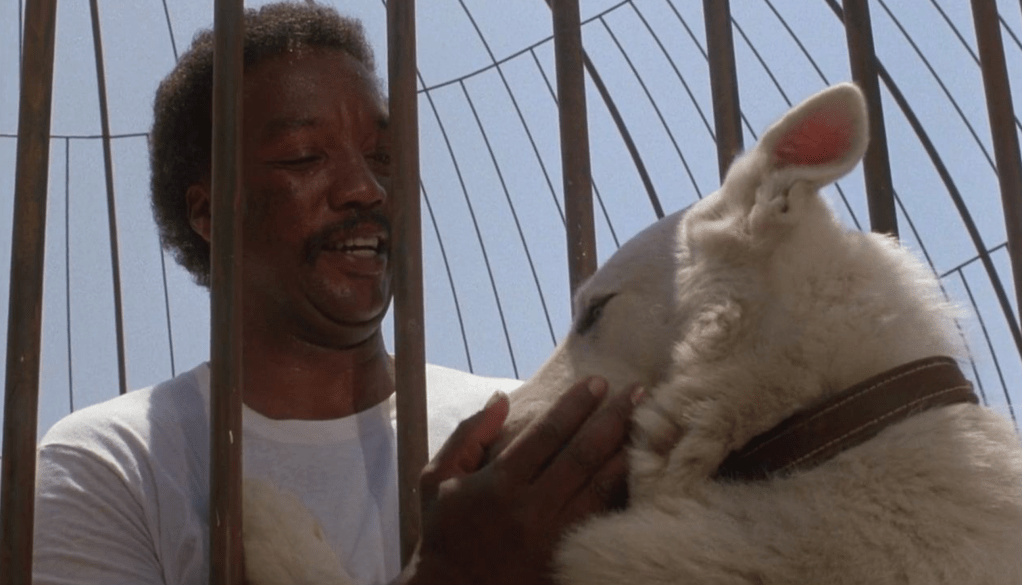
Samuel Fuller’s consistently unsentimental movies became less amenable to happy endings the older he got. His last American movie, White Dog (1982), was no exception, whether we’re talking about the arc of its narrative or the fraught circumstances surrounding its theatrical release. The movie is about a beautiful, snow-white German Shepherd taken in by a young actress, Julie (Kristy McNichol), after she accidentally hits him with her car on a winding Los Angeles road. Saved at the nick of time by a 24-hour vet clinic, the lost dog, whose owner Julie cannot immediately find, initially lives up to the man’s-best-friend ideal. He’s patient and affectionate, and early in the movie, when Julie is nearly sexually assaulted at home by a neighborhood-prowling rapist that breaks in, he proves to be a dutiful guard dog. Breaking through Julie’s closed-shut bedroom window like a superhero, he tackles the intruder mid-escape and keeps him writhing uncomfortably on the ground until the police arrive.
But after the dog takes off on a different occasion, unable to keep himself from chasing a rabbit hopping around his new owner’s property, an unsettling truth reveals itself: This Shepherd’s protective instincts actually come from him having been trained, by whomever owned him previously, to kill Black people on sight. That isn’t at first clear to Julie, whose reunion with her quickly beloved pup sees his fur rouged with the blood of what she assumes is another animal. When she takes him to Carruthers (Burl Ives), an animal trainer who literally tames lions, tigers, and bears for TV and movies, for help, she thinks this is merely a means of getting rid of generalized guard-dog instincts.
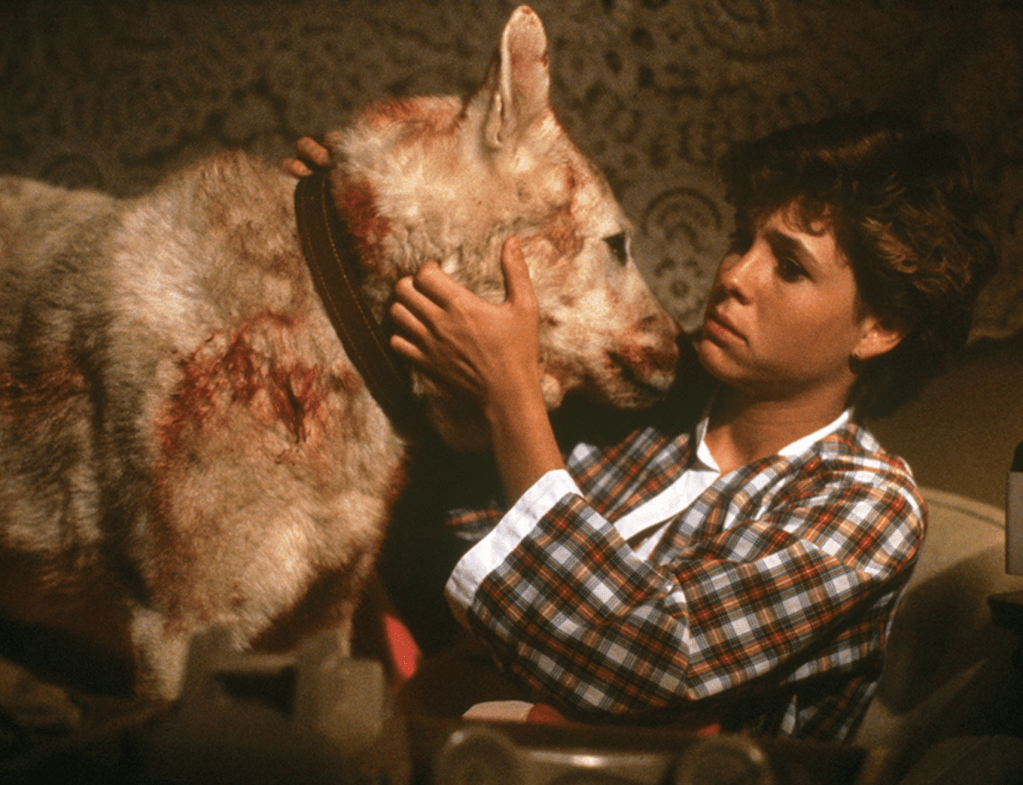
Kristy McNichol in White Dog.
Even without knowing the full truth of the dog’s background, Carruthers thinks the animal ought to be euthanized. Enough of an expert in his field, he’s wary about remediating a pup who’s spent so many years programmed for easily-switched-on aggression. Yet even after the dog’s racist upbringing is made clear to Keys (Paul Winfield), a Black trainer who works with Carruthers, the latter diverges from his boss, thinking there’s still hope for a dog who still seems to have the capacity to love. The Shepherd becomes something of a project for Keys, who, day after day, goes about his scary, patience-testing work inside a giant, dome-shaped cage that feels symbolic of the dog’s brain’s inner workings, suddenly made to seriously confront what’s been entrenched in him.
A more sanguine filmmaker than Fuller might turn the tragic White Dog, loosely based on a homonymous book by Romain Gary, into something more stomachably uplifting — make the movie into an optimistic story about how deeply ingrained racism is something that can ultimately be cured. You don’t doubt that Fuller, who co-wrote the film’s screenplay with Curtis Hanson, believes that those who’ve been vehemently racist are capable of ideological evolution. But he takes things a pragmatic step further than the kind of generally more hopeful movies with an anti-racist message likelier to receive mainstream awards attention. When someone has demonstrated an ability to viciously hate — and has gone on for years existing with that hate festering inside them — can that bandwidth for hostility be easily vanquished? White Dog posits that while even those most vile are not necessarily lost causes, forward movement and self-interrogation must be ongoing, lest it manifest somewhere else. Forgiveness and change cannot preclude true atonement, either.
Fuller and Hanson are not easy on their characters. Julie, who sometimes undermines Keys’ methodically strict efforts out of pity for the dog, can be representative of how ostensibly progressive white people might be softer around white bigots if a white bigot hasn’t harmed them directly. Keys’ noble efforts are eventually framed as something of a fool’s errand, his increasingly obsessive fixation on changing this dog seeming like a stand-in for toppling a racist society whose institutions cannot so immediately transcend their racist oppressiveness. One might wish, over the course of White Dog, more were revealed of Keys’ inner life: he’s the film’s most fascinating character, but its positioning of (a still very good) McNichol as the main protagonist confines him to a more limited healer sort of role.

From White Dog.
A too-rare anti-racist movie that lingers in hard questions and gray areas more than it does softhearted solutions, White Dog never once flatters, as is often the wont of many anti-racist movies made by white people, liberal white viewers accustomed to watching something like Driving Miss Daisy (1989) or the more recent Green Book (2014) and walking away thinking about little besides that they knew who was right and who was wrong from the beginning.
It’s frustrating, though hardly surprising, that White Dog continues to be seldom seen. It was supposed to get a conventional release but, after prerelease rumors swirled that it was ideologically in step with what it actually rejected, Paramount mangled its rollout — delaying it before dumping it in very few theaters with no promotion for only a week — before shelving it. Thanks, in part, to a 2008 Criterion Collection-sanctioned rerelease, White Dog has been reappraised. But the damage had already professionally and personally been done to Fuller by then. He never again made another movie in America, struggling for years with the pain and self-doubt incurred by a film that was asking smart, worthwhile questions.
 Peterson Reviews