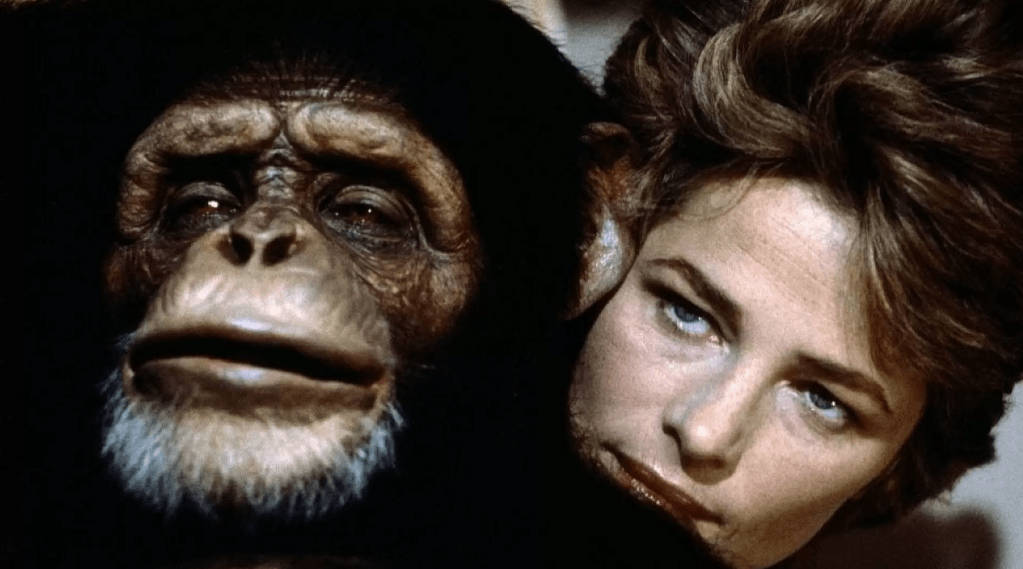
Nagisa Ōshima’s penultimate movie, Max, My Love (1986), has an absurd premise — a woman takes a chimp as a lover — it doesn’t do much with. The woman, Margaret (Charlotte Rampling), is the dignified wife of a British diplomat, Peter (Anthony Higgins), stationed in France. Her bestial transgression is discovered when Peter barges into the ₣2,000-a-month Paris apartment he finds out she’s been secretly renting and finds her in bed with the monkey, whom she calls Max. They met while she visiting the zoo with a friend, the eye contact too tantalizingly strong and prolonged for her to stop herself from visiting over and over again.
Though horrified, Peter also doesn’t react how we assume he might. He nearly right away suggests that Max come to live with him, Margaret, and their young son, with his own quarters scarcely consisting of much besides a torn-up mattress behind some precautionary, prison-like bars. The ludicrousness of the situation prepares you for slapstick comedy; some moments come close enough. Peter coaxes a surprisingly game sex worker (Sabine Haudepin) into ultimately unfruitfully seducing Max so that he can get a better sense of what the chimp and Margaret get up to; in another scene, Max manages to get his coarse hands on a shotgun that Peter has to try to sloppily snatch.
But Max, My Love, much like the surreal black comedies of Luis Buñuel (some of whose frequent collaborators — namely screenwriter Jean-Claude Carrière and producer Serge Silberman — worked on the film), largely plays things detrimentally straight. It’s not that there’s a lack of recognition from the characters that a literal monkey is disrupting their lives with a strange relationship. It’s more that Max, played by a man in a monkey suit, isn’t presented that much differently from a conventional man who simply can’t speak. World-class Buñuel’s flair for dry, not-saying-the-quiet-part-too-loud comedy ensured that it was funny on its own to see silly things be repurposed with seriousness. Ōshima, in contrast, didn’t as often work in comedy — an inexperience evident in a movie that’s somehow objectively harebrained without rising to the occasion of being amusing at minimum.
Max, My Love’s utmost success is its nailing of the subtle sadness at its core: reaching a point in a relationship where it’s clear that the person with whom you’d fallen in love has evolved in the subsequent years to someone you might still care for but are fundamentally at the kind of odds with that there’s no returning from. Inviting Max into the home feels like the foredoomed gesture of a man who knows, deep down, that his marriage is probably a lost cause but doesn’t yet know how to accept it. Who hasn’t done something ridiculous for love?
 Peterson Reviews