
Just-graduated Ana (America Ferrera) comes across to her English teacher, Mr. Guzman (George Lopez), as someone with so much potential that he’s moved to show up, uninvited, to her graduation party to try encouraging her, for what we can tell is the umpteenth time, to consider going to college, even though she’s missed the application deadline for basically every university. He doesn’t want her working-class immigrant parents’ financial situation to hold her back. She’s eligible for plenty of cost-covering scholarships, he repeatedly assures her, and he can pull some strings at Columbia if need be. It’s clear, though, both to Ana and us, that that isn’t all that’s making her so hesitant about leaving home.
Marking the debuts of both Ferrera and its director, Patricia Cardoso, the long-in-the-making, East Los Angeles-set Real Women Have Curves (2002) goes nowhere surprising. But it’s warm and likable as it charts its young protagonist’s journey getting to its ultimate destination: having Ana arrive at a place of self-acceptance, not just when it comes to her own desires but the very way she carries herself. (The film’s title doesn’t so much strike me as an exclusionary conclusion as an affirmation Ana perhaps repeats to herself internally as she’s told by the world at large — though never as much as her nagging, body-shaming mother Carmen, played by Lupe Ontiveros — that her fuller weight somehow makes her less-than.)
Carmen is Ana’s biggest obstacle. In addition to her hectoring, hurtful obsession with her youngest’s physique — vicious to the point of practically swatting a slice of cake out of Ana’s mouth at her own grad party — she’s rigid that her daughter should strive for marriage before she does a college education. She’s also unwavering about Ana having a duty, more than anything else, to help with the ever-stressful family business, a seen-better-days dress-making factory that her still-living-at-home older sister, Estela (Ingrid Oliu), now runs and where their mother has worked for nearly 40 years.
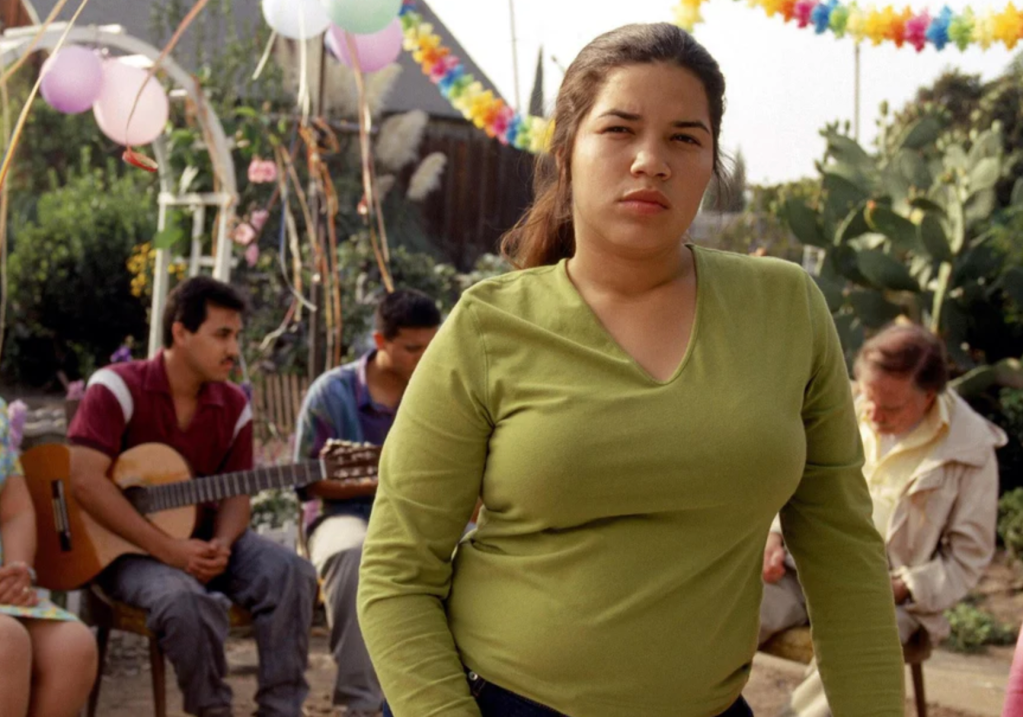
America Ferrera in Real Women Have Curves.
Ana gets a job there at the start of the summer, tasked with steaming endless stacks of dresses. Immediately pegged as “Miss Know-It-All,” she’s resented by her new co-workers for how obviously she finds her duties beneath her and her pointing out that it isn’t right that they’re making $18-a-piece dresses Bloomingdale’s will go on to typically resell for around $600. But eventually she finds her place, even helping Estela — who’s framed as what Ana could later become if she doesn’t leave — get inspired enough to design her own line. It includes a red dress tailored to Ana’s measurements rather than the traditionally thin women to whom the factory’s garments are catered. Real Women Have Curves has much tenderness for the taken-for-granted creative gifts of women whose talents are taken advantage of by an exploitative system, their own creative caprices bounded by the unyielding demands of underpaid labor.
Carmen is a sympathetic character. Her cruelties are borne of love steadily poisoned by years of thankless hard work; she lashes out at her family for not being able to live up to impossible-to-meet ideals she’s sure will one day vindicate her struggles. The film’s screenwriters — Josefina López, who wrote the book the film is based on, and George LaVoo — go to great lengths to depict the back- and hands-breaking work she’s devoted her life to and the real hurt she feels when Ana is so loudly dismissive of it.

Lupe Ontiveros and America Ferrera in Real Women Have Curves.
But they’re also honest about how much of that’s connected to the controlling, projection-minded toxicity in which she drowns Ana’s life, creating an atmosphere where her daughter can never take pride in her body or feel like she has the right to chase after her own hopes and dreams, decided-for-her familial obligation be damned. LaVoo and López acutely make you feel the claustrophobia of Ana’s plight, of which Ferrera portrays the resulting interior rumble marvelously. You can feel the burden of contradicting expectations — her family’s, her teacher’s, her own — press down on her. She carries herself with something older’s weariness.
Though they’re predictable, it’s still satisfying when in late-movie scenes Ana pushes against her mother’s iron fist, hit with the realization that there’s no reason she has to collude with someone who expels so much energy on hurting her. Real Women Have Curves’ most indelible scenes see Ana’s growing self-assurance spread to others. She’ll lead her co-workers, all of whom practically bake in their sun-absorbing workspace with no fans (it would supposedly get dust on the dresses), to peel off all their sweat-soaked clothing and finish the day’s work in nothing but their underwear. The body parts they’ve come to resent are suddenly transformed into points of pride and, if not, something close to it. Everyone in the room notices their colleagues have disdain for their respective bodies — which, to another person’s eye, is never as bad as the person living inside it might tell themselves. At a different point in the film, Ana loses her virginity to the guy she’s casually dating (Brian Sites) — a part of the storyline that welcomely renders her much-doted-on weight as a nonissue — and makes it a point to keep all the lights on so that he can admire the body she’s been led to believe she should be ashamed of. (He happily obliges, her confidence seeming to draw him to her even more.)
A 21st-century milestone in Latinx representation in film, Real Women Have Curves went on to be a hit at the Sundance Film Festival without, frustratingly, properly jump-starting Cardoso’s career in the way it would Ferrera’s. It’s moving without pandering to a too-pat happy ending’s phoniness. Ana will actualize at least the first steps of her nebulous dreams, but you can tell that that’s going to come at a great cost to her relationship with her mother, and that everyone in the family isn’t as much excited for her as grudgingly accepting that she isn’t going to go down the path that had been laid out for her. Getting what you want — pursuing what’s best for you — sometimes requires charging ahead without worrying about what could come in its wake.
 Peterson Reviews