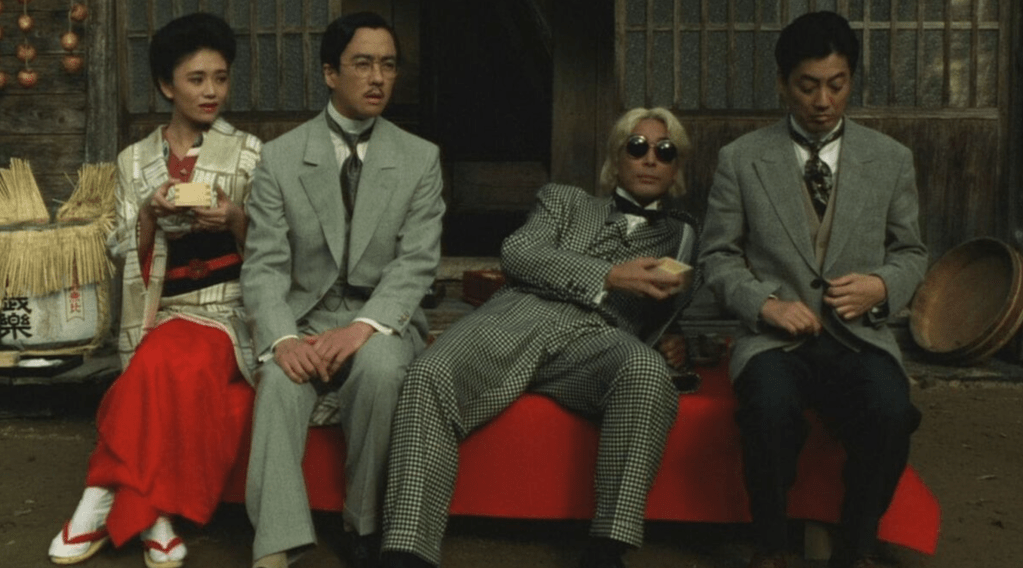
“I am Yumeji — I do whatever I want and turn it into poetry and paintings,” says the eponymous subject of Seijun Suzuki’s mostly just nominal biopic Yumeji (1991). That statement from this much-fictionalized version of the artist (played in the film by Kenji Sawada) also feels representative of Suzuki’s own idiosyncratic approach to filmmaking, which, for nearly all of his career, resulted in movies that were foremostly made to fulfill his own visions, for better and for worse. (Yumeji is itself part of a loose trilogy united by their abstract style, Taishō period settings, and conscious departure from Suzuki’s primarily crime-focused métier.)
Yumeji makes yet another case for Suzuki as a brilliant stylist, with one-after-the-other compositions distinguished for their painterly care and the ghostly wispiness of their color. To call a movie a “feast for the eyes” can feel like hyperbole when applied elsewhere but here feels almost like a restrained description, especially in one scene where a woman bobs around in a giant pot of creamy soup.
Yumeji also takes Suzuki’s reputation for unwieldy storytelling to a new level: it’s so incomprehensible, with little of its narrative having to do with the dramas of its painter-slash-poet subject’s life, that there comes a time not long into the film that it seems wisest to retreat into its ambiance than exert too much effort to make sense of what, exactly, is going on.
That can make it, especially as it moves into its third act, tedious, but also invigorating when compared to the largely staid biopic genre’s other offerings. Biopics are generally so preoccupied with the arc of its subject’s life that they can feel more taken with narrative than personhood. Eschewing the temptations of mythmaking, Yumeji finds Suzuki and the film’s writer, Yōzō Tanaka, speculating on what it was like living inside their subject’s head — an obsessive, distractible place that, naturally, does not bode well for the restrictions of a comfortably digestible plot. It’s a difficult but formally thrilling movie whose bedlam becomes easier to appreciate the more distance you’ve gotten from it.
 Peterson Reviews