
It makes sense that Patrik-Ian Polk would follow up his directorial debut, Punks (2000), with a TV show: It’s an affable, low-stakes ensemble dramedy populated with characters you wouldn’t mind spending more time with than a feature. It distinguishes itself from other 20-something coming-of-age works of its era — it at times arouses memories of movies like Reality Bites (1994), The Last Days of Disco (1998), and The Best Man (1999) — for being chiefly concerned with the lives of Black queer people, a demographic still underserved by the movies to whom Polk has continued to make an effort to cater.
Punks follows a quartet of young friends — Marcus, Hill, Dante, and Crystal (Seth Gilliam, Dwight Ewell, Renoly Santiago, and Jazzmun) — living in West Hollywood, improvising their way through their early 20s. No one is decisive about what they want romantically or professionally; the steadiest things in their lives are each other. The sturdiest of everybody is Marcus, who successfully works as a fashion photographer but is agonizingly reserved around relationships. He bypasses heat-of-the-moment hookups and limits things to fantasy even when he has a clear romantic opportunity; when he’s told “you snooze, you lose” after hesitating too long to make a first move at a club, it’s a neat synopsis of his romantic prospects in general.
Punks will see Marcus try to loosen up a bit, a type of development whose formulaicness isn’t confined to just him. Crystal, a trans woman who works as a drag queen, is in a quasi-civil war for being a spotlight hog in a girl group whose performances the movie regularly pauses the storyline for to admiringly watch. Fresh from a betrayal-born breakup, Hill dives headfirst into one-after-the-other, no-strings-attached one-night stands, which the pearl-clutching-prone Marcus regards with open dismay. Not much goes on with Dante — the group’s only “member” who isn’t Black — except that he’s good for a pint-sized laugh. His life doesn’t consist of much more than carefree debauchery since his Beverly Hills mansion-owning parents subsidize him.
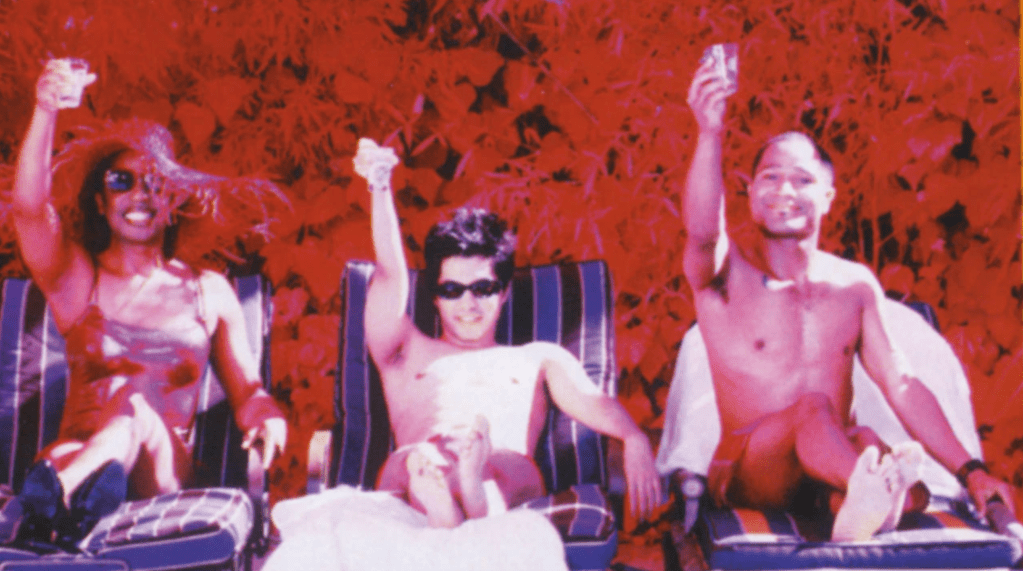
Jazzmun, Renoly Santiago, and Seth Gilliam in Punks.
I didn’t mind that many of Punks’s narrative and character beats have a predictable thrust. When they’re applied to people who’re seldom given main-character attention in a movie, they feel somewhat new again. And Polk only really adheres to sitcom-like expectations when talking about larger arcs. Clichés are largely avoided when getting into the more granular. You half-expect the movie, for instance, to side with Marcus’ clucking about Hill’s insatiable hunger for meaningless encounters, but Polk wisely never implies that there’s a correct way for a gay man to conduct himself. And he skillfully handles a late-in-the-movie reveal that a character understood to be straight actually isn’t. It’s made no more of a big deal than someone in a romantic comedy suddenly having the realization that they have feelings for the person the script has been trying to nudge them toward all movie along. Polk allows the moment to just be joyful, no questions asked. It’s a movie that knows how much of a drag it can be to have to overexplain who you are.
The latter reveal sets the stage for Punks’ touching romantic finale. But what I like most about the movie is how, even though sex and romance are integral, it’s most interested in the friendship between the four friends, whose conversations, whether pondering existential uncertainty or dwelling on something silly like which actors they’d sleep with if they were given the chance, are always vibrant with a sense of ease only possible when you’ve known each other for years.
Polk’s to-follow TV show — Logo’s two-season-long Noah’s Arc, which premiered in 2005 — expanded on Punks’ group-of-gay-people-figuring-life-out conceit. “I created this show because I wanted to see people like me in this format that I had grown to love after seeing Golden Girls and Sex and the City,” Polk told The Hollywood Reporter a few years ago. Punks’ final image, which sees the friends pack into a car for a day out, feels like a visual nexus point regardless of if Polk intended it that way.
 Peterson Reviews