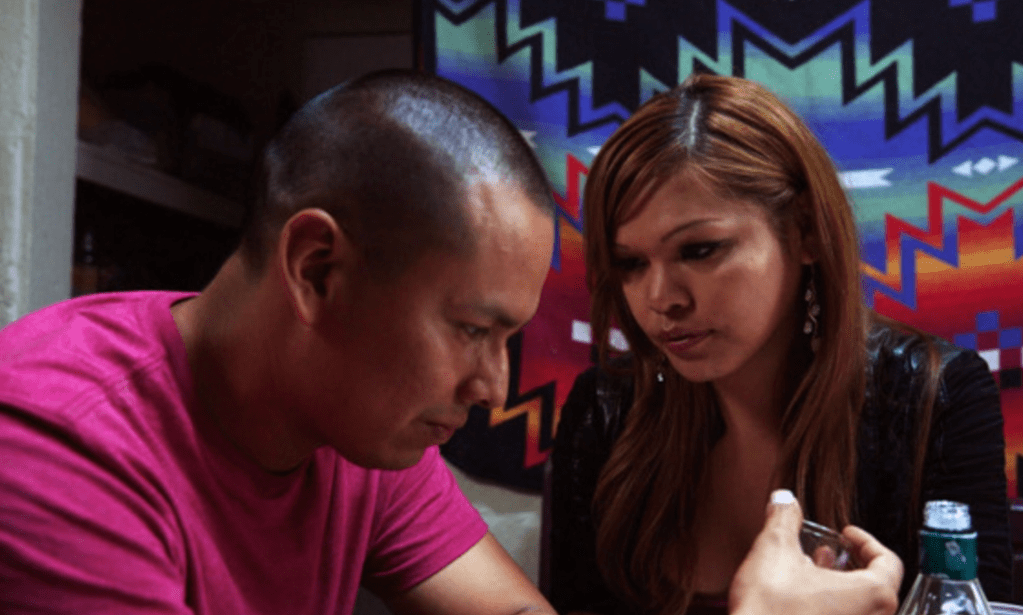
Reminiscent of the ensemble films of Robert Altman, the slowly revealed interconnectedness of Drunktown’s Finest’s principal characters gives subdued you’re-not-alone-in-your-problems pathos to already-moving, but never maudlin, stories. Writer-director Sydney Freeland’s 2014 drama follows the travails of a trio born on a Navajo reservation near Dry Lake, New Mexico, who are edging toward what they expect to bring about major life changes — that is if the complications they’re braced for don’t interfere first.
Soon-to-be father Sick Boy (Jeremiah Bitsui) is due to start basic training soon, but a history of petty crime and the sort of public drunkenness with which Freeland introduces him might sabotage his chances at what he hopes is a more stable life with his wife and child. As a 7-year-old, now-high-schooler Nizhoni (Morningstar Angeline) was adopted by a white Catholic couple who’ve forced her to remain distant from her upbringing; her recent determination to get into contact with the surviving family members of her deceased biological parents — augured by scholarship-motivated community service pointedly done on the reservation — might irreparably complicate her relationship with the adopted family for whom she nevertheless has genuine love. And Felixia (the late Carmen Moore) is close to landing a place on the annual Women of the Navajo calendar on which she’s always dreamed of appearing, but her being transgender and a sex worker could interfere with her chances of success if exposed.
Working with a conspicuously but not detrimentally low budget, Freeland isn’t opposed to knocking her characters down, but she never resorts to a strand of pessimism that feels excessively miserablist. Drunktown’s Finest’s realism doesn’t undercut its compassion for its characters; it’s as much disinclined to soften their struggles as it is to let them be definitive, evoking an opportunity-scarce atmosphere that can lead to impulsive, regrettable decision-making like Sick Boy’s without letting it overwhelm the instances of familial and cultural warmth existing within it.
Its most engaging stories belong to Nizhoni and Felixia, who’ve most internalized notions of what they’re “supposed” to be but continue to push toward what feels right. Nizhoni is still working up the courage to advocate for what she wants when we first meet her; her climactic argument with her parents is cathartic, suggesting the first time she’s come close to righteously erupting at them. Felixia, though, is further along, supported by an accepting family but still dishearteningly treated by much of the outside world. She nonetheless maintains the kind of impressive resolve Drunktown’s Finest unfussily salutes.
 Peterson Reviews