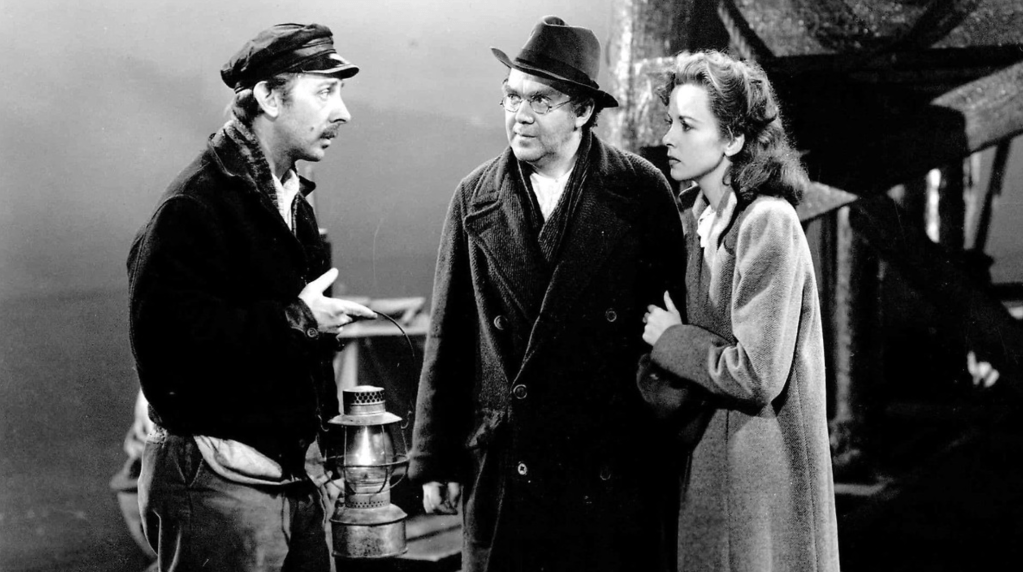
The fog is so suffocating on the Brooklyn docks on which Anatole Litvak’s Out of the Fog (1941) is nearly entirely set that it quickly has the effect of making the setting seem like an anonymous, insert-here stand-in for any place in America. (I’m wont to think, though, that this wasn’t intentional — more a technical decision made a smidgen more artful by James Wong Howe’s moody cinematography to cover up that the movie was shot on Warner Bros.’ sound stages and not on location.)
The atmosphere of universality conjured works well with a message-minded story like Out of the Fog’s, which was adapted from Irwin Shaw’s 1939 play The Gentle People. Its original staginess is felt in all of its scenes, which take place in the same handful of sets and are prone to expository dialogue. It sees the simple lives lived by its principal characters — happy-go-lucky fishermen Olaf and Jonah (John Qualen and Thomas Mitchell), plus Jonah’s discontented 21-year-old daughter Stella (Ida Lupino, the best thing about the movie) — disrupted for the worse when an extortion-minded gangster, Goff (John Garfield), shows up out of the blue and intimidates the pair to start paying him $5 a week to continue using their boat without a “problem” of his own winked-at making.
Christened a tinhorn Dillinger by a waiting-to-spring policeman, Goff’s financial demands are steep for the duo. Jonah makes a mere $30 a week, and has less than $200 in his savings account. Olaf makes little from his cook gig, which requires him to work 10-hour shifts every day under a boss (Odette Myrtil) who’s made his livelihood contingent on him feigning romantic interest in her.

Ida Lupino and John Garfield in a promotional photo for Out of the Fog.
Goff is played with near-cartoonish villainy by an entertaining Garfield, whose eyebrows are almost always smugly cocked and who speaks near-exclusively with self-important smarm. He becomes an increasing source of stress for Olaf and Jonah, who don’t want trouble. But he’s an object of fascination for Stella, who’s bored of her monotonous telephone-operator job and bland nice-guy boyfriend, George (Eddie Albert), who naïvely believes a marriage and kids will quell her ever-worsening malaise.
Stella’s frustrations with her limited prospects as a woman — she’s only left Brooklyn once, to attend an uncle’s funeral in Buffalo — initially feel strikingly progressive in their bluntness. But Out of the Fog isn’t airing them out to make a feminist statement. Stella’s angst and how they feed her attraction to Goff, which continues even after she’s found out how predatory he is, are more meant to be allegorical, topically warning of fascism and how easily one can be pulled in by its dog-eat-dog seductiveness when one’s desperate enough.
The stage play had a pessimistic ending that drove home fascism’s corrosiveness when it continues to go unchecked. Out of Fog, not surprisingly for a movie of the happy ending-fixated era of the studio system, softens things to move toward a good-guys-winning climax that’s also unsettlingly explicit in its celebration of don’t-fight-the-status-quo-too-much compliance. (Even when Olaf and Jonah try to take matters into their own hands, the film relieves them of the responsibility of getting their hands dirty.) There’s nothing inherently wrong with Jonah’s declarations that Stella shouldn’t be so disposed to think being ordinary is a bad thing. What’s off-putting are the several suggestions that dutiful adherence with social mores, even when they’re restrictive, is a laudable moral duty. They muddle a nonetheless engaging movie that can feel overly telegraphed and heavy-handed. How can a movie be successfully antifascist while also extolling the virtues of not too forcefully fighting for a better life?

