
Gurinder Chadha’s charming feature-directing debut, Bhaji on the Beach (1993), chronicles a day trip to the seaside town of Blackpool embarked on by several South Asian women who belong to the same community group in Birmingham. Its young leader, Simi (Shaheen Khan), wants the posse to look at the day as much of a mindless, scenic outing as a respite from patriarchy, racism, and the obligations of womanhood. In other words, she wants it to be, as she memorably puts it, a “female fun time.”
The film’s screenwriter, Meera Syal, shares Simi’s desire for the trip to be more than just a trip. But she’s a little less escapism-minded. She uses the varying ages and values of the women attending to incisively and often humorously examine the fault lines jutting out between older and newer generations and the differences being an immigrant and a naturalized citizen can make on how one moves through the world.
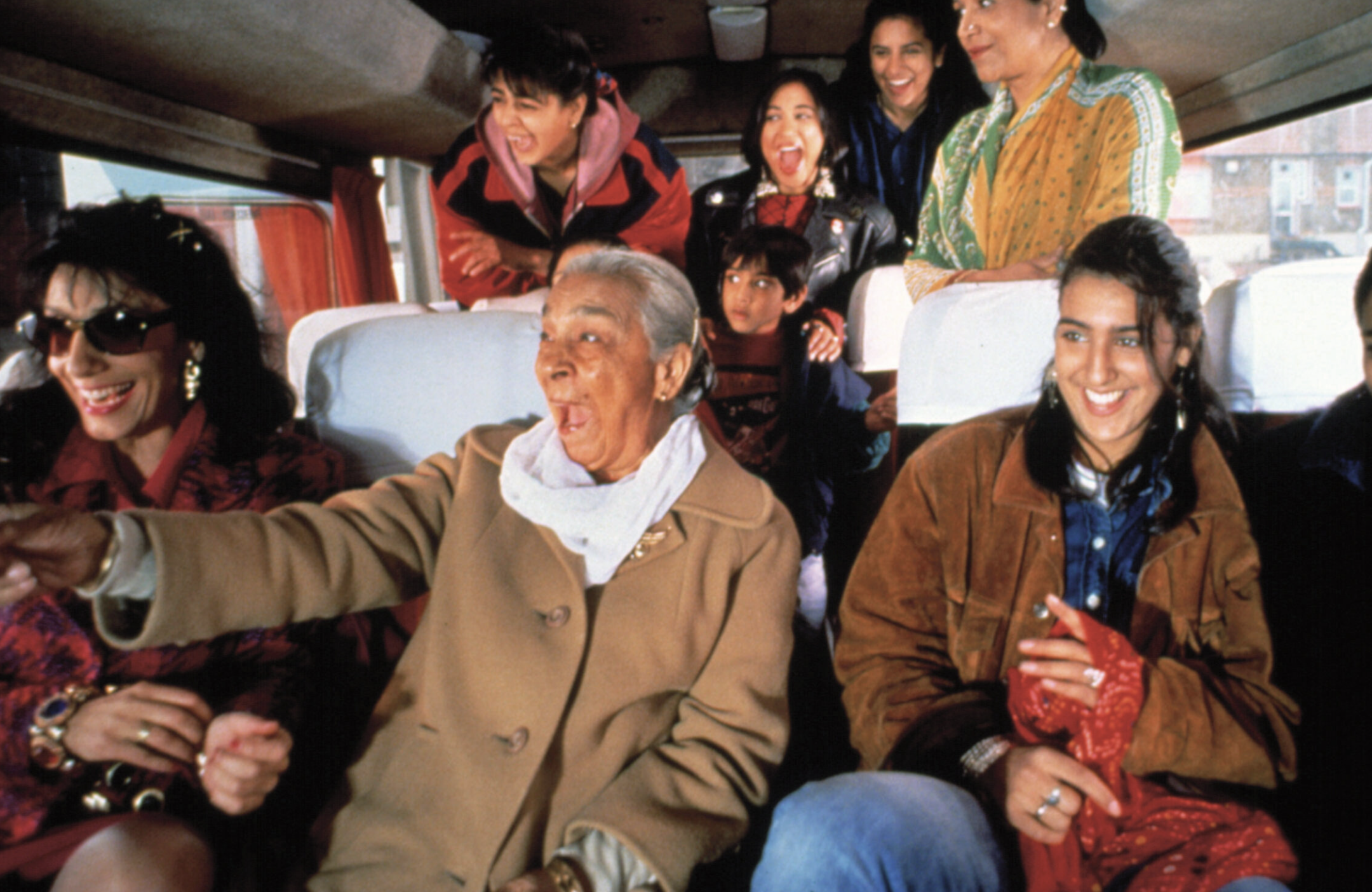
The cast of Bhaji on the Beach.
Bhaji on the Beach puts most of its focus on a duo having an especially hard time with what’s wanted of them versus what they really want. Hashida (Sarita Khajuria), whose “perfect child” reputation precedes her, is en route to medical school and becoming a doctor, but she’d much rather study art, a complication deepened when she finds out that she’s pregnant by the West Indian boyfriend (Mo Sesay) she’s managed to keep hidden from her traditionalist parents for more than a year. With her young son in tow, Ginder (Kim Vithana) is using the trip as a trial run for a recent, not-yet-committed-to decision to leave the husband, Rhajit (Jimmi Harkishin), who’s been physically abusing her.
Unsolicited comments about how they should handle their respective situations differ. The most opinionated of the bunch is the elderly Pushpa (Zohra Sehgal), who clings tightly to ideas of premarital purity and spousal deference and is no holds barred when confronted by someone who doesn’t live up to them. The film’s most sharply conceived scene signals how many layers of societal and cultural bullshit can be heaped onto one of these women at once. In a café, Pushpa and her dining companion berate Hashida for her prospective out-of-wedlock pregnancy while the business’s white proprietor racistly chides the older women for bringing some of their own cooking from home to enjoy alongside their drinks.
Syal doesn’t let the film’s more conservative characters off the hook for the racism and colorism they perpetuate in addition to their misogynistic ideologies even when it sympathizes with them when they’re themselves attacked. Although Pushpa would argue that societal divisions are more typically brought about by cultural difference than skin color, “through the younger women, Syal and Chadha suggest that it’s more likely culturally conditioned bigotry — and a view that they don’t wish to inherit,” as Simran Hans wrote in The New Statesman a few years ago.

The cast of Bhaji on the Beach.
One woman, the middle-aged Asha (Lalita Ahmed), is like a living nexus point between the film’s younger characters and its oldest. The conservatism she abides by hasn’t calcified into outright meanness, but it’s part of what’s boxed her into an unexciting life as a convenience-store owner. She often escapes from it with her own mind through fantasies that play out like scenes from the Bollywood movies she marathons. She experiences some of first true fun she’s had in a long time in Bhaji on the Beach when she meets and spends most of the day with a kooky actor in a red-striped hat (Peter Cellier) who no doubt puts into perspective how many joys she’s starved herself of out of a fear of what other people think.
Some of the women get something close to resolutions for the problems nagging them at home, but the film knows that giving too much credence to tidy solutions only props up a fantasy that might not as be as emotionally satisfying to watch. Syal evidently gets the hard truth that in life, a positive development is less lasting than it is a potential springboard for new problems. Bhaji on the Beach’s chief pleasure is found just in watching these women maneuver change, dealing as best as they can with what they’ve been dealt. Chadha’s next movie, What’s Cooking? (2000), would even more ambitiously show an ensemble of culturally disparate characters trying to straighten out their respective existential tangles. The project to follow, Bend It Like Beckham (2002), would be her proper breakthrough — a delayed mainstream step forward that likely prompted some adherents upon release to say “about time.”
 Peterson Reviews