
On “Song for Sharon,” off her searching 1976 album Hejira, Joni Mitchell ruminates on how easily she and the woman the song is dedicated to — a friend from the past with similar musical aspirations who wound up in a more traditionally domestic life — could have ended up with fates resembling the other’s had their respective circumstances been tweaked. Herbert Ross’ 1977 melodrama The Turning Point is guided by a similar narrative. It’s about a pair of friends and ballerinas who grew up training together but went down different forks in the road once they got old enough to pursue the art professionally. One became a venerated master of the form. The other got married, had kids, and by financial necessity gave up dancing to run a humble studio with her husband nurturing the next generation of budding ballerinas.
The “celebrity” of the duo, Emma, is played by Anne Bancroft. The one who settled down for a more family-focused life, DeeDee, is played by Shirley MacLaine. Based on the friendship between dancers Isabel Mirrow Brown and Nora Kaye, The Turning Point begins after some years of estrangement, which comes to an end because Emma’s touring company comes to Oklahoma City, where DeeDee is now based.
The friends fall into old patterns immediately. Resentments — which will come to eclipse the good feelings of picking up right where you left off with a friend from the past — are drawn up too. Had Emma secretly been happy that DeeDee had gotten pregnant all those years ago so that she’d no longer have such an immediately threatening rival? And is Emma overstepping her bounds as she tries to help DeeDee’s gifted ballerina daughter, Emilia (Moira Shearer lookalike Leslie Browne), start a career with her own company?
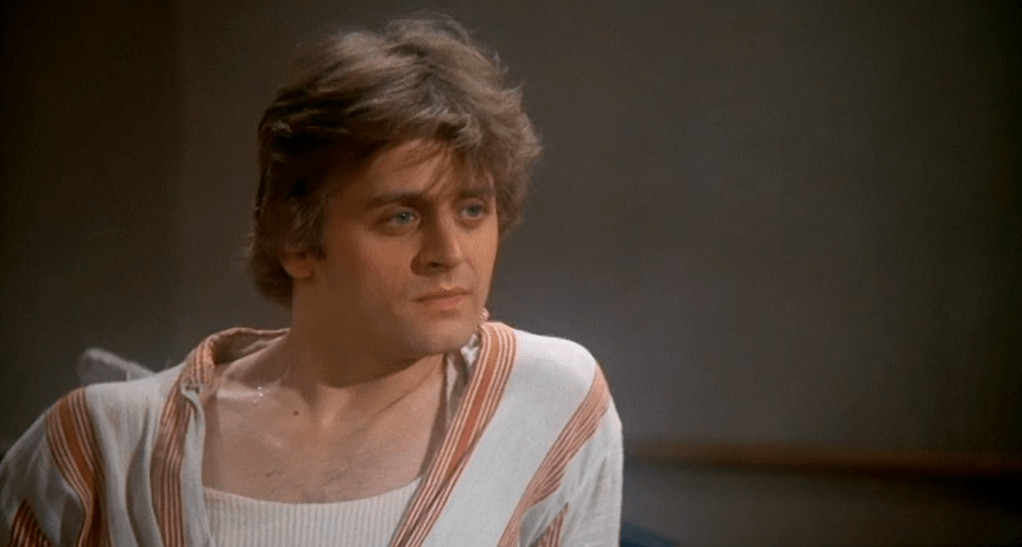
Mikhail Baryshnikov in The Turning Point.
The Turning Point’s resemblance to the women’s pictures of the 1940s — specifically 1943’s Bette Davis- and Miriam Hopkins-starring Old Acquaintance, in which the duo enlivens a generations-spanning literary rivalry with shoulder-shaking force — has been noted plenty of times. It suitably hits some of the emotionally overwrought pleasure centers of the genre, particularly through a climactic fight between MacLaine and Bancroft. (It begins with a cocktail chucked in another’s face and continues onto a rooftop, where the sparring will descend into thrown purses and clawed-at clothing.)
Though sometimes feeling more like non-sequiturs than nexus points in the storytelling, the obligatory dancing sequences are pretty stunning, too. Also a choreographer, Ross has the good sense to let the cameras mostly remain static in order to better capture the elegant movements of the movie’s fleet of dancers. He also creates dynamic juxtapositions between the graceful beauty of an official performance and the sweaty, tough-to-endure marathons of long-lasting practice sessions.

Shirley MacLaine and Anne Bancroft in The Turning Point.
But generally speaking, The Turning Point is mostly a perfunctory homage to a bygone style of movie. You expect more twists, more betrayals, and bigger emotions, but it turns out to mostly be without that much compelling incident. Much of that can be blamed on too much of the story being apportioned to a tedious, underwritten subplot about the friction between Emilia’s undeniable talent and her youthful susceptibility to self-destruction when faced with an obstacle. Her biggest is the romantic manipulations of a foxy Russian upstart, Yuri, who’s played by, in his American movie debut, the legendary dancer and choreographer Mikhail Baryshnikov.
Written by Arthur Laurents, The Turning Point evidently strives to be more progressive compared to its sometimes ideologically traditionalist forebears from a few decades earlier. It takes pains to make it clear that neither DeeDee’s nor Emma’s life is somehow better than the other’s — though they each can daydream, usually with some envy, all they want as middle age forces them to confront their desires and regrets — and the aforementioned catfight is unexpectedly tempered with mutual bursts of laughter, both women realizing how silly it is to be physically brawling with one of few people who understands them. Rather than coming across like natural refreshes, those updates mostly make the movie feel self-conscious, the swerves away from potential boldness cultivating a feeling of dramatic timidity.
The Turning Point being its year’s leading Oscar-nomination magnet is at once baffling and seems about right. It feels like the former because of its ultimate mediocrity and the latter because Oscar voters tend to celebrate movies that not only cull from real life but also nod to Hollywood’s past. That’s especially true when it has megawatt stars — in this case MacLaine and Bancroft, both of whom are great in a way that feels mandatory rather than thrilling in the way their finest performances are — helping do the revivification. The Turning Point doesn’t harness their powers as effectively as one might hope. It’s as if Ross and his collaborators figured it would be great simply because they were in it.
 Peterson Reviews