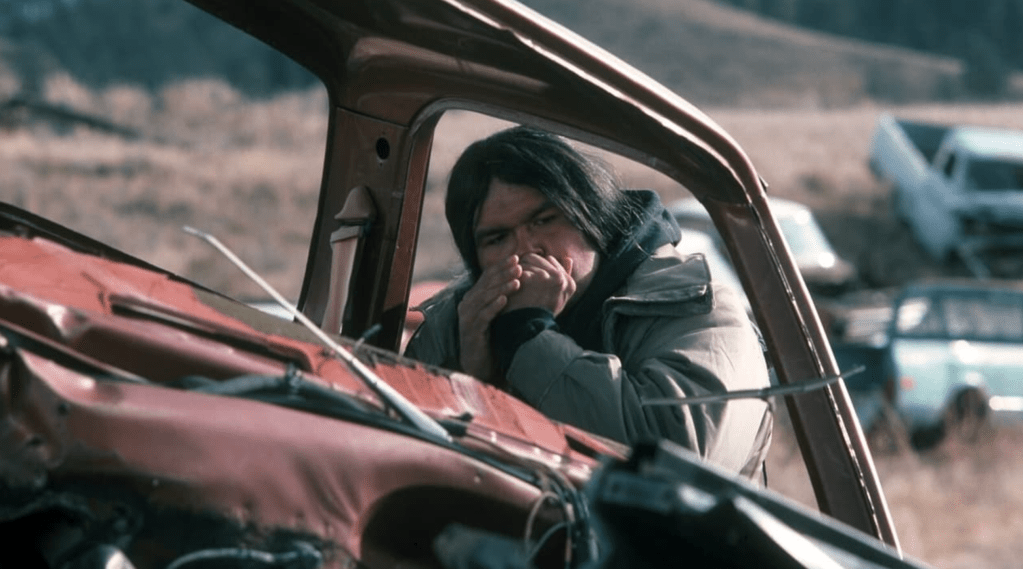
In Jonathan Wacks’ Powwow Highway (1989), a loved one’s wrongful arrest indirectly brings two poles-apart men closer together. They’re Buddy Red Bow and Philbert Bono (A Martinez and Gary Farmer), Northern Cheyenne tribe members living in Lame Deer, Montana, abiding by different existential philosophies. Hot-tempered community activist Red Bow is steered by present-day exigencies — right now, he’s the de-facto leader opposing the renewal of a white corporation’s strip-mining contract in the area — to the point of rejecting cultural traditions like powwows (he thinks they’re a waste of time) and writing off Indigenous legends as fairy tales. Comparatively mellow, perennially smoked-out Bono lives a life indebted to his ancestors to a level of seeming almost disconnected from present-day reality. “I trust my instincts,” Red Bow replies when Bono encourages him to have faith in higher powers.
Red Bow and Bono are friends, but they’re not that close. (A core memory of Bono’s is Red Bow in childhood bullying him for his weight.) But when, in the days leading up to Christmas, car-less Red Bow gets word that his Santa Fe-based, single-mother sister, Bonnie (Joanelle Romero), is in jail for the possession of some marijuana that has no doubt been planted in her car’s trunk, he sees if Red Bow — who’s just bought a severely discounted, actively-falling-apart sedan at a junk yard — can give him a ride there to pay his estranged sibling’s bail. Bono obliges. What will become clear, though, is a tendency to go way off-course whenever Red Bow falls asleep. Bono might exit toward the South Dakota Black Hills so that he can leave behind a cliffside offering — in his case, a half-scarfed Hershey bar — for his ancestors, or meditate for a spell while knee-deep in a piping-cold river.
Bono’s fixation on the past can be a point of contention for Red Bow. But his annoyances don’t completely quell potential open-mindedness. He’ll take part in that rivery tribute. And he’ll quietly come to see the value in a gymnasium-based powwow he initially dismisses. For Bono, Red Bow’s forward-pushing determination doesn’t make him dramatically alter his ways: instead it encourages him to live in the moment with more urgency.
It’s an expectation in a road-trip movie like Powwow Highway for disparate characters to grow fonder of each other. One of the movie’s pleasures is how it doesn’t simultaneously demand its characters change themselves. Here they see enough merit in each other’s ways to widen their perspective. In what seems partly the result of a conscious effort to avoid perpetuating the limited kinds of Indigenous characterization in movies, Powwow Highway avoids giving more credence to one man’s purview than another’s. It appreciates two worldviews that are complementary in their foregrounding of community.
Martinez and Farmer are excellent in parts that could easily have been one-dimensional: Red Bow confined to his sometimes-pugnacious passion and Bono to his zen, on-another-dimension tranquility. But the actors make these men feel lived-in, the way they position themselves in life patently different manifestations of long-held frustrations and righteous anger. Fundamentally a stealthy crowd-pleasing comedy whose levity is most pronounced during its climactic rescue mission, Powwow Highway is not, fortunately, the sort of movie that will let the types of setbacks these men have been dealt in their lives get the last word. It’ll conclude on a note that makes the last-minute adventure they’ve embarked on not only rewarding fatefully but spiritually. It’s a road movie that ought to be more widely recognized as a classic of its genre.
 Peterson Reviews