
Biopics about musicians tend to be better when they don’t have an implicit obligation to run through the facts of a life. I’m not talking about examples with a real-world figure driving them — say, the Billie Holiday-focused Lady Sings the Blues (1972) or the Patsy Cline-centered Sweet Dreams (1985) — but ones that are conspicuously based on real-life stories but don’t try to sell themselves as anything other than a work of fact-informed fiction: The Rose (1979), That Thing You Do! (1996), Dreamgirls (2006). When a biopic’s very genesis frees it from expectations of certain real-life details being met — and, by extension, the letdown of some things being left out whether because of running time-related concerns or because of a filmmaker’s desire to dishonestly flatter an image their subject might have etched in the popular imagination — the experience is less hampered by disappointment. (Disappointment is probably the defining characteristic of the biopic, a genre cursed, no matter a specific film’s quality, to massage the knotty stuff of life into a generally smooth, movie-length narrative.)
Though it contains most of the clichés associated with the genre, Robert Townsend’s invigorating The Five Heartbeats (1991) makes another good case for the fictional musical biopic’s superiority to its putatively factual analog. Taking and then mixing components of the lives of several Black pop acts that rose to fame in the 1960s — most obviously The Temptations and The Four Tops — the movie charts the inception, rise, and ineluctable decline of the homonymous five-piece vocal group.
Townsend, who also co-wrote the script with Keenen Ivory Wayans, stars in The Five Heartbeats as its main narrator and the group’s core songwriter. He’s the steady one in a band that will be tested, and in some instances temporarily undone, by womanizing, drugs, and the general existential difficulty of being public figures in a time where garnering crossover success might necessitate obscuring one’s Blackness until enough songs have become solid-enough hits to ensure live performances and face-revealing album covers won’t overwhelmingly attract racist, career-detonating controversy.
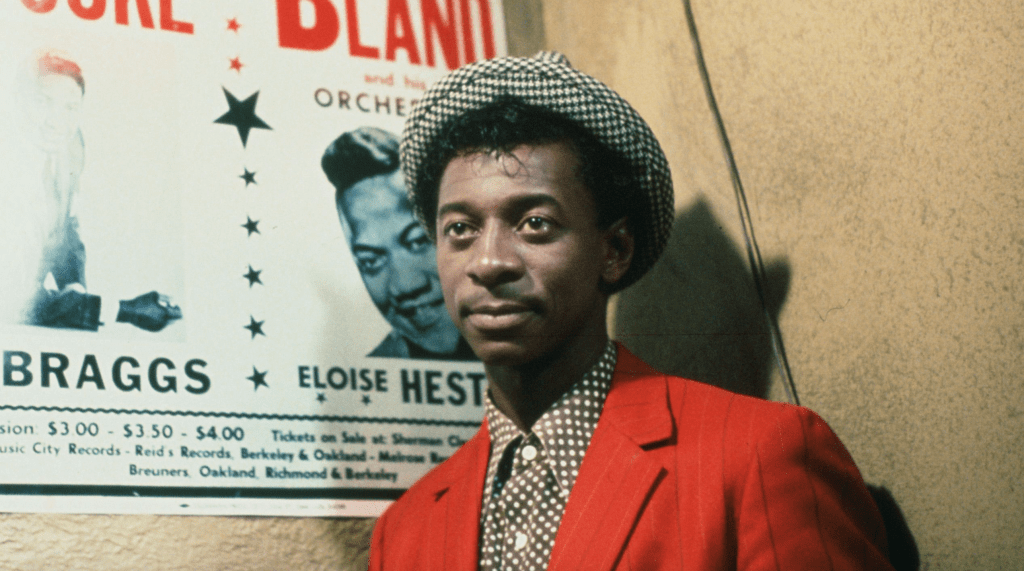
Robert Townsend in The Five Heartbeats.
Enough goes on, and enough time passes, in the decades-spanning The Five Heartbeats to suggest it might have more comfortably fit into a miniseries format. More members of the band besides Townsend’s Duck, his pathologically skirt-chasing brother J.T. (Leon Robinson), and genetically self-destruction-prone lead singer Eddie (Michael Wright) could have been known better than their superficial but amiable qualities and powerful vocal tones. And moments that function as sharp cultural critique — like the racism the men face while on their first real tour, where they have to queasily sing their way out of a false arrest in a Confederacy-celebrating Southern town, or the artistic exploitation practiced by the unremittingly grinning mogul (Hawthorne James) who signs the group to his corrupt label — could be dug into more.
But The Five Heartbeats is also so much more exuberantly made than its standard-biopic equivalents that its periodic slightness isn’t that bothersome. The music, by Stanley Clarke, provides fine approximations of 1960s and ’70s soul that all sound like probable hits. And it’s not hard to be charmed by one of the group’s main selling factors: that it’s their distinctive, not-quite-pretty singing styles and cheerful disdain for polished vocal-group homogeneity that makes them worthy of the glossy Jet, Rolling Stone, and Ebony cover stories that flash across the screen during the film’s mandatory “rise” section of its rise-and-fall arc.
Even if they’re not uniformly substantially written, the men in the band have the kind of believable brotherly chemistry that secures the tear-jerking poignancy of a late-movie reunion that’s also, in a way, subversive. (You’re promptly endeared to these men the moment they’re barely getting it together in time for a frenzied, film-opening Battle of the Bands-style performance.) Despite the varying adversity they faced in their youth, the quintet finds what seems like genuine happiness. Only some of it has anything to do with music. The Five Heartbeats was neither critically nor commercially embraced upon release; the decades have seen it reappraised as one of Townsend’s finest movies. It’s a heartening twist of fate in keeping with the film’s decision not to have a “fall” define its characters’ lives.
 Peterson Reviews