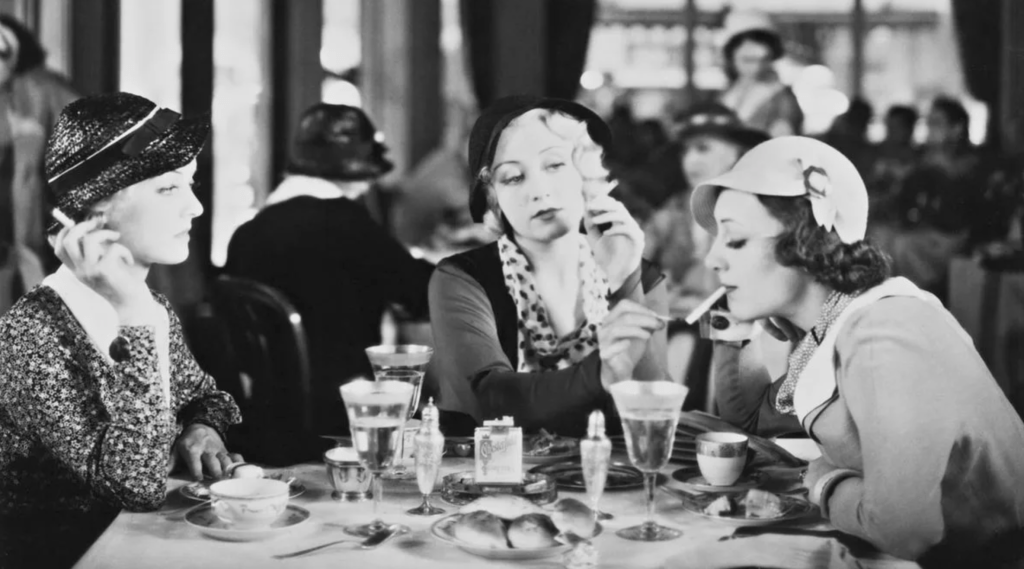
Mervyn LeRoy’s fleet 1932 melodrama Three on a Match gets its name from a now-antiquated superstition often falsely attributed to the Swedish match magnate Ivar Kreuger. The belief, which the movie noisily advertises via a newspaper advertisement the cameras home in on, goes like this: If a trio of people all light their cigarettes with the same match, then someone in that group is fated to soon die.
Three on a Match’s troika of reuniting-classmate main characters — streetwise showgirl Mary (a scene-stealing-as-usual Joan Blondell); sensible stenographer Ruth (Bette Davis); and level-headed, married-with-a-kid Vivian (Ann Dvorak) — will, of course, act against the superstition’s warnings during an early-movie lunch out. And the film will, of course, see one of them meet their premature end by its conclusion, the woman being punished by the universe the one most brazenly refusing the now-century-old social mores expected of that era’s young women. (Never mind that her stepping out has to do with feeling reasonably suffocated by a life where her well-being is reliant on how much she supplants her own desires for the men in her life.) Depending on how you look at it, Three on a Match is conservatively moralizing or progressively disheartened — either way, the message from both sides is that crossing gendered bounds will lead to ruin under stifling patriarchy — though it was probably more than certainly wanting to be the first thing.
Melodramas seldom have good politics. Their sagas usually come from over-the-top nightmares improbably rising up when someone strays from what’s socially expected of them. What happens to Three on a Match’s accursed woman lead is an over-the-top nightmare, all right; the film couches her downfall in a succession of bad news that makes the movie entertaining in a bewildering way. It’s been a common complaint since the movie’s autumn release some 90-plus years ago that its 63-minute runtime doesn’t give it enough time to breathe. I conversely appreciate how it complements the idea of life being a nasty, brutish, and short thing. It might not take much, or that much time, for everything to irreversibly fall apart.
A common complaint I do agree with: that Davis, two years from her breakthrough in the Oscar-nomination-garnering Of Human Bondage (1934), is not given enough to do to make clear the prodigious talents that wouldn’t long after declare her a generational talent. But if she was given enough to do, I might have to walk back the defense that Three on a Match’s length suits it just fine.
 Peterson Reviews