
Angel Heart’s still-pretty-cinematically-novel merging of detective fiction with the supernatural would probably be more potent if its director, Alan Parker, didn’t lay on its increasingly hellacious atmosphere thick to the point of getting suffocating, and if the meant-to-be big-gasp-inducing final reveal weren’t immediately followed by some befuddlement around why its greasy gumshoe main character’s (Mickey Rourke) client (Robert De Niro) would, essentially, engineer this complex of a time-wasting runaround. (Even the easy-to-see-coming uncloaking of the latter’s identity doesn’t make things easier to believe.)
For a while, though, Angel Heart is a (mostly aesthetically) thrilling change of pace for PI noir. The dangerous, criminal-abundant worlds the genre creates tend to be seductive. Their environments abound with tantalizing secrets and often just-as-alluringly secretive people, usually women of the problematic (but still frequently entertaining-to-be-around) femme fatale variety. Angel Heart gets, in contrast to its genre peers, less seductive as it goes on despite the invitingly sumptuous, red-rich cinematography from Michael Seresin. (It bristles with sinister imagery good at burning into the brain: walls dripping with blood; elevators descending into what only could be Hell; omnipresent black-shrouded figures; spinning ceiling fans that oddly become vaguely baleful, like room-cooling equivalents of flipped-over hourglasses.) Detective stories reliably lure you into wanting to know more; Angel Heart engenders far more dread and anxiety, the bloodier it gets and the further it creeps into the occult, around where it will lead. It’s something shared with 1955’s Kiss Me Deadly, a detective noir it feels descended from that also goes to uncanny, not-quite-of-this-world places.
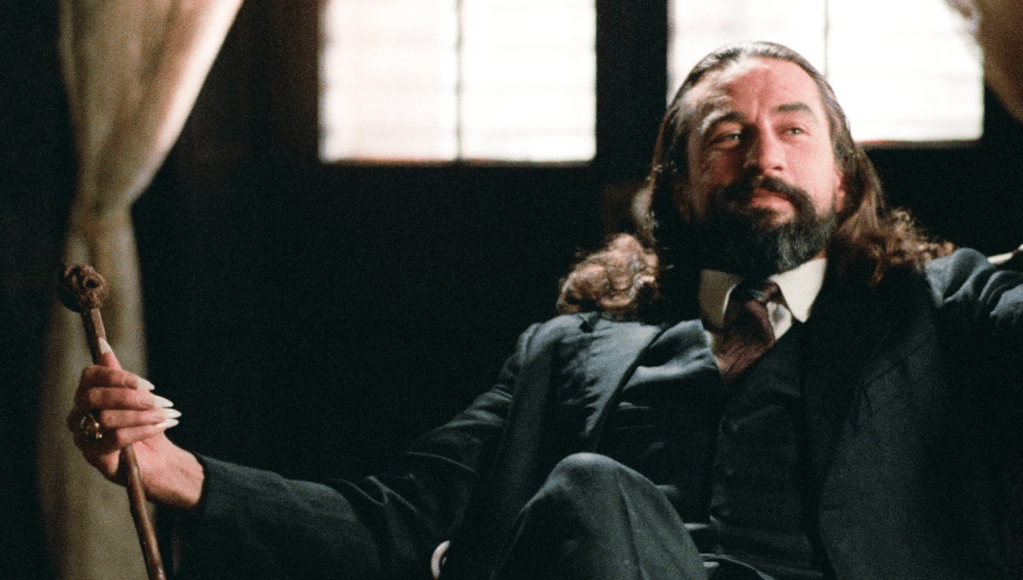
Robert De Niro in Angel Heart.
Soundtracked by Trevor Jones, whose score makes Angel Heart sound like Edward Hopper’s Nighthawks metamorphosed into night terror-tinged music, the 1987 movie begins in snow-capped, Gotham-like New York City in 1955. There, war veteran-turned-private detective Harry Angel (Rourke) has for years worked as a shamus that specializes in unglamorous insurance and divorce cases. He’s pulled away from his typical clientele by an unsmiling, long-haired and -fingernailed man rather tellingly named Louis Cyphre (De Niro). Cyphre asks him, for $125 a day (then, to prevent Angel from backing out, a difficult-to-reject $5,000 overall), to track down a forgotten crooner. The man being pursued, Johnny Favorite, quickly rose to stardom toward the end of World War II, and since his disappearance around the same time has supposedly owed Cyphre a debt about which the latter is illiberal with details.
The case takes Angel to New Orleans. The relentless humidity never seems to move him to shower or put on clean clothes. The film also accordingly ups the ante on voodoo-related imagery that more often than not wanders far past the line of injudicious exoticism — fear meant to be generated simply because of kitschily shot cultural difference. (It’s a given that mid-movie, some early-career Dr. John would malevolently lilt over some nighttime scenes.)
The more people Angel interviews in the Southern city, the more it seems that Favorite was in some way involved with the dark and mystical. Angel’s apprehensions about where everything is headed understandably accumulate as a trend develops: any serious lead he has usually winds up gruesomely murdered. Ripped-out hearts and boiled faces are probably — not that acts of deranged violence should be measurable — the least ghastly acts encountered. The sound of Angel’s pumping heartbeat, played over scenes as if it were music, becomes a leitmotif. His nervousness, for a time, braids with the viewer’s own. He’s wont to remain cool, though, in moments where we think he might not, like when he happens about a corpse, its right eye freshly ripped out, and he blithely uses its shoe to light a match for his cigarette.

Charlotte Rampling and Mickey Rourke in Angel Heart.
Angel Heart is decent at cultivating a foreboding ambience. How couldn’t it, when such vileness seems to lurk around every corner? But the story gradually loses you in a way I can’t imagine happens as pronouncedly in its unread-by-me source material, the 1978 William Hjortsberg book Fallen Angel. (It does, however, get some additional last-act charge from an appearance by the always-transfixing Lisa Bonet — pretty much blacklisted by Bill Cosby for taking a decidedly adult role at odds with her family-friendly Cosby Show image — as the teenage daughter of an old lover of Favorite’s.) Much of what we know about the case for too long largely remains unchanged. By the time the exposition-heavy laying out of what’s really going on comes in the film’s final few minutes, it’s slightly undone by a faint too-little-too-late quality.
It’s more undone by its convolutedness, which one might more readily buy as a byproduct of nightmare logic if the explanation weren’t expounded on so exactingly. Rourke is slimily great in Angel Heart until the finale, where he gets worked up to such operatic why-God-why, scream-at-the-sky proportions that your instinctual reaction to his all-consuming despair might be to laugh. It’s hard to take him or the movie as seriously as they’d like.
 Peterson Reviews