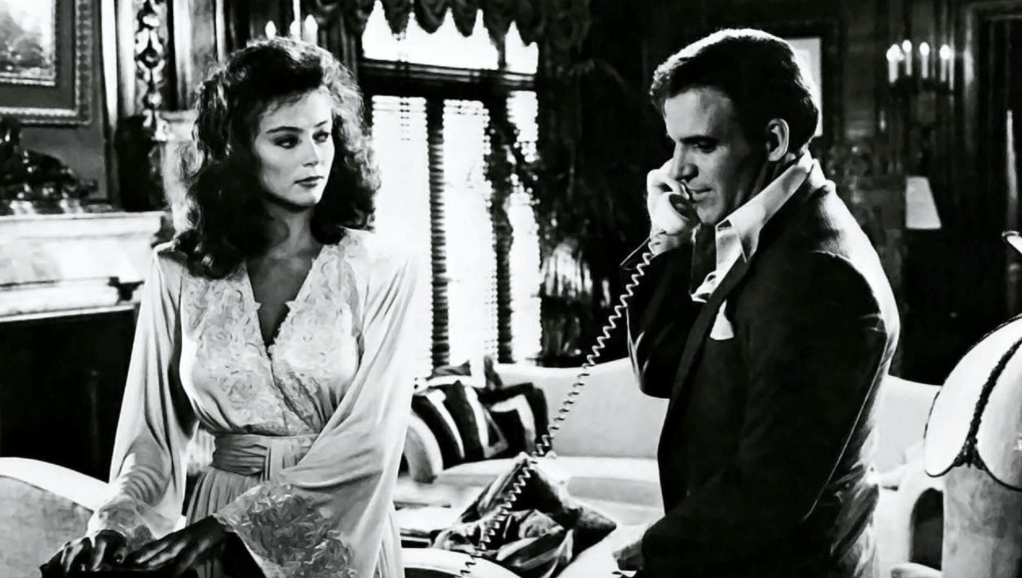
The Hollywood Golden Age is turned into a playground in Carl Reiner’s Dead Men Don’t Wear Plaid (1982). In the detective-movie parody, Steve Martin plays a 1940s-era, case-starved gumshoe investigating the suspicious death of a cheesemaker, and the film accordingly presents itself aesthetically the way a PI film from the period would be. It’s photographed in pearly black and white; it has decade-accurate sets and costumes designed by the late Edith Head, whose sartorial creations were instrumental in defining how movie stars looked during the Classic Hollywood epoch.
Beyond those dutiful surface-level callbacks, Dead Men Don’t Wear Plaid takes its nostalgic tribute a step further. (Martin had done some even-more-earnest homaging the year before, with the wistful musical Pennies from Heaven.) Much of its comedy derives from the footage of several majority-’40s movies — from decade-defining hits like 1944’s Double Indemnity to more under-the-radar picks such as the middlingly successful Bette Davis vehicle Deception (1946) — spliced into the film’s action. Reiner and his collaborators make it appear, throughout the movie, as though Martin is interacting in various scenes with the likes of Burt Lancaster; Humphrey Bogart; and Barbara Stanwyck, the latter of whose bedridden hysterics in the phone-preoccupied melodrama Sorry, Wrong Number (1948) are repurposed for one of the movie’s funniest moments.
Dead Men Don’t Wear Plaid is a technically impressive excuse for Reiner and Martin to live out their presumable vintage Hollywood fandom while also having much fun cheerily ribbing the overwrought nature of a bygone style of movie. It has an even better time underscoring that detective movies of yore, amusing as they can be, are also cluttered with apologia for appalling methods of law enforcement and steady misogyny — things highlighted and then satirized by the loony incompetence of Martin’s character and the woman lead (the game, high-cheekboned Rachel Ward) always being painted as intellectually superior amid some of the bubble-headed chauvinism Martin’s character subjects her to.
Dead Men Don’t Wear Plaid’s collagist approach is responsible for about as many laughs as awkward insertions that don’t feel quite right for a scene — like when Ava Gardner, as she appeared in The Killers (1946), is first introduced — that are too insisted on to really inspire a laugh. The interweaving usually works best when the absurdity is played up but still makes sense in the context of the movie: a long lead-up to present Veronica Lake, as she appeared in The Glass Key (1942), only for her to have a single, hilariously discouraging line; billing temporary female sidekick Lana Turner as someone who can take “direction like a pig takes to slop”; an early exchange with Bogart managing to mostly be about how Martin hates how his peer can’t be depended on to wear ties. His fashion-borne contempt doesn’t prevent respect, though: Martin has advice from Philip Marlowe — whom Bogart played in 1946’s The Big Sleep and also, without his express permission, in Dead Men Don’t Wear Plaid — in multiple places in his office. (One Marlowe quote, “Don’t fall in love with a client!,” appears on some wall art.)
Whether the mosaically built storyline of Dead Men Don’t Wear Plaid comes together — it doesn’t, really — doesn’t matter that much. As is usually the case with the detective movies from which it takes a page, the maintenance of vibes is paramount. Dead Men Don’t Wear Plaid has good ones, with the caveat that those who watch it with a less-than-passing familiarity with the Hollywood Golden Age won’t have nearly as good of a time as those who treasure it as much as the film’s makers clearly do. Still, that fandom, though giving the film a lot of mileage, can’t totally mask that the movie is more diverting than it is consistently funny, never coming as close to the most well-realized, boisterous of Martin vehicles.
 Peterson Reviews