
After she released 1934’s Murder on the Orient Express, prolific mystery writer Agatha Christie tasked her arguably most famous detective protagonist — a Belgian with an egg-shaped head named Hercule Poirot — with solving six additional cases before she got to 1937’s Death on the Nile. But cinematically speaking, the 1978 adaptation of Nile, meant to capitalize on the Oscars-attracting movie version of Murder on the Orient Express (1974), is a direct follow-up.
It eschews a sequel’s bigger-is-better mindset so that it can repeat what had worked last time: letting its audience have about as good a time watching a gargantuan, A-list cast let loose playing monied or desperate-to-be-monied murder suspects as trying to guess who among them is responsible for its story-driving killing. An about-as-good sequel might feel like a letdown for neither upping the ante on nor enriching the original. Death on the Nile avoids disappointment because it recognizes that much of the pleasure of Christie’s oeuvre comes from its consistency — how reliably it satisfies a craving, soothes a desire for the restoration of even a hint of order in a haywire world.

The cast of Death on the Nile.
Played in Orient Express by Albert Finney, Poirot is recast in Nile — Finney feared typecasting and sitting still for too long in the makeup chair — with Peter Ustinov. He plays the character with a hint more mirth than Finney had. (Way more into embodying the sleuth than his predecessor, Ustinov would play the investigator five more times, mostly in TV films when commercial viability at physical theaters started to wane.) The detective is this time dropped off on a Nile-set cruise whose beglamored passengers have in common a distaste for its decidedly flashiest guest. She’s Linnet Ridgeway-Doyle (Lois Chiles), a spoiled socialite we can immediately guess will be the one obligatorily marked for death. (Gal Gadot’s casting in the 2022 version of Nile is apt: Like Chiles, she too cannot act.) Aloof, acquisition-minded Linnet is introduced by talking down to her ever-patient hired help, then unhesitantly stealing the toothy fiancé (Simon MacCorkindale) of her doe-like best friend, Jackie (Mia Farrow).
Onboard, Linnet and her swiped beau are neighbored not just by the vengefully stalking Jackie but a host of other opps. Some see her with passing chagrin, like the Marx-reading Ferguson (Jon Finch), who calmly opines that people as idly and exorbitantly wealthy as Linnet are guillotine-deserving parasites. Others have a deeper and more personal disdain. Romance novelist Salome (Angela Lansbury, having a ball in Norma Desmond drag) is fielding a financially ruinous defamation lawsuit from Linnet, who found that a villainous character in a recent book too closely resembled her, and a woman we know only as Miss Bowers (Maggie Smith) used to be rich before Linnet’s father supposedly snuffed out her family’s once-secure prosperity. (Bowers is now the underpaid companion of the kleptomaniacal, Bette Davis-portrayed Marie, an elder in pancaked-on makeup coded like an aged version of one of the outspoken divas Davis played in her youth.)
It feels so inevitable that Linnet won’t survive the trip that we almost wait hungrily for her death to be announced. Death on the Nile takes its time to give us what we want. The lack of hurry is applicable to other things in the overlong, 140-minute-long movie — namely how, when Poirot attaches a certain theory to a certain character, we watch the hypothetical play out as if it were a reenactment in a true-crime TV doc. (With so many characters, that gimmick, novel for a time, gets a little old.)
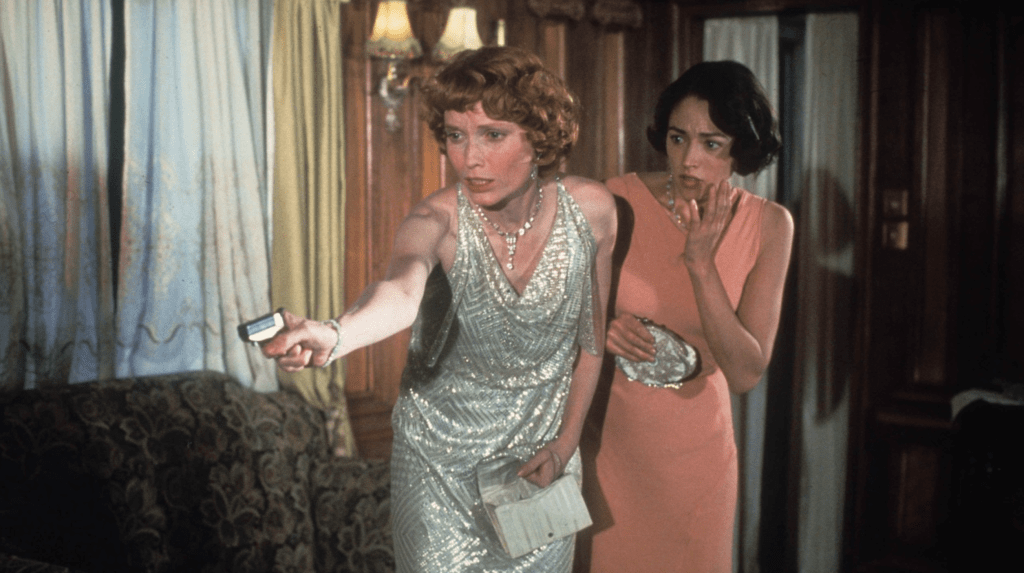
Mia Farrow and Olivia Hussey in Death on the Nile.
Those complaints aren’t likely to diminish one’s enjoyment of the movie that much, though. Death on the Nile is likely to be sought for those in the mood for a glamorous, handsomely cast whodunit, and, barring the rather perfunctory way it’s directed (by disaster-movie doyen John Guillermin) and shot (by the legendary cinematographer Jack Cardiff, who nevertheless gives the built-in staginess a glinty, antique-room quality), it delivers.
The customary finale — the sort of thing where all the well-heeled, lily-white subjects cram into a room and Poirot, at length and with startling accuracy, posits what has gone on beneath everyone’s noses — marks an infrequent example of long-winded exposition being not just a good thing, but gratifying, even if its killer reveal doesn’t jolt as much as Orient Express’ had. At least it, spoiler alert, clinches one of Farrow’s finest performances, her trademark meekness substituted for a wild-eyed ferocity she’s almost never tapped into across her decades-long career. She seems to relish the opportunity.
 Peterson Reviews