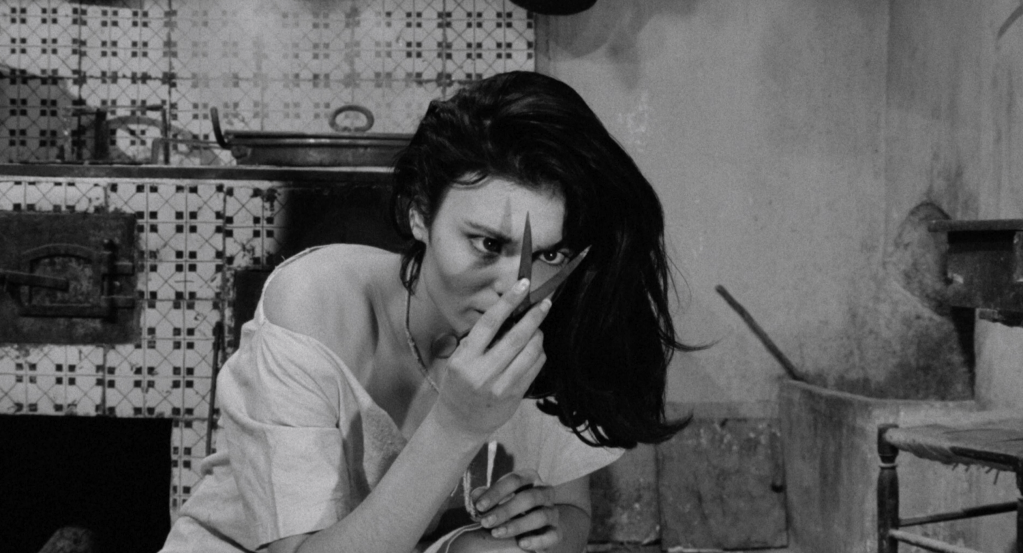
Purif (Daliah Lavi), the wild-eyed anti-heroine of Brunello Rondi’s The Demon (1963), would have been cursed regardless of whether she was being supernaturally terrorized by the titular menace. She is openly, loudly obsessed with Antonio (Frank Wolff), a man with whom she was apparently once romantically involved who’s now marrying someone else. (Adding to her bewilderment, Antonio more than once gives in to his sexual impulses when around her post-breakup.) In Lucania, the tiny, ideologically conservative village where she and Antonio live, a woman to so resoundingly make her desires clear — especially when those desires point toward someone betrothed to another — is to transform herself into a pariah whom we can tell will never be able to overcome her disdain-stained reputation. “What little shame she has,” a community elder hisses to the woman sitting next to her when Purif, self-harm injury still healing on her chest, enters a church one morning.
What Purif decides to do in that church — in front of everyone place a demonic curse on Antonio so that he won’t ever stop thinking about her and will have a dead firstborn — exemplifies both her gossiped-about shamelessness and marks her pivot from mere outcast to someone possibly endangered. That’s not just because it might lead to her possible possession by the very entity she thought might be able to help her. (Wanting to keep things ambiguous, The Demon will carefully only have her later doing worrisome-but-not-explicit things like looking fearfully, at certain times, at something off camera; sticking her tongue out at a crucifix; or, most memorably, doing some distinctly unhuman spider-walking that presages Linda Blair doing the same in the decade-younger The Exorcist). The austere, mountainous Lucania, as it’s portrayed by screenwriters Rondi, Ugo Guerra, and Luciano Martino, also seems to be a place whose traditionalist residents would sooner kill someone than continue putting up with someone so destructive to the omnipresent conformity it abides by.
Antonio’s hurtful dismissal seems milquetoast compared to what Purif will be put through in The Demon. She’s assaulted at least twice by older men who take advantage of her in vulnerable moments alone. Her family is so ashamed of her that her father viciously whips her with a belt early in the movie, then, later, is joined by other members in essentially burying her alive, hoping she’ll go undiscovered.

Daliah Lavi in The Demon.
Guided by some anthropological research of southern Italy by The Demon’s filmmakers to make the movie hew closely to real life, Lucania is also shown as a village that gives superstition and ritual a central cultural role. Before a new couple consummates their marriage, for example, we see a group of greyed relatives spread dried grapes in the shape of a crucifix on their marital bed to ward off any ill-intentioned spirits. But unexpectedly for a genre movie made in the early 1960s, such ceremonies are framed with fascinated respect. It avoids a lazier, less nuanced conclusion: that cultural difference is one simple way to locate a folksy society’s inherent evil. Lucania’s evils, it’s made clear, come more from its hardly uncommon adherence to gender convention.
Lavi’s gaping-wound performance emotionally and physically contorts. Her long, jet-black hair, often stressfully mussed, evokes Medusa. Twenty when the film was released, Lavi’s startling work — and the nightmarishness of the situation in which she’s caught — can be sapped of some of its urgency by Rondi’s rather detached direction, though. The film, as some pre-opening intertitles clarify, was based on a true (and more recent than one might assume) story. Rondi and his co-writers thereafter betray what seems like a true-crime-TV-predating distance, often presenting the movie with reenactment-like flatness. You hunger for some visual daring to more lucidly bring Purif’s anguished interiority to the fore — later movies revolving around a young woman’s unraveling, like 1965’s Repulsion or 1968’s Hour of the Wolf, are some good instances of features accomplishing something in that vein — that never comes. Though stirringly rendering the oppressiveness of Purif’s geographical and social environments, The Demon can make you feel like you’re on the outside looking at her despair instead of convincingly showing the world as she sees it.
Still, The Demon’s provocative decision to never fully tumble into classic horror-movie tropes pays off. By forbidding us from seeing its eponymous monster — if there is one — it makes the enigmatic entity appear less frightening than Purif’s concrete reality. Uncommonly for its decade’s schlock-forward horror films, it makes everyday emotional hardship — especially womanhood-related horrors — far scarier than anything otherworldly, inexplicable. Maybe the demon the film’s title refers to is really Antonio.
 Peterson Reviews