
The entrance of Night of the Demon’s eponymous beast is more frightening than the beast itself. In Jacques Tourneur’s 1957 supernatural horror movie, the arrival of the creature — a monster movie-size, horned and winged villain with a dragon-like face — is ushered in by some high-pitched, nails-on-a-chalkboard ringing and a puff of smoke that eventually blooms into a fire that gives way for the scaly creep that has been summoned.
Once we actually see the beast, it’s a little underwhelming — a feeling aggravated by the knowledge that Tourneur and the film’s screenwriter, Charles Bennett, never wanted to show the demon in the movie at all. They cannily believed that the feature ought to rely on suggestion rather than special effects-forward confirmation, but they were undermined by co-producers Frank Bevis and Hal E. Chester, who inserted glimpses of the demon into the theatrical cut without Tourneur and Bennett’s knowledge. “[They] made this horrible thing, cheapened it,” Tourneur recalled in a 1973 interview. “It was like a different film.”

From Night of the Demon.
Demon’s many champions generally believe that, despite the back-stabbing interference, the eerie, atmospheric movie endures as a horror-genre high point. But I find the tampering, especially because it’s unveiled during the film’s opening, ruinous in a way that diminishes the other achievements of the movie, which is elsewhere stylish and gorgeously shot, the English countryside’s vistas and sprawling estates turned into shadow-seeped hells on Earth for its already fish-out-of-water protagonist the moment night falls. The movie’s scariness, as envisioned by Tourneur and Bennett, was meant to come from anxious speculation, capitalizing on the familiar feeling of being watched only to be greeted by shadows and rustling when you turn your head. Bevis and Chester almost completely destroy that not-easy-to-simulate sensation.
Night of the Demon’s plot is contingent on the feeling of one’s safety unraveling. It follows a steadfastly logical American psychologist, played by Dana Andrews, who’s in England to investigate the leader of a supposedly satanic cult (a hammy, chin-bearded Niall MacGinnis) who might have been responsible for the death of Andrews’ colleague. Andrews’ rational poise inevitably starts taking hits the more it seems that the snakily threatening MacGinnis is up to no good, his nefariousness maybe backed by the otherworldly. The audience’s mounting doubts should line up with Andrews’ own. But by immediately making it explicit that there is something tangibly worth worrying about that isn’t quite of this Earth, a feeling of anticlimax becomes inescapable in Night of the Demon. Instead of becoming a sympathetic audience stand-in, Andrews’ character becomes frustrating, an embodiment of someone who doesn’t see what’s clearly there.
Horror movies Tourneur had directed the decade prior — Cat People (1942), I Walked with a Zombie (1943), and The Leopard Man (1943), all under the guidance of the adroit producer Val Lewton — give a glimpse into what could have been. Because of budget constraints, those movies used the evasiveness Tourneur had foreseen for Night of the Demon less because of a narrative vision than a need to save money.
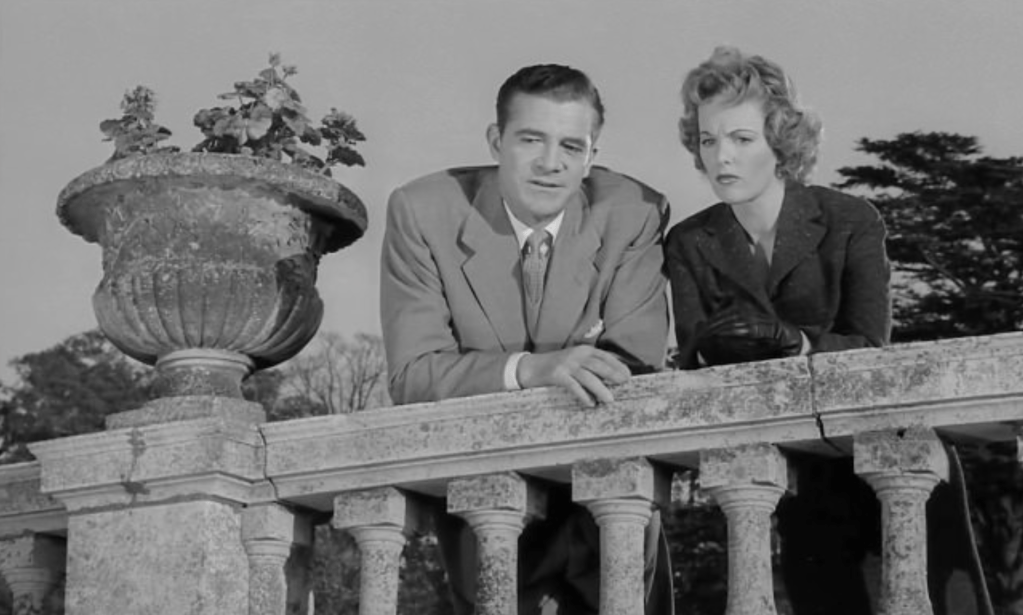
Dana Andrews and Peggy Cummins in Night of the Demon.
Obliqueness works for those films beautifully. Tourneur and Lewton forward-lookingly understood, in an era where horror was still largely schlocky, that there was power in letting the audience fill in the blanks — that the limitlessness of one’s imagination could often take a viewer to places far more terrifying than a special effect could. Favoring atmosphere over shock value was also more amenable to allegorical possibility that you could take seriously. It’s hard not to watch Cat People now, for instance, and not see it, at minimum, as a heartbreaking metaphor for a woman at war with her homosexuality.
Night of the Demon is pioneering in different ways. It’s been widely praised for being an ahead-of-the-curve example of both occult and folk horror, subgenres that would not really take off in the mainstream for another decade. But it mostly, to me, feels like a cautionary tale: Distrust a visionary’s instincts at your own risk.
 Peterson Reviews