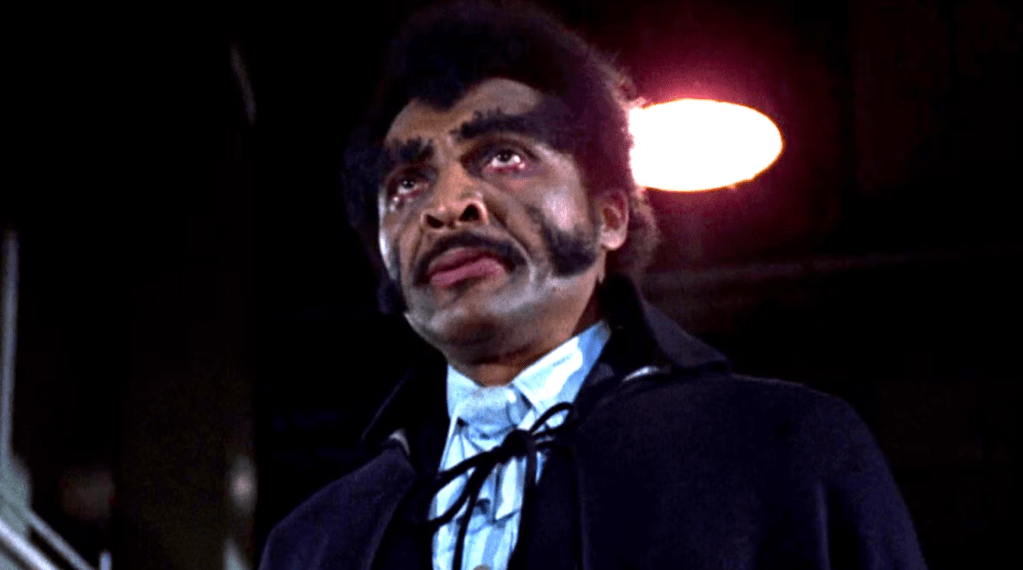
The name of Blacula’s title character might suggest that the movie to come is a Blaxploitation-era remake of the adapted-and-remixed-to-death Bram Stoker book. But the 1972 film is really more of a side quest kind of movie with, narratively speaking, some reboot-like qualities. The baritone-voiced, African prince main character, Mamuwalde (William Marshall), gets the nickname from Count Dracula (Charles Macaulay) himself while he and his wife, Luva (Vonetta McGee), are visiting his sprawling Transylvania castle in 1780. They’re there to try to convince the politically powerful nobleman to support their efforts to end the slave trade. Legendarily evil Dracula does not take to the request kindly, so he spitefully turns Mamuwalde into a fellow vamp and curses him to lie unconscious in a dusty coffin for a few centuries. Luva’s fate is horrific, too: She’s lethally locked in the dungeon in which her husband is doomed to rest, her screams going unheard by anyone who could rescue her.
Blacula’s trio of screenwriters, Joan Torres, Raymond Koenig, and Richard Glouner, make it so that Mamuwalde is awoken by a couple of effete interior decorators (Ted Harris and Rick Metzler). They’ve bought Dracula’s castle so that they can revamp it into a tourist destination, and they are, naturally, predestined to be the newly bloodthirsty royal’s first victims. Some convolutions whose mechanics it’s best not to get into lead Mamuwalde to Los Angeles, where he, in a credulity-stretching twist, happens upon Tina (McGee), a young woman he not unrealistically thinks might be Luva reincarnated. Since it’s coming after a world-altering trauma worsened by his now being forced onto terrain that’s alienating in more ways than one, Mamuwalde’s desire for Tina instantaneously gives Blacula a deep twinge of sadness. She’s all he has, evidence-wise, of his stolen life.
Blacula is about Mamuwalde’s lust for Tina — which will, not very convincingly, be returned in a life-or-death sort of way — and the handful of killings for which he’ll inexorably be responsible in order to satisfy his unusual strain of hunger. The movie’s writers and its director, William Crain, struggle, though, to make the ways the film checks off various Dracula-story clichés not feel obligatory, and they never fully commit to whether they want the movie to be properly scary or if they’d like the melancholic tone that sets in early on to be its dominant one. Blacula has a couple of solid-enough horror-movie-style set pieces — the shadow-seeped sidewalk stalking of Tina by the yearning Mamuwalde; the darkroom murder of a photographer who’s bemused when she develops a Mamuwalde-less snapshot she was positive he was in — but its genre commitments are generally more perfunctory than very inspired.
Twenty-three-year-old Crain’s inexperience is evident in the frequently echoey sound and the movie’s generally flat look. He wouldn’t get many more opportunities to get rid of his greenness. After helming 1976’s Dr. Black, Mr. Hyde, another twist on a horror classic that would not have been possible without Blacula’s box-office success, he wouldn’t make another movie until the little-seen short Nothing As It Seems (2016). Blacula and its Blaxploitation-horror peers — 1973’s Blackenstein and 1974’s Sugar Hill among them — are not, barring 1973’s bold, kaleidoscopic Ganja & Hess, very good. But one is disposed to treasure them anyway: They were, and continue to be, representational breakthroughs in a continually white-dominated genre.
Marshall is Blacula’s saving grace. He doesn’t give a particularly great performance in the way preceding Draculas like Béla Lugosi and Christopher Lee had, and he can’t avoid looking rather goofy running around in a fluttering black cape the film puzzlingly has him wear around modern-day Los Angeles. He never quite locates the tragic anti-hero-cum-boogeyman balance the film trickily requires, either. But he has a seductive, room-filling presence heightened by his voice’s booming richness. (Wanting to keep hearing him speak is a quality he has in common with Lugosi.) And Marshall really does come across as frightening when his face transforms before going to town on a human’s neck. The jutting-out fangs, demonic tufts of facial hair, and red-rimmed eyes don’t wear this actor clearly statelier than his material — it’s the other way around.
 Peterson Reviews