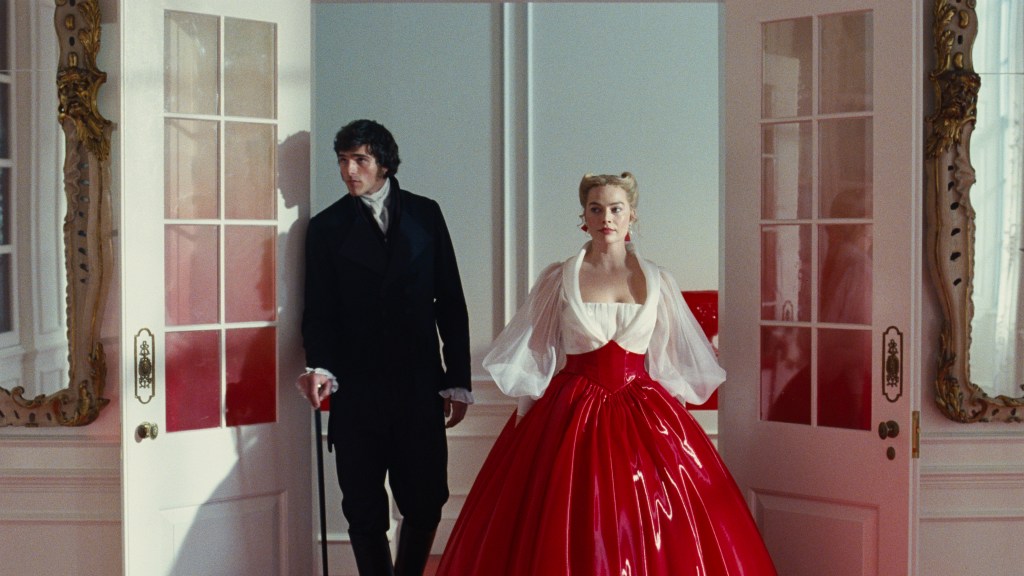
Wuthering Heights, dir. Emerald Fennell
If a filmmaker decides to resurrect a generations-old novel that’s been made into a movie something like 20 times, I’d rather they play in the source material like a shovel- and pail-wielding toddler in a sandbox than treat it as sacred. That’s probably why, before watching English writer-director Emerald Fennell’s stab at reviving Emily Brontë’s Wuthering Heights (1847), I kept bristling against early complaints about her supposedly fan fiction-adjacent tampering despite my respective misgivings about and hatred of her big-picture-fumbling previous movies, 2020’s Promising Young Woman and 2023’s Saltburn. Wouldn’t it be more interesting to have the two texts conversation-startingly interfacing with each other than have the movie loyally reiterate what’s long been established on the page?
I might have ultimately held on to that idea more tightly if Fennell didn’t jettison much of what made the book compelling and if she had a clearer idea of the movie she wanted to make. Some things about it suggest she was going for a cheeky, welcomely irreverent parody: the arch quotation marks around its title in promotional materials; baroquely exaggerated costuming and set design that wouldn’t be out of place in a Ken Russell movie or on a David LaChapelle photoshoot site; a playfully overwrought Charli XCX-headed soundtrack; a movie-stealing supporting performance from a dollhouse-obsessed, unsettlingly ingratiating Alison Oliver as romantic pawn Isabella Linton. But Fennell mostly plays it head-scratchingly straight in more than just the tonal sense of the term, since the vigorously motioned-at upping of sexuality in main characters Cathy and Heathcliff’s (a too old Margot Robbie and an arguably theme-deflatingly white Jacob Elordi) iconically class-, family-, and race-agitated relationship remains, in this R-rated but PG-13-feeling movie, clothed and largely square onscreen.
Read the full column at South Sound.
Photo: Warner Bros. Pictures
 Peterson Reviews