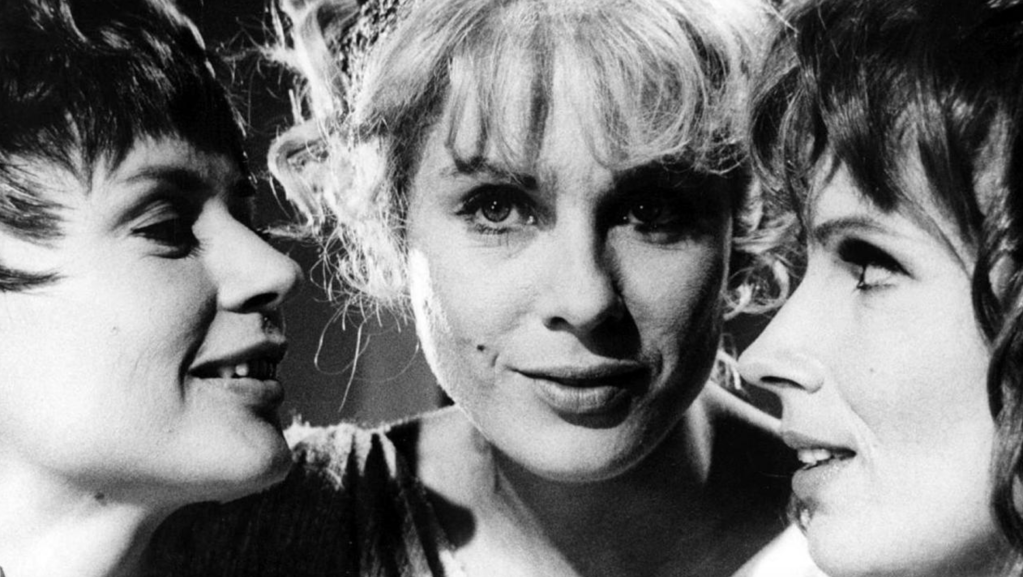
The legacy of Swedish actress turned director Mai Zetterling’s The Girls (1968) has been somewhat blemished by infamy. It was so comprehensively rejected by reviewers and audiences upon release that its negative reception is usually the explanation given for why Zetterling’s until-that-point pretty prolific, albeit still new, feature-filmmaking career dramatically stalled, never to regain its previous momentum.
The Girls’ spurning makes sense today, though not because of anything having to do with quality. It’s because it actively courts unpleasantness, its vinegar-dipped sense of humor tangled up in a sense of crushing defeat. It’s feminist and pines for gendered liberation, but it’s disinterested in rousing people to support its cause in a straightforward rah-rah way. It’s more about how difficult it can be to put feminist ideals into practice under patriarchy, where power-wielding straight men have a related tendency to be churlish and belittling to women, any potential for empathy marred when the world bends to your will. The Girls takes the ensuing frustration — and the lure of silently suffering for the sake of keeping things comfortable — as something worth seriously sitting with.
In The Girls, the gap between one’s philosophical convictions and the sometimes-dehumanizing drudgery of day-to-day life is painfully felt by a trio of theater actresses famous enough to make talk-show appearances. Played by Nordic icons Bibi Andersson, Harriet Andersson, and Gunnel Lindblom, they’re starring in a touring adaptation of Aristophanes’ Lysistrata, a play in which a sex strike is leveraged to end a war. Unlike the tenacious women they’re portraying, The Girls’ leads are being tortured by, but are at a loss about how to effectively overcome, their domestic malaise. (The movie nonetheless finds some parallels between the actresses and their ancient parts; appropriately for a movie directed by a veteran performer, the film knows how difficult it can be to completely sever one’s personal emotions and psychology from an assignment, particularly when it hits close to home.) Liz’s (Bibi Andersson) husband is an unrepentant cheater. Mother-of-four Gunilla (Lindblom) is being nudged by her spouse to abandon acting so that she can commit to housewifery full time. Securing child care is a constant challenge for single mom Marianne (Harriet Andersson), who’d rather not have to sacrifice her artistic passions just because she has a kid to raise.
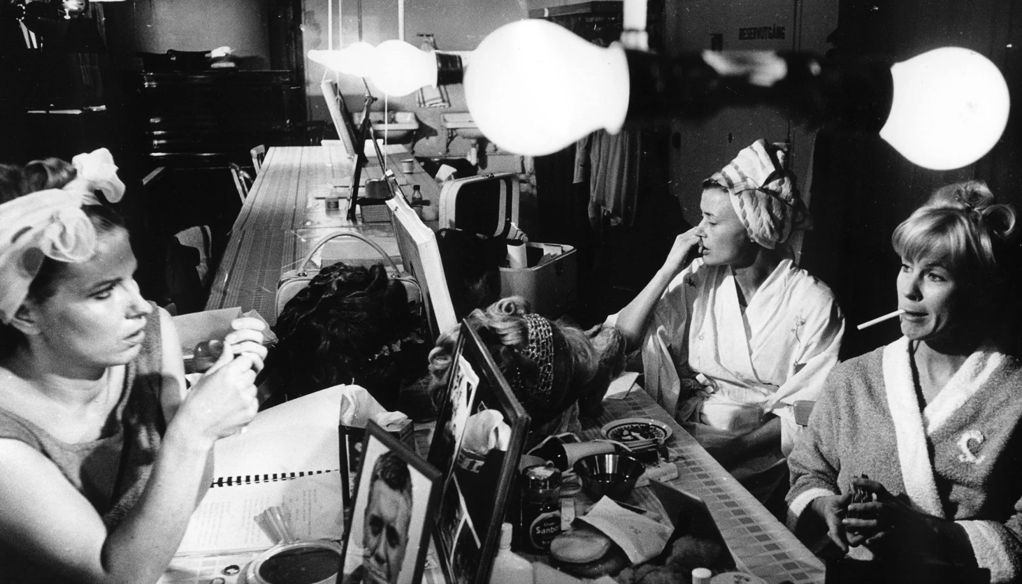
Gunnel Lindblom, Harriet Andersson, and Bibi Andersson in The Girls.
Zetterling ingeniously heightens the dissonance between life and art by transposing audio recordings from the play onto the lives of the women. We might see them running wearying family-first errands or, in one darker case, attempting to fend off a sexually aggressive man while an impassioned monologue proceeds in the background. The Girls also at an increasing clip features fantasy sequences, including one where a group striptease pokes fun at the male gaze’s objectifications or another where Gunilla gives a soulful speech about women’s rights in front of an audience of parked cars whose horns are being rudely honked by impatient men. The movie’s formal boldness powerfully evokes the unrealities of the human experience, which can be unbearably hounded by daydreams and paranoia just as much as one’s literal problems.
One of The Girls’ final fantasy images is of a group of women physically fighting — a cresting of Liz’s exasperation. As much as she’d like everyone of the so-called second sex to be on the same page about women’s liberation, it’s impossible to reach universal understanding or agreement for a best approach, even if you’re in a room comprising only likeminded, progressive people. Discord between women in The Girls’ “real” rather than imagined world is perhaps more devastating than the brawling because of the indifference in which it’s couched. Liz will visit with a homemaker living in one of the farther-flung cities where the theater troupe performs and finds even her most basic liberal talking points met with eyebrow-cocked annoyance. Later, when Liz directly confronts a mixed-gender audience about what they thought of the play after bows have been taken, she’s met only with contemptuous silence.
Moments of catharsis are healing on the intermittent occasions they arrive. After a dinner out is interrupted by a man who petulantly can’t handle the rejection of an ulteriorly motivated invite to his neighboring table, Liz, Gunilla, and Marianne blow off steam by dancing up a storm in one of their hotel rooms. And the movie’s version of a happy ending firmly rejects old-fashioned notions of marriage and romance as salvation. In order to better humiliate her philandering husband, Liz declares publicly that she wants a divorce. One set of shackles has come off.
 Peterson Reviews