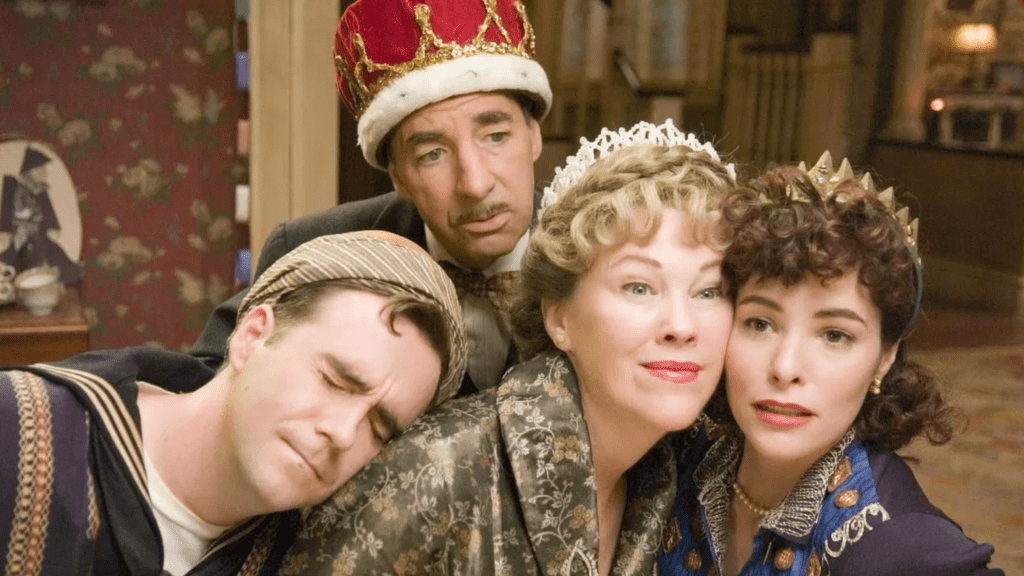
For Your Consideration (2006), Christopher Guest’s for-now penultimate directing effort, does away with the mockumentary framing device used on his best ensemble comedies while maintaining their absurdist, uncomfortably funny brand of comedy. Maybe he was worried that that formal approach would create too much of a Russian doll effect. Much of For Your Consideration takes place on a movie set, on which an assortment of his usual kinds of delusional grotesques gun for Oscar glory.
Though Guest’s mode of improvisation-dependent filmmaking here feels slightly diminished when contrasted with his previous peaks, including 1996’s Waiting for Guffman and 2000’s Best in Show, its comedy can still hit, usually when pertaining to scenes with brashly ignorant entertainment “journalists” played by Jane Lynch and a baby mohawked Fred Willard or the arc of late Guest mainstay Catherine O’Hara. In For Your Consideration she gives a characteristically wonderful tragicomic performance as Marilyn, an awards-hungry never-was liable to start off her day with, say, a morning rewatch of 1938’s Jezebel, whose every line of dialogue she knows by heart.

Jennifer Coolidge and Michael McKean in For Your Consideration.
Marilyn is among the four leads of Home for Purim, an in-the-works tiny-budgeted period drama so paint-by-numbers treacly that its story seems unable to move forward unless its emotionally manipulative orchestral score has decided how it wants you to feel. Marilyn is playing the slowly dying matriarch of a Jewish family and is trying to accept that her daughter (Parker Posey) is a lesbian. Something of a precursor to O’Hara’s foiled-thespian character on Schitt’s Creek (2015-20), Marilyn thinks of herself as a capital-A artist committed more to her craft than superficial optics. But she also worries that her older and terminally sick character’s makeup is unflattering, and eventually she goes under the knife in a puzzling bid to support her rumored Oscar chances. Her face is subsequently so frozen that her eyes and mouth suddenly seem like prisoners that can only twitch for help.
Guest puts Marilyn and her primary co-stars — Posey’s Callie; Harry Shearer’s Victor, best known to local audiences for rather embarrassing commercials where he’s a hot-dog-brand ambassador — through the wringer as they try to build awards hype for themselves. He has them hop from interviews with barely qualified reporters who give them less than the time of day to odd acting advice from Home for Purim’s own director (a tall-haired Guest). Laughs are scarcer than one is used to from a Guest film, but For Your Consideration is always charming, and its ensemble comes up with characterizations that carefully toe the line between deep silliness and a realisticness that doesn’t make it seem far off to meet one of these people in life. That realisticness helps elicit compassion for its fragile characters. The dichotomy is a Guest calling card. Amid all their goofing around, he and his collaborators have what appears to be at least understanding of and at most love for the insecure people they and we also happen to be laughing at.
The degrading media appearances For Your Consideration’s characters make in a ploy to secure coveted nominations are heightened for Guest and co.’s farcical version of the world. But they today feel predictive of a current moment where an expected part of a press run might involve eating hot wings with an interviewer or answering questions while getting mobbed by wet-nosed puppies. Likewise for the movie’s depiction of corporate-requested concessions, which only seem to be increasing and aren’t likely to slow down as entertainment-industry monopolization continues. The eventual studio request that Home for Purim sand down its ethnic edges to better pander to a broader range of filmgoers — and then to have the responsible executives try to take credit for the acclaim the movie receives — barely registers as satire, though I’m sure it didn’t in 2006, either.

Catherine O’Hara and John Michael Higgins in For Your Consideration.
More things remain evergreen. When a woman on the behind-the-scenes side of Home for Purim’s production correctly notes that both voters and the public alike hate it when a talent appears to want an Academy Award nod too much — something that could bode badly for Marilyn and Victor — I couldn’t help but immediately think of someone like Timothée Chalamet. I won’t rehash the eternal-feeling uproar he caused after offhandedly dismissing opera and ballet in an interview, but I and some others have no doubt that much of the furor was symptomatic of a general exhaustion around what’s felt like a neverending Oscar run largely defined by his conspicuous awards hunger and off-putting assuredness in his undeniable abilities. I’m drafting this review a few days before the official Oscars telecast; the feeling in the air is that Chalamet’s ravenousness will work against him, stopping his once-immovable-seeming frontrunner status in its tracks. The feeling turned out to be right.
Chalamet, along with the majority of For Your Consideration’s fictional cast, could learn something from the one actor in Home for Purim’s ensemble who seems truly impervious to the lure of the little gold man. You never know when putting your head down and focusing on the art will pay dividends. A related sense of humility and underrecognition are probably part of why O’Hara’s death earlier this year has been so hard to live with. Even though she was acclaimed and decorated throughout her career, she never seemed to be high on her clear genius, which was so endearing and singular that she could have netted even more awards and that still wouldn’t feel like enough. It goes without saying that she deserved Oscar acknowledgement for For Your Consideration, in which she gives a performance that, much like her others, feels tinged with the miraculous.
 Peterson Reviews