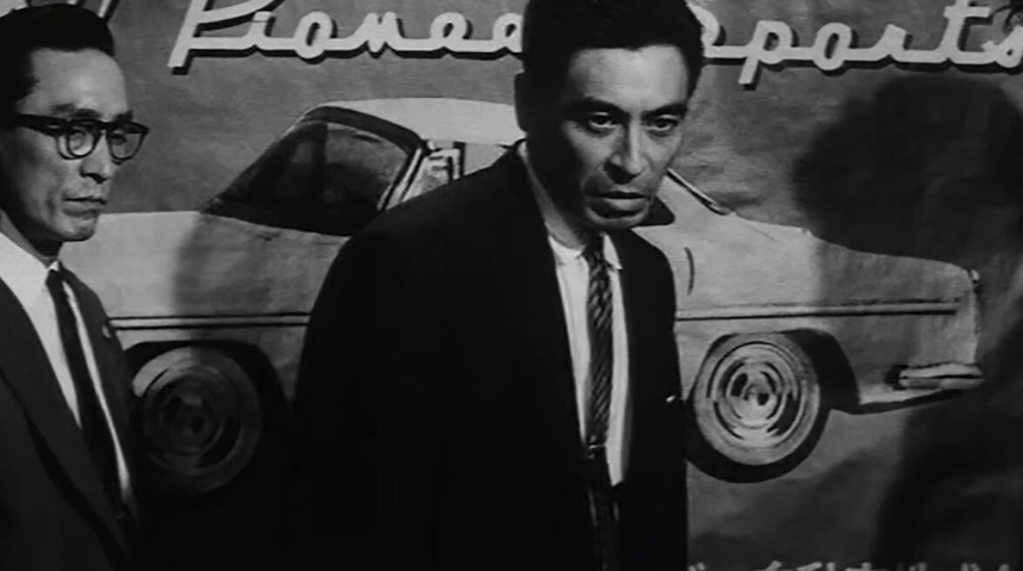
Yasuzo Masumura’s Black Test Car (1962) rather disappointingly ends with some didactic moral clarity — off-brand for a movie that, until then, offers a cutting, thoroughly jaundiced view of corporate ruthlessness without having to say the quiet part that loudly.
Written by Kazuo Funahashi and Yoshihiro Ishimatsu with a caustic comic tone that only accentuates its scheming central figures’ wicked shallowness, Black Sports Car plays not unlike a physically ill-matched game of tug of war. Its warring involves two parties — Tiger Motors and Yamato Motors, car companies respectively known for their mediocrity and quality — on the cusp of releasing their newest models. Yamato is actively working to sabotage its competitor’s prospective sales through espionage. The film opens with Yamato employees, apparently tipped off by a Tiger-embedded “spy,” sneakily taking pictures among some bushes during a top-secret Tiger test drive. The move proves especially damning when the freshly manufactured car turns a corner too quickly and turns turtle in the ditch below, its matte body hot with flames.
Black Test Car mainly unfurls from planning-department staffer Asahina’s (Jirō Tamiya) point of view. He wants to be at the top of the company food chain and takes a leading role trying to weasel out the mole who seems to be in their midst. He cajoles his hostess girlfriend (Junko Kanō) into trying to seduce opponents into giving away telling-enough slivers of behind-the-scenes information; he often serves as a sidekick figure to his immediate supervisor, Onada (Sachiko Meguro), a man who’s unopposed to physically threatening and then blackmailing a Yamato designer into handing over preliminary specs.
Cinematographer Yoshihisa Nakagawa’s inky, hermetic cinematography aestheticizes the claustrophobia of corporate pressure and mind games. Funahashi and Ishimatsu give everything a slightly arch seriousness — as if they were laughing to themselves about the objective preposterousness of all the sweat and tears shed over a sports car, whose very existence meets a want more than a need. Things never get as melodramatically messy as one might expect from a movie so nastily spirited, but there’s still much dark pleasure in watching a game of avaricious, bumbling one-upmanship, particularly in one scene where Tiger manages to furtively record a Yamato staff meeting and, while playing the footage back in slow-motion, has a lip reader only gallingly confirm that this move they’re convinced is ingenious hasn’t really changed them being several steps behind.
A key character deciding at the end of Black Test Car that corporate interests are not worth compromising one’s humanity for supplies the film with an arguably unearned dose of sentimentality. But some newspaper headlines seen around the same time pragmatically make another, more tonally fitting point: that there’s fairly commensurate potential for corner-cutting to get you ahead or to take you down. Even if ostensibly playing by the rules, it’s impossible for a corporation to be comprehensively “good.”
 Peterson Reviews