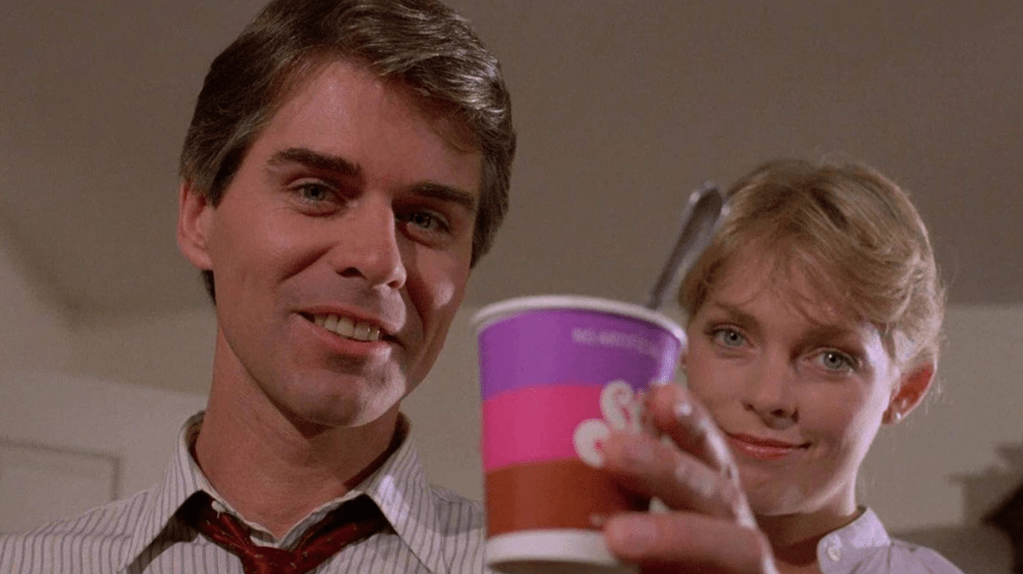
It’s found gurgling in some snow next to an industrial plant. Texturally it’s a little like milk — specifically when a restless kid is blowing bubbles into a glass of it at the kitchen table. The hard-to-believe natural instinct of the man who discovers it is to put a glob of it in his mouth. “That tastes real good,” he exclaims. “Tasty! Sweet.” Next time we encounter the mysterious substance, now known as The Stuff, it’s on the market. It’s billed as sort of like yogurt or ice cream but better — a dessert so irresistible, and shockingly without any fat or calories, that the public could also eat it for breakfast or rely on it nearly exclusively while dieting. But the first time we see it in its funhouse-colored packaging, we learn to understand it as more of an interloper than a mere treat. The white gloop is accidentally caught in a refrigerator wriggling outside its container, looking for an escape.
In The Stuff (1985), written and directed by Larry Cohen, the apparently extraterrestrial goop comes to exceed the popularity of Coke, has the addictive quality of cigarettes, and has ostensibly body snatcher-like goals. Its tagline is “one lick is never enough,” an early manifestation of the not-quite-right feeling one gets watching a Cohen movie. (The product is eaten by the spoonful, not like a dripping ice-cream cone.) But the slight offness of The Stuff — further embodied by its kooky southern-gentleman corporate-investigator protagonist (Michael Moriarty), who spends the movie zeroing in on the product’s genesis, with sidekicks that include a shrill little boy he isn’t related to (Scott Bloom) and a catchphrase-ready failed industrialist nicknamed Chocolate Chip Charlie (Garrett Morris) — mostly works to its benefit. The film’s persistent illogic and ever-present suggestion that it’s going to fly off the rails make it come across as an up-is-down nightmare heightening real fears. Yet it’s never particularly scary, nor does it lean very hard into potential monster-movie theatrics.
The Stuff’s weirdness is tonally appropriate for the very act of conspiracy theorizing. Though possibly containing a few truths, the mind-squiggling pastime is mostly so contaminated with absurd paranoia that if things were to be shared with someone without a matching proverbial tin-foil hat, the conspiracist is likelier to get an eye roll than another person added to the cause. The Stuff’s weirdness is also appropriate for Cohen’s primary, more serious targets: blind consumerism; the sort of corporate greed that doesn’t care if a product is harmful as long as there’s money to be made. It’s weird how many people don’t meet a suddenly ubiquitous product with skepticism; it’s weird that profit-minded executives can sleep at night knowing they’re making money from something they know is destructive. (In this movie where it can be hard to tell how much is meant to truly be a joke — Cohen, whether or not he means it, has a way of making something surreal seem like an earnestly held belief — a particularly good and clear one is when, late-movie, after the truth about The Stuff sees the light of day, the product’s old pushers try to release an alternative called The Taste, claiming it harmlessly consists of just 12 percent Stuff.)
I couldn’t help but also think about The Stuff’s “the consumed is eating the consumer” slant in relation to the present-day Trump supporter. They continue to uncritically devour the propaganda of a president with a parasitic relationship to the rest of the world, cannibalizing civil life until it becomes unrecognizable. So often I feel like I’m being driven crazy by the evils inflicted daily by powerful people, which is generally inextricable from their stupidity. The Stuff packages the feeling in a purple, pink, and brown paper tub.

