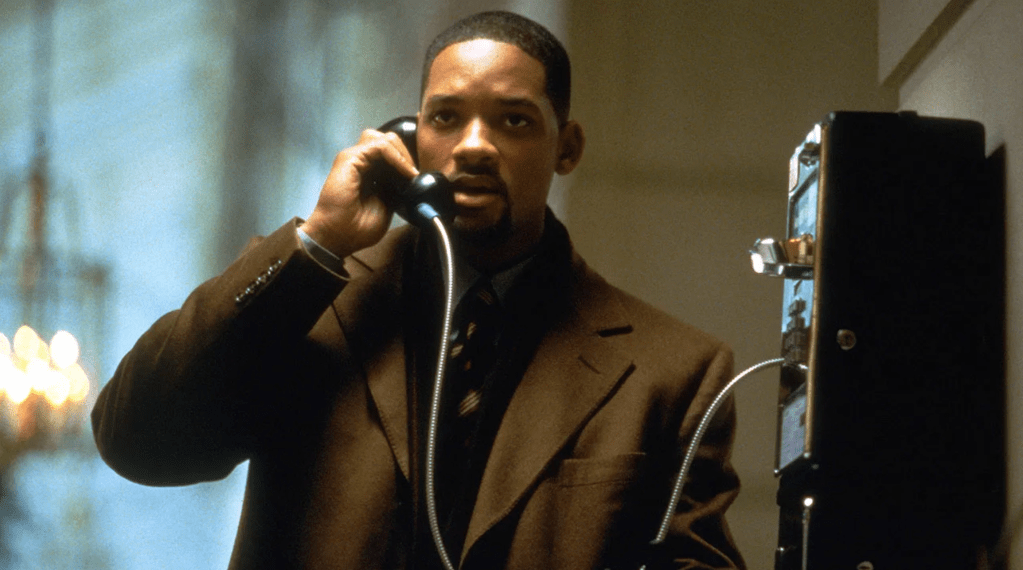
Enemy of the State’s reputation for depressing foresight has only grown since its original release. Yet it remains hard not to gasp when it’s offhandedly revealed mid-movie that its NSA-executive villain (Jon Voight) was born on Sept. 11, 61 years before the date became infamous. Some movies are prescient. Conspiratorial Enemy of the State regularly seems to be indirectly hinting that it knows something we don’t.
Tonally and thematically descended from Alan J. Pakula’s Watergate-era paranoia trilogy of the 1970s, which collectively concluded that we ought to meet people in power with a raised eyebrow and perhaps full-on fear, 1998’s Enemy of the State turns Will Smith into a man on the run, the people after him flexing institutional muscle in their determined chase. This happens because of a quasi-Rube Goldbergian wrong-place-wrong-time turn of events. The abbreviated version of them is that his character, a labor lawyer named Robert unopposed to blackmail if the outcome is right, unknowingly ends up in the possession of a damning videotape. It shows that a congressman, Hammersley (Jason Robards), who’d publicly opposed an overstepping new counterterrorism bill, was actually assassinated during a morning park visit for his resistance, not suddenly betrayed by his recently-operated-on heart. (Hammersley being a Republican with stubborn and generally decent morals feels quaint now.)
Reynolds, the NSA leader who arranged the hit and is the legislation’s foremost champion (Voight), is fully captured in the footage. He calmly looks on as one of his goons lethally injects his opponent with who knows what before dumping him into his car, scattering pills over its floor, and pushing it into the park’s pond, Hammersley’s brought-along Golden Retriever helplessly yelping nearby. (The only thing that could be noted positively of Enemy of the State’s rapacious set of villains is that pets — two more of whom, a yipping Pomeranian and a lap-happy orange tabby, appear — are carefully kept out of their line of fire, though it nevertheless annoys me that animals turn out to be safer in the film than Lisa Bonet’s character.)
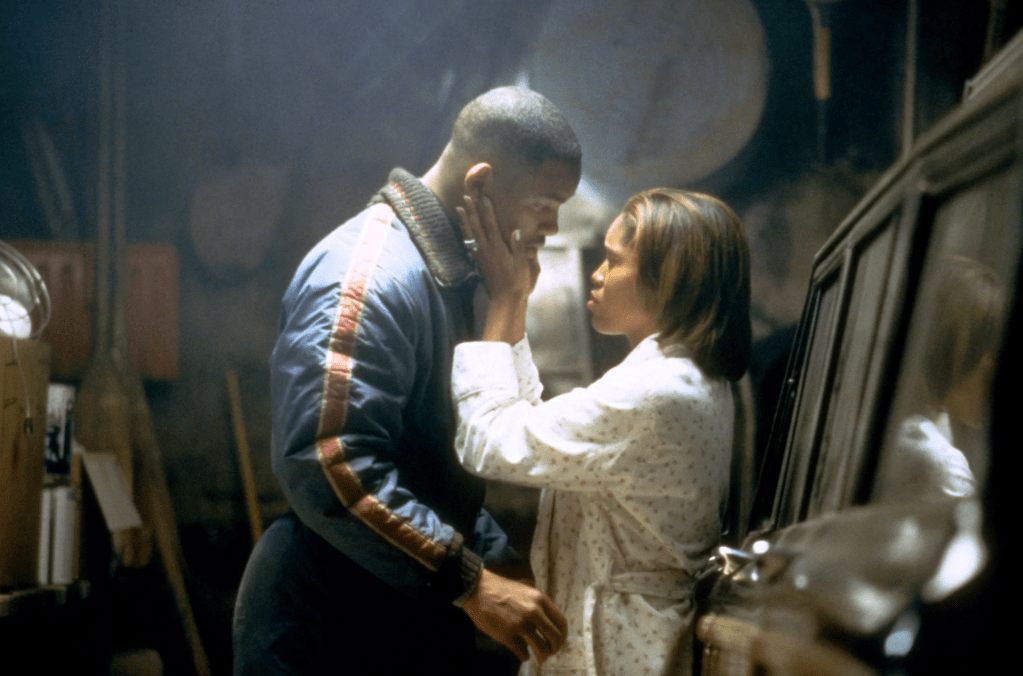
Will Smith and Regina King in Enemy of the State.
Reynolds and his baby-faced posse of yes men, which includes tech-savvy desk warmers “just following orders” portrayed by playing-against-type Jack Black, Seth Green, and Jamie Kennedy, quickly prove there’s nothing they wouldn’t do to acquire the footage. False headlines about Robert are planted. His bank accounts are frozen; his shoes are bugged. It takes just a few hours for him to become a wanted man running around the D.C. area, trouble barely dodged. Giving a furrowed-brow performance as Robert’s perplexed, patient wife, Regina King charmingly fumes in the meantime, making the most of a role that if embodied by another actress might have felt thankless. The movie at least tries to dispel accusations of this being a one-dimensional long-suffering-wife-style character, and King is prepared to take things above and beyond. She’s a high-powered ACLU attorney who spends much of her free time at home inhaling the TV news, huffily complaining about the government’s various fascism-adjacent or -forward pursuits. You’re made to want to watch a different movie starring King, too.
Tony Scott directs Enemy of the State with his typical hot-blooded restlessness. Director of photography Dan Mindel’s cameras aggressively swoop and careen, often from an all-seeing bird’s-eye view that preys on the paranoid feeling one gets after thinking too long and hard about surveillance omnipresence. Multiple chases — the most dynamic of which involves speeding cars, a duo of parallel-running trains, and a helicopter — are athletically conceived and executed, building on what Scott had previously done well with the likes of Top Gun (1986), Days of Thunder (1990), and Crimson Tide (1995) and kept refining. (His final feature, the fatless runaway-train thriller Unstoppable, is concurrently an appropriate — and tragically premature — swan song for an action filmmaker par excellence and an apogee of his best-in-his-class genre instincts.)
Working from a screenplay by David Marconi, Scott makes what Smith’s character goes through feel extraordinarily abnormal and vice versa. It also feels, in a way, anxiety-inducingly banal — as in, something not unlike this has happened before and will happen again. Take away its blockbuster-style action sequences and Smith’s befitting physicality to survive them and the film doesn’t feel that implausible. How much real protection does one have once institutional brawn decides you’re on its bad side? Unlike a fantastical horror movie or a credulity-stretching romantic comedy, the surveillance thriller can be, and usually is, disconcertingly resistant to “this could never happen” self-assurances, particularly ones with the-government-is-not-looking-after-me premises like Enemy of the State’s.
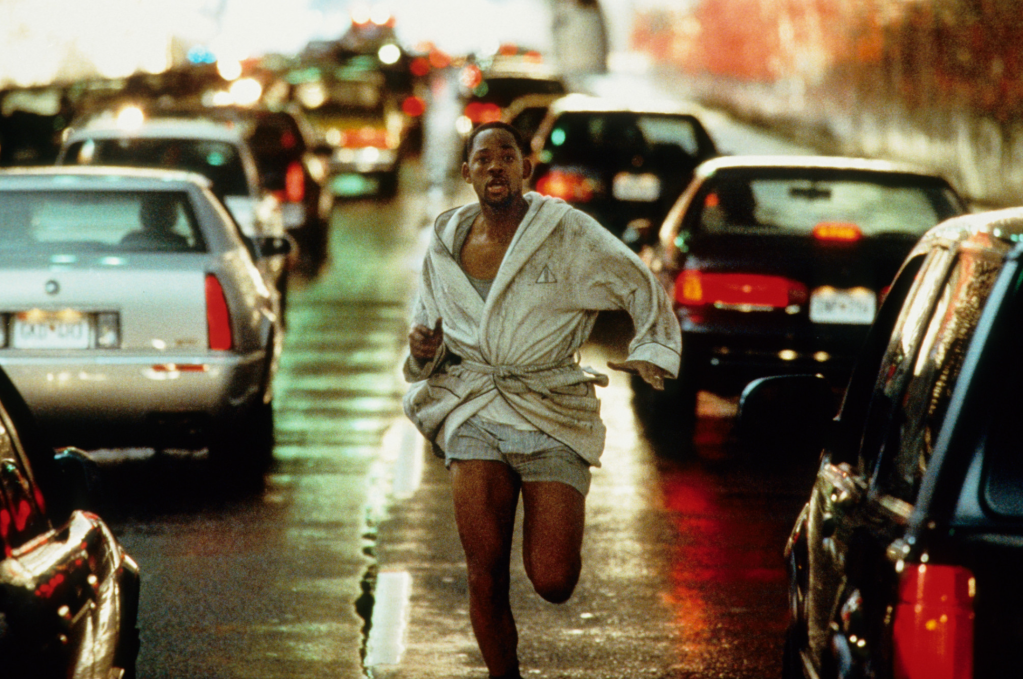
Will Smith in Enemy of the State.
The movie is also astutely but nonpedantically conscious of how that racistly compounds in the case of its protagonist, suddenly unprotected by his worked-hard-for financial and professional security. Enemy of the State nonetheless inserts some moments of levity in what seem like a concerted effort to not bog its viewers down with too much hopelessness. Some time is bumblingly spent in a lingerie store that will seem unimportant to the plot until that’s no longer true. In another scene, Robert goes on and on about his love for his blender, comparing it to meditation or massages as a worthy tool for relaxation. Enemy of the State’s attempts at humor so awkwardly seem like exactly what they are — attempts at humor — that the movie could have gone on without them entirely and been fine (and burn some of its slightly flabby 135-minute running time).
A film with Enemy of the State’s crowd-pleasing intentions wouldn’t let its clever-in-a-crisis protagonist — belatedly joined by a likably gruff ex-NSA employee played by Gene Hackman in a much-noted echoing of his role in Francis Ford Coppola’s surveillance-heavy The Conversation (1974) — lose this rigged flight. But it leaves open the basically ensured possibility that Robert’s one-off triumph against NSA overreach is an only temporary victory. One’s initial worries of Enemy of the State becoming dated by 2026 standards — possibly Pollyanna-ish in a liberal belief that taking care of a federally sanctioned entity’s so-called bad apples will stop a larger problem — get quelled.
There’s no real reason to reiterate the common wisdom that the level of surveillance so feared in Enemy of the State has in the last near-30 years become grudgingly lived with. Now integral to the movie’s power is its feeling resonant in a way it couldn’t have fully fathomed at its inception. If it’s not street cameras taking stock of what you’re doing, then it’s social media, online purchases, streaming services, and so on. A private moment never fully feels like one in our algorithmic contemporary times. In 2026, when even those dressed like a suburban neighbor might snatch you off the street with impunity, Enemy of the State feels glumly prophetic — surprisingly sound. The pain of that is somewhat assuaged by Scott’s studious filtering of his movie’s thematic seriousness through action-film heft, not to mention Smith’s and Hackman’s comfortingly competent movie-star heroism.

