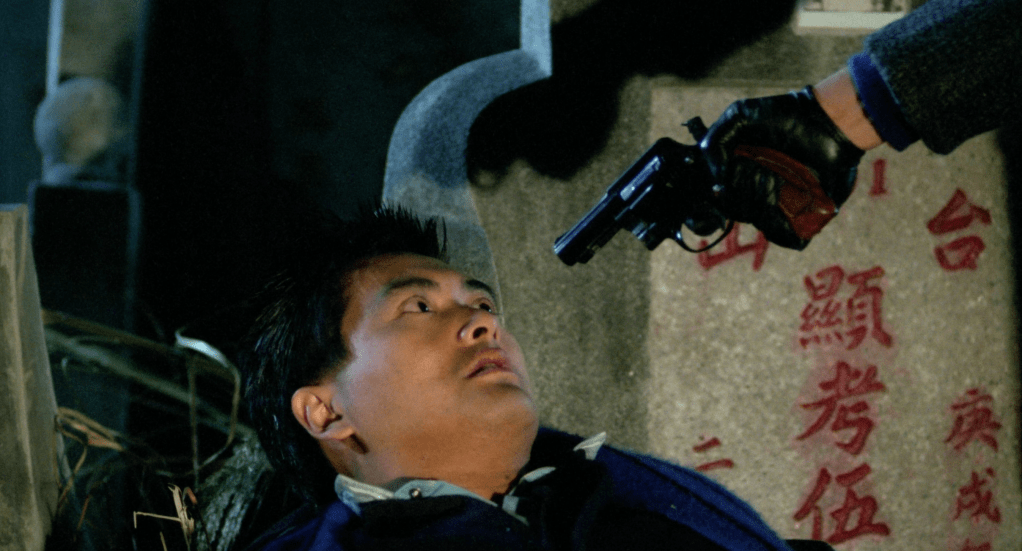
I haven’t seen Reservoir Dogs (1992) in more than a decade. So it was possible to enjoy City on Fire (1987) — the Hong Kong police thriller Reservoir Dogs’ writer and director, Quentin Tarantino, has confessed to copying much of — on its own terms, uninterrupted by memories of its better-known copycat.
The Ringo Lam-directed movie was the filmmaker’s fifth of the ’80s but his first to be bona-fide bleak. It stars Chow Yun-fat, an action-genre icon still then on the come-up, as the messy-haired, initially goofy undercover cop Ko Chow. He’s not a very good one, liable to ethical breaches and susceptible to befriending men against whom he’s meant to be making a case. (He still has blood-covered nightmares making him relive a recent betrayal.)
Chow is tapped by his second-chance-giving police-inspector uncle, Kung (Sun Yueh), to ingratiate himself into the maneuverings of a group of restless jewel thieves wreaking havoc across town. Their work has become a huge threat to public safety, not just rich people’s wallets. (An early endeavor sees them speeding off with $1.2 million worth of swiped jewels.) Their jobs are always blighted with the deaths of witnesses, usually caused by the gun-happiness of on-edge men. Chow agrees to the dangerous assignment, albeit on the condition that he be done with undercover work the moment he wraps up the sham gun sale organized by Kung on which the investigation seems to hinge.
City on Fire isn’t all dark. Chow is, in the first few passages of the movie, still boyish, reminiscent of a bratty teen. He’s disposed to impolite behavior, like blowing cigarette smoke in a restaurant host’s face; he’s joke-prone, too, particularly when it comes to his long-suffering girlfriend (Carrie Ng), whom he’s convinced just needs to lighten up. (The nagging female romantic partner trope in Hong Kong action movies just might be its worst.) The action, unsurprisingly for what the industry was producing in rapid succession at the time, can reach Looney Tunes levels of implausibility, with a comic tenor to match. A police car partially explodes and flips over simply after one of its front wheels is shot. Chow loses his footing near a muddy grave and not only manages to dig up a skull in his clumsiness but irreparably crack it with his boot. And during a subway foot chase, when Chow impulsively decides to slide down the stainless steel sides of an escalator, he ass-hops over every small bump all the way down to prevent any undue bruising of the posterior.
But City on Fire’s half-seriousness can’t last. It’s increasingly thick with Chow’s middleman stress. And it’s otherwise pessimistic about law enforcement, both as it relates to its public reliability and the souls of those practicing it. (The more obviously heroic Chow and Kung can only be said to be different, not better, than Kung’s younger rival: a more by-the-books but nevertheless excessive force-using Roy Cheung.) Many a Hong Kong action film has no qualms about valorizing the profession, quick to employ tacit “whatever it takes”-style support for even the most questionable methods of bringing about justice. City on Fire has more reservations, bookended by an exhilaratingly action-packed finale — a culmination of a series of haywire set pieces — with a tragic comedown that feels far sadder than it does valiantly bittersweet. The lonesome, lilting sax heard in the film’s introduction seems not unlike sonic foreshadowing in retrospect.

