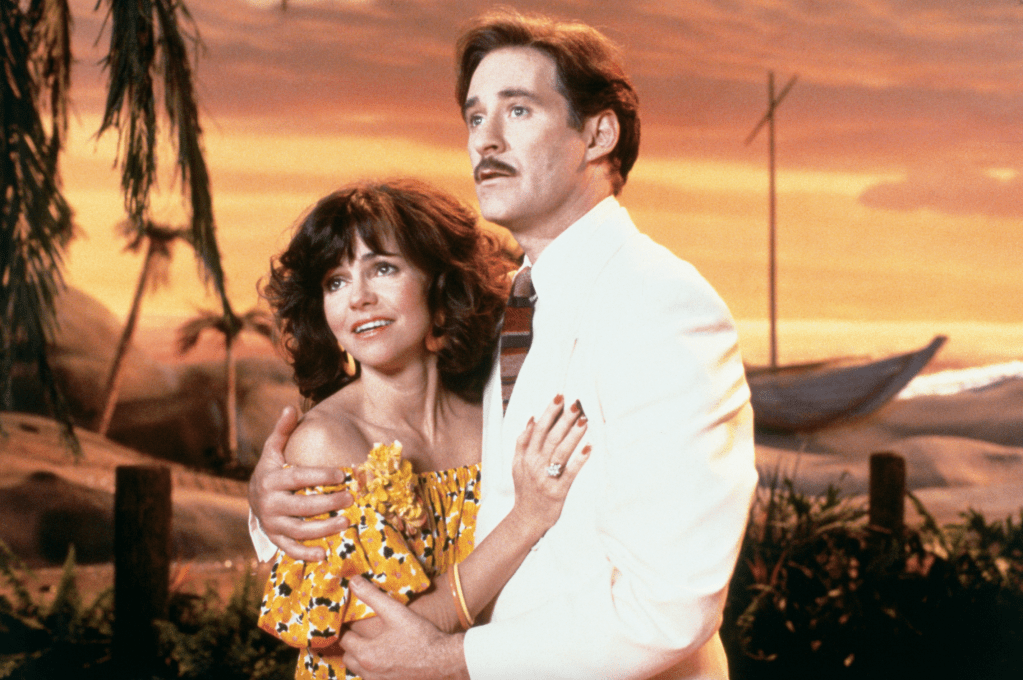
I’m not the only one to like Michael Hoffman’s Soapdish (1991) before vigorously hating it. Before the souring, it’s a fast-paced comedy that feels like slightly downtempo early-career Pedro Almodóvar and looks like late-career Rainer Werner Fassbinder. Then it destroys its goodwill with a finale that giddily brandishes transphobia as a weapon to shoo away its main villain. The movie’s ornate of-its-time-ness is amusing until it isn’t.
Soapdish is a backstage farce. Its milieu of choice is the soap-opera world, largely as it relates to the on- and off-set dramas of a fictional All My Children equivalent called The Sun Also Sets. Soapdish opens with the show’s star, Celeste (Sally Field), winning a major industry award, though in her always-keeping-it-moving profession that means nothing besides short-term vindication. She’s 42, and already she can see things on set shifting to frame her as aging: the costume department, for instance, is trying to introduce Gloria Swanson-like turbans and grand-dame dresses into her wardrobe. A diva who speaks either in a snarl or between spiraling sobs, Celeste is not subtle about her hatred of the way things are evolving — the there-but-unacknowledged truth that this series, fast declining in the ratings, would happily get rid of its most sacred cow and start fresh if it weren’t likely to be a huge pain dealing with Celeste in the aftermath.
Written by Robert Harling and Andrew Bergman, Soapdish is cheekily plotted like a season of The Sun Also Sets. A new actress on the show turns out to be a kept-secret daughter. A false pregnancy rumor spreads and endangers a career. Incest is threatened. The mirroring between the show and its behind-the-scenes bedlam is funny and pleasingly symmetric; Soapdish impressively never trips over itself despite all its intersecting plotting. Field is gamely verklempt throughout all of it, often doing what I see as her trademark expression — eyes half-bugged, mouth slightly agape, openly struggling to process what’s happening in front of her. Kevin Kline, as an old paramour and co-star who’s written in to return, and Whoopi Goldberg, as her undyingly patient representative in the stuffed-to-the-gills writers’ room, are sturdy foils.
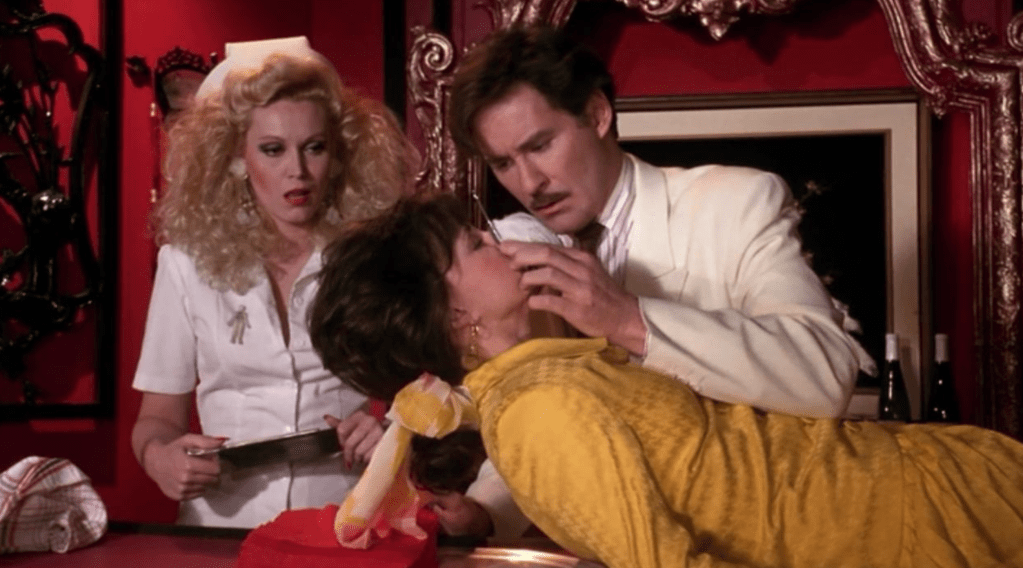
Cathy Moriarty, Sally Field, and Kevin Kline in Soapdish.
Soapdish saves its largest twist for the ending. It almost completely undoes what’s enjoyable about everything coming before it — a good example of the “one twist too many” adage that makes you see anew, and have contempt for, its worldview. Soapdish has been out long enough for it not to be much of a spoiler. It’s revealed that Celeste’s biggest rival, the egotistical, cat-like Montana (Cathy Moriarty), is actually transgender, a no-big-deal fact treated with about as much nuance as expected from a mainstream movie released in 1991 that functionally parodies the hairpin narrative turns of the soap-opera form.
The reveal becomes shorthand for fundamental deceit and malice, already integral to Montana’s characterization. A movie-long bit involving producer David’s (Robert Downey, Jr.) unconcealed sexual attraction to the wild-haired Montana is rendered as a humiliating consequence for his slimy character, who’s been conniving with her to approve a storyline that will sink Celeste’s long-standing dominance. (His reward, if he pulls it off, is a night in the sack with Montana.) When he finds out the truth, he gags. Its insulting late-movie turn aside, Moriarty’s performance is delectably Medusa-like, of a piece with Faye Dunaway thundering in Joan Crawford makeup. Would it have been so bad to punish her character’s toxic blonde ambition without the same merciless dehumanization and delayed recontextualization of Moriarty’s work?
Soapdish’s transphobia is so harsh that its comedy, which had before then sharply sent up soap-opera artifice and the delusional big-headedness of its easily replaceable talent, suddenly acquires off-putting retroactive mean-spiritedness. You go from rooting for most of its varyingly grasping characters to being unable to care less about what happens to them and the cruel joke for which they stand idly by. Soapdish, campy and chaotic, might be more widely regarded as a classic if not for its concluding few moments. It epitomizes the problematic favorite.


