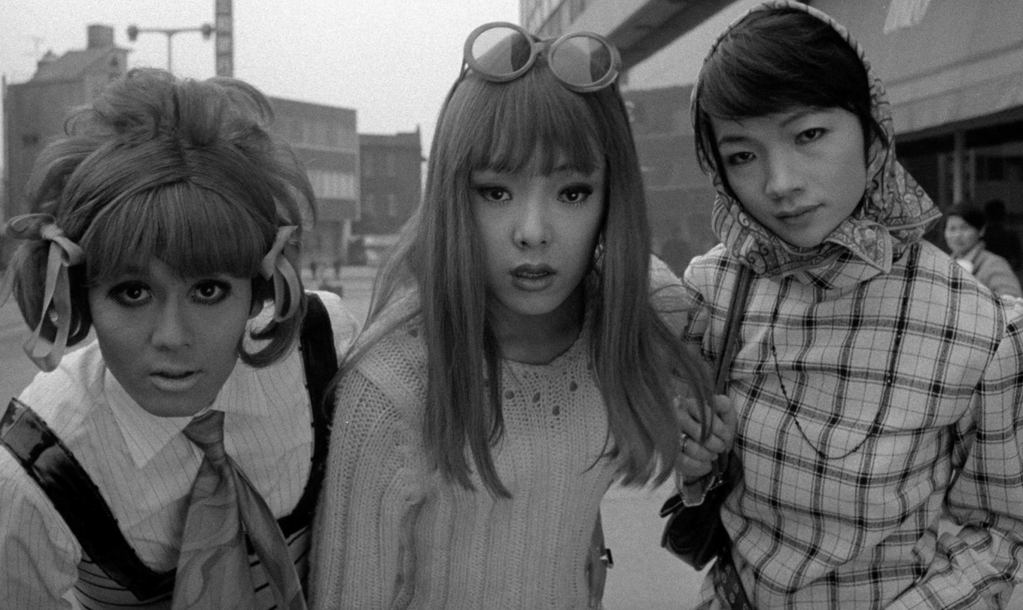
Eddie is the most popular girl among the male clientele of Genet, the host club bar where she works in Tokyo. Played by the gender-flexible and mononym-preferring performer Peter, Eddie — who by our contemporary standards would likely be considered a trans woman — is a vision of enviable beauty: puffy lips, glassy skin, fashion-magazine wide-set eyes rarely unadorned with butterfly-wing-size false lashes. But beneath the well-trained coquettishness and childish manners some of her peers groan about, Eddie is barely keeping it together, afflicted with traumatic memories of what seems to be the fatal stabbing of her mother. She does not seem to have been a helpless bystander.
Eddie is, in some ways, the heroine of Funeral Parade of Roses (1969), though the movie is such a visual and formal swirl that to give her that straightforward a designation doesn’t feel quite right. Though it pulls elements from Oedipus Rex and dwells on a professional rivalry between the young and hip Eddie and a more conservative older colleague (and romantic rival) named Leda (Osamu Ogasawara), the movie abstains from a conventional narrative. It couldn’t really be called a character study — the category often applied to movies keener on mimicking life’s vagaries than practicing traditionally structured storytelling — either.
Characters who appear onscreen are additionally seen in ostensibly behind-the-scenes interviews, commenting on Funeral’s script or, as is more common, giving insight, if they’re a gender-nonconforming person, into what it’s like to live as “queens,” as the late-’60s shorthand typically goes. (The cumulative consensus seems to be that it’s not that great, but life is always more bearable when not pretending to be what you’re not.) Initially unrelated-seeming footage — of student protesters stoically congregating, of a group of nude men lined up in front of a white background with their backs turned to the camera — intrudes on the film’s action; one memorable fantastical sequence has Eddie and Leda working out their feud with a High Noon (1952)-style shootout, then a messy saloon-like brawl.
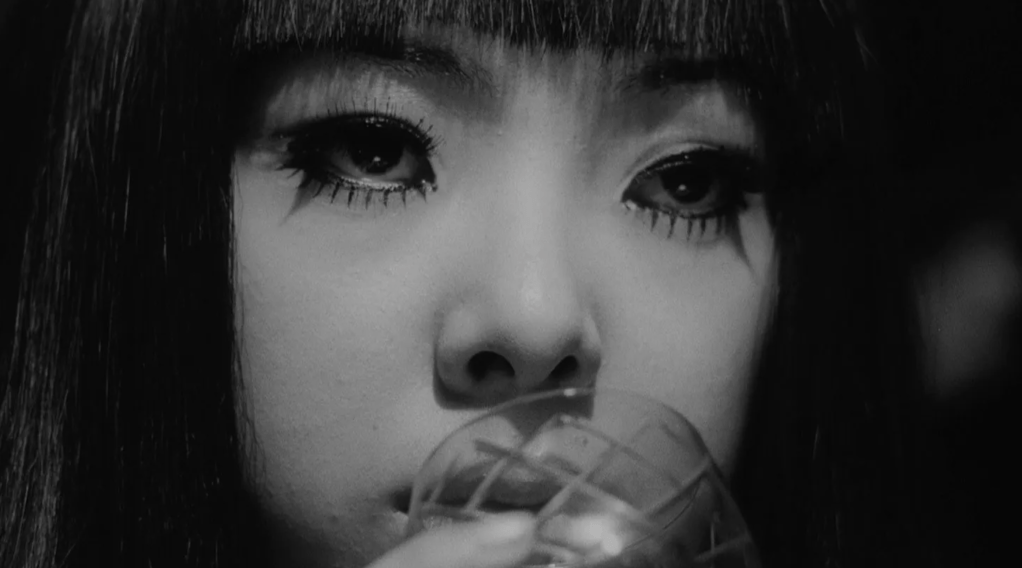
Peter in Funeral Parade of Roses.
Piloted by writer-director Toshio Matsumoto, who until Funeral Parade of Roses had only made experimental short films and documentaries, the movie’s dizzy, sometimes Novelle Vague-inflected aesthetics and blurry storytelling can be bemusing. But they mostly remain, more than 50 years later, exciting — a “free-form evocation” of a community, as Jonathan Romney has written. I’m not the first person to observe that its refusal to submit to well-tread cinematic conventions itself feels queer, the status quo intimated not to be something worth aspiring to. Its mosaic-like look and feel is most productive during the film’s final stretch, when the bleakness of Eddie’s past becomes too intolerable to withstand, worsened, in a shockingly violent slasher-movie way, when the inevitable Oedipus Rex-nodding twist arrives.
On the surface, Funeral Parade of Roses is guilty of perpetuating the same ills of already-scanty trans representation in movies. The “interviews” have a slight luridly interested tint. Raveling Eddie’s gender expression with bloodshed echoes, at face value, the schlocky twists of Psycho (1960) and its chintzy William Castle-helmed knockoff, Homicidal (1961). But its compassion is crucially far more evident than it is in those two movies, which fundamentally conflate gender dysphoria with mental illness. Even if the interviews marginally gawk, they appear sincerely fascinated, wanting to hear their subjects out. The milieu in which they exist is not condescended to. And the film’s two defining moments of violence first have to do with intensely hurtful homophobia, then a discovery that would be impossible to live with regardless of how you identify. Their sensationalism is somewhat palliated because you feel so firmly placed in Eddie’s shoes.
In accordance with its stylishly haywire visual presentation, Funeral Parade of Roses turns tropes on their heads. The violence probably won’t be what you immediately think of when remembering the movie years later, anyway. I saw the movie for the first time about a decade ago, and what had abided in my mind was the cover-star looks of Peter, who was only 16 when the film came out, and the sequence where Eddie and a couple of friends peacock around Tokyo. Dressed in echt-’60s women’s wear, they at one point use urinals, their heads nonchalantly and perhaps preparatorily turned in case anyone tries to challenge what they’re doing. They’ve heard it all before; they know what they want, and who they are.

