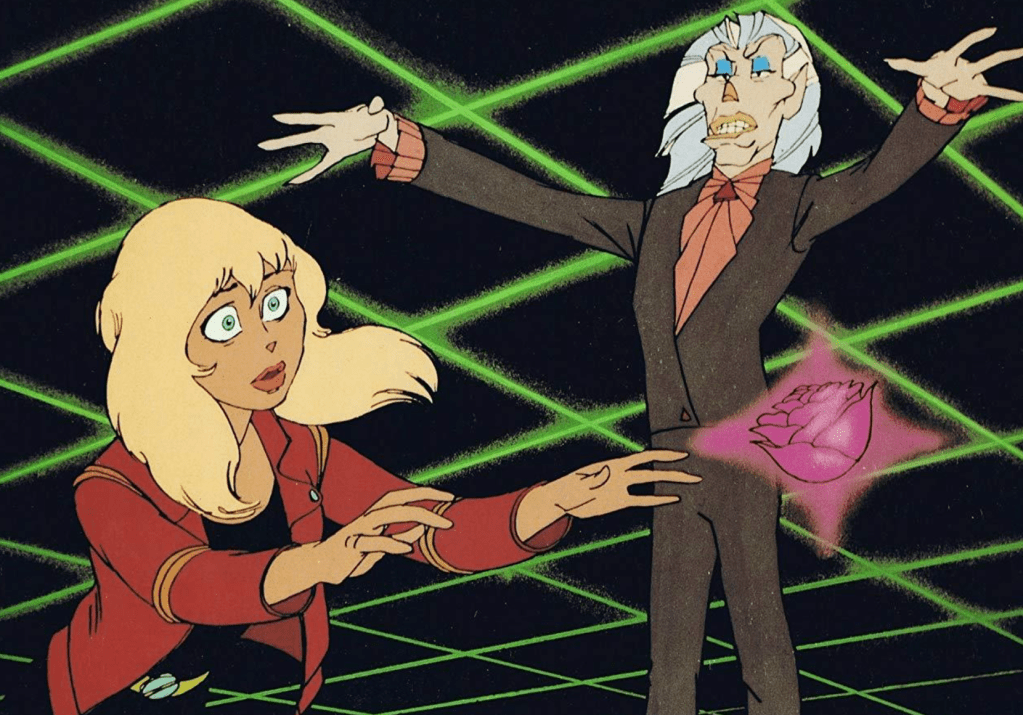
Rock & Rule’s Star Wars-like opening scroll is intriguing. It informs us that, years ago, after the end of a devastating war, the only survivors were street animals, and that, in the time since, the populace has mutated into human-mammal hybrids. But it’s not nearly as intriguing as the names prominently touted before then as being featured on the soundtrack: Cheap Trick, Debbie Harry, Lou Reed, Iggy Pop, and Earth, Wind, & Fire. One immediately has an idea in their minds of what this 1983 cartoon for adults, seeming like it’ll be in the vein of the impolite animated films of Ralph Bakshi and 1981’s musically oriented anthology Heavy Metal, will be: a fun-to-look-at sci-fi adventure with killer music.
It’s partially that. Set decades into society’s reestablishment, Rock & Rule is about a has-been rock star with a taste for the occult, Mok (voiced by Don Francks and by Pop and Reed when he sings), who kidnaps Angel (Susan Roman when speaking, Harry when belting), the frontwoman of an up-and-coming new band. He wants to open a gateway beckoning a demon onto our mortal plane, mostly so that he can be the name on everyone’s lips again. The only way to do it, his distaff HAL 9000-like computer says, is if a powerful enough voice sings a precise progression of a few notes.
The rescue mission conducted by Angel’s bandmates — one of whom is her boyfriend, Omar (voiced by Paul Le Mat and, when singing, Cheap Trick leader Robin Zander), who too has frontman aspirations that are getting in the way of their relationship — has a requisite quality, with DOA comedy provided by Omar’s noodly second fiddles. Far more interesting are the scenes with Mok, if only because he’s so delectably drawn. The film’s animators devise him visually like a cross between David Bowie and a wicked stepmother, with a set of sharp, banana-size teeth, a predilection for cape-like robes, and eyelids blotted with baby blue. (That also sets up Pop’s and Reed’s famously unaffected voices to sound underwhelming coming out of his beastly mouth: Mok’s flamboyant looks might’ve been better served by the likes of the New York Dolls’ David Johansen or Sweet’s Brian Connolly, even if both their bands had lost much of their cultural relevance by 1983.)
Rock & Rule’s highs are most consistently found in the musical sequences, which are too few and far between for a movie that makes it as much of a point to boast about its sonic bona fides, and in its look: chiaroscuro and menacing, its environs not unlike the dilapidated, danger-ridden metropolis seen in John Carpenter’s Escape from New York (1981), with noirish pops of neon and electricity crackles. (It reaches an apogee during a purple-tinted nightclub scene, where characters have to essentially battle a strobe light to figure out where they’re going and how to stay away from the foes that’re in the crowd with them.) But Rock & Rule too often feels like a cashing-in on the far more commercially successful, and better-resourced, Heavy Metal: It bears the feeling of a film that thought first about its sound, thinking everything would subsequently fall into place, then didn’t have as much music as originally envisioned and not enough plot to hitch that dearth of plot to.
Rock & Rule’s belly flop at the box office — barely over $30,000 on an $8-million budget — almost destroyed Nelvana, its production company. It was able to rebound by shrewdly retraining its focus to children’s programming, its canniest movie perhaps being its acquisition of the Care Bears’ character rights. Rock & Rule isn’t much of a success, yet it also makes me vaguely sad that its bombing made Nelvana fairly permanently avoid putting its backing behind risk-taking animation. Cartoons can be artistically thrilling when they make the most of their ability to go anywhere one’s imagination takes them. Gravitating toward what’s comfortable only reinforces the limitations of live-action entertainment animation has more leeway to eschew.

