
In Dutch writer-director Marleen Gorris’ filmmaking debut, A Question of Silence (1982), three female strangers browsing a clothing store spontaneously kill and then castrate its male owner in broad daylight after he catches one of them attempting to shoplift. The psychiatrist tasked with separately analyzing the class-divided trio afterward finds that their collective motive involved no premeditation or personal vendetta. It was borne, apparently, of patriarchally induced frustration, their day-to-day lives slow-dripped with the poison of, in two of their cases, sexist male-dominated workplaces and, in the other, relief-famished housewifery in service of an underwhelming husband. They’d all just happened to have had a breaking point in common. When at the end of the movie the inevitable trial’s male judge confidently concludes that this vengeful threesome would have committed the very same act if the shop’s proprietor shared their gender, they break out into loud, cathartically dismissive laughter.
Broken Mirrors (1984), Gorris’ follow-up to the provocative, powerful A Question of Silence — which she’d written in the first place after seeing a similarly premised news story, and directed after encouragement from another pioneering woman filmmaker, Chantal Akerman — has several things in common with its antecedent. It, too, matter-of-factly explores a conceit that in different hands might have occasioned a more traditional thriller, and it, too, is principally motored by three women at their wits’ end with male oppression.
Two of them are sex workers making a living in a brothel called Club Happy House. The other, a housewife, is the latest victim of a company-slash-married man moonlighting as a serial killer. He creeps around Amsterdam kidnapping women, seemingly at random, so that he can chain them up in a spartan, pitch-black basement only intermittently lit by a portable lantern. He starves them, keeping them alive with lukewarm bottles of water, and takes polaroid portraits while they plead; he keeps, as a cruel taunt, his sadistic snaps neatly displayed in tidy, eight-photos-long timelines on the wall across from his victims’ cot — from which they’re never allowed to get up to simply go to the bathroom — so that they’re aware of the fate that will befall them. He refuses to speak during his regular visits. Though his back remains turned to the camera for nearly all of Broken Mirrors, we can feel his stare’s chilly arrogance.
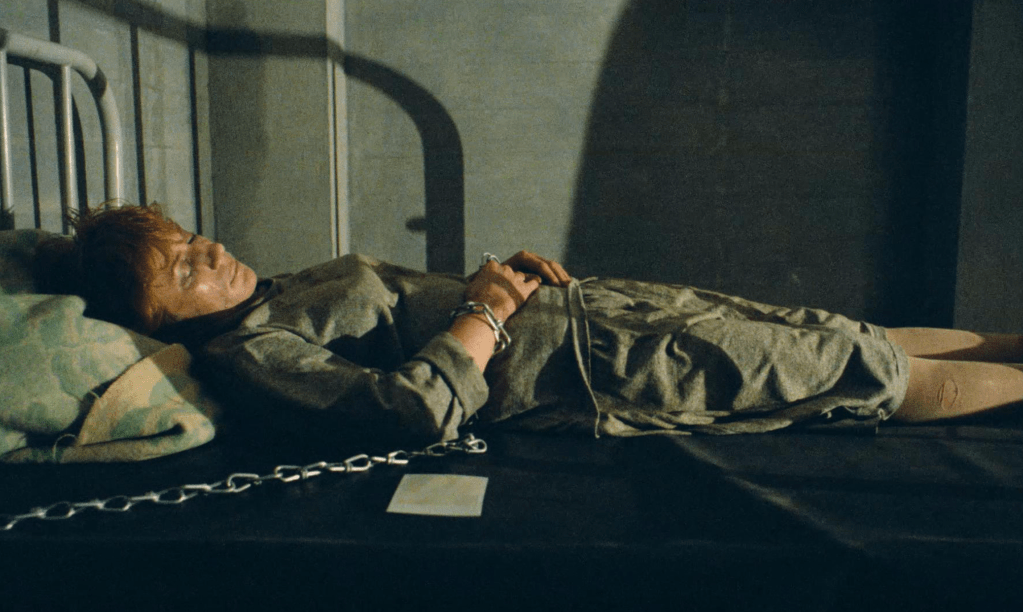
Edda Barends in Broken Mirrors.
How these three women are directly connected is kept ambiguous for most of Broken Mirrors, though Gorris has a character share a blunt-but-effective observation that makes an explicit link not that necessary. “It’s not much safer being a middle-class housewife than a whore,” they remark after hearing of the abduction. Like Lizzie Borden’s better-known Working Girls (1986), most of Broken Mirrors — which notably marks a major stylistic and technical leap for Gorris — unfolds in a brothel’s confines. Its beautiful, giallo-esque lighting — everyone’s faces are nearly always bathed there in goddessian gold and traces of pink, and the stairs leading up the space’s warren of bedrooms are thick with violet — belies the hard-to-reconcile fury its stable of workers stomachs for the perks of a relatively flexible schedule and a payday preferable to what’s available to a woman in the local blue-collar milieu.
The woman who manages the place (Colby Stunnenberg) is also, in contrast to Working Girls’ insufferably girlbossian madam, a benevolent, secretly revolver-toting leader who looks out for her employees as best she can. Behind closed doors, though, she too is beholden to a man. She has to implore the space’s aloof owner to be more on top of its constant plumbing issues — johns are always clogging toilets and vomiting chunks onto floors and sinks after swiping too many drinks from the business’s cherry-stooled bar — and generally be more cognizant of workplace cleanliness. (He thinks such practical matters are of less concern than potentially offering possibly profitable S&M-style services.)
One of Broken Mirrors’ two main sex-worker characters, Dora (Henriëtte Tol), is flatly pragmatic about the job’s expectations. She doesn’t, however, know how much longer she can handle the piggishness of the men who regularly come by. “Even the ‘nice ones’ aren’t nice,” she all but groans; later, after a particularly busy night, she grumbles about feeling like a “human lavatory.” During a memorable montage that shows the Club Happy House’s employees all barely feigning interest in (and in one example rejecting specific requests from) the johns they’re currently accommodating, Dora’s demeanor is the most indelible. She sits there, her eyes frozen in a roll, as her client fatuously declares, over and over, that he’s in love with her.
The other, Diane (Lineke Rijxman), is newer to the profession, only turning to it as a last resort. She isn’t a single mother to her baby but might as well be. She doesn’t trust that her junkie husband can be left alone with their child, and she needs the money for the child care her obliging older neighbor sympathetically provides. She’ll undergo a noticeable transformation over the course of Broken Mirrors: a flinching naïf not sure if she can handle her new job’s demands to a fiercely protective older sister-like colleague. The film’s climax sees her fearlessly brandish a gun in response to a client’s stupefyingly inhumane response to a traumatic act of workplace violence.

Arline Renfurm, Lineke Rijxman, and Henriëtte Tol in Broken Mirrors.
Gorris walks a tightrope. But she manages to unflaggingly maintain core feminist values: the imperatives of female agency; the right of women to do what they want with their bodies, even if many others — including a subset of other self-proclaimed feminists — decry their choice of employment. She’s frank about the emotional toll sex work can have without sliding into condescension toward those who practice it or teetering into what feels like over-the-top scared-straight alarmism — surprising, considering the kinds of violence it contains. And, seeming to be aware of man-hating accusations from bad-faith members of the public and press — to which A Question of Silence and Broken Mirrors were subjected anyway — a sweet homeless man Dora befriends reminds us that male entitlement is taught, not innate. He would never, it seems, begin to act like the other men for whom the movie has so much contempt.
Stirring especially in its several moments of professional and personal solidarity — perhaps the only positive corollary of so many toxic workplaces, sex work-related or not — Broken Mirrors is inspiriting without turning unrealistically optimistic, “thematically rich but never didactic,” as Bryan Miller wrote in Bright Wall/Dark Room. The serial killer’s victim (A Question of Silence‘s Edda Barends) learns not to give her captor what she realizes he wants — for her to keep fruitlessly begging for food and freedom so that he can revel in his power — but though that will weaken some of his upper hand’s grip (he gets so upset about her epiphany, which prompts her to give him the silent treatment, that it makes him suddenly become frantically talkative), it will not, spoiler alert, result in her release. Sex work can, as shown during the film’s last act, be turned away from, but it can’t undo the injustices and degradations that will continue dogging the profession.
Gorris’ filmmaking, as it was with A Question of Silence, doesn’t have obviously utilitarian aims. I’m reminded of another feminist movie I recently saw, Mai Zetterling’s also criminally undersung The Girls (1966), where the majority of the film’s force came from the very depiction of women’s patriarchy-related frustration, which then and still does not drive many films’ narratives. Moviegoers are likelier to endorse escapism by default; A Question of Silence and Broken Mirrors interrogate the everyday prisons patriarchy creates and safeguards, wishing for the kind of liberation too institutionally fortified to be immediately achieved. The very least that can be done in the near term is to talk about it.

