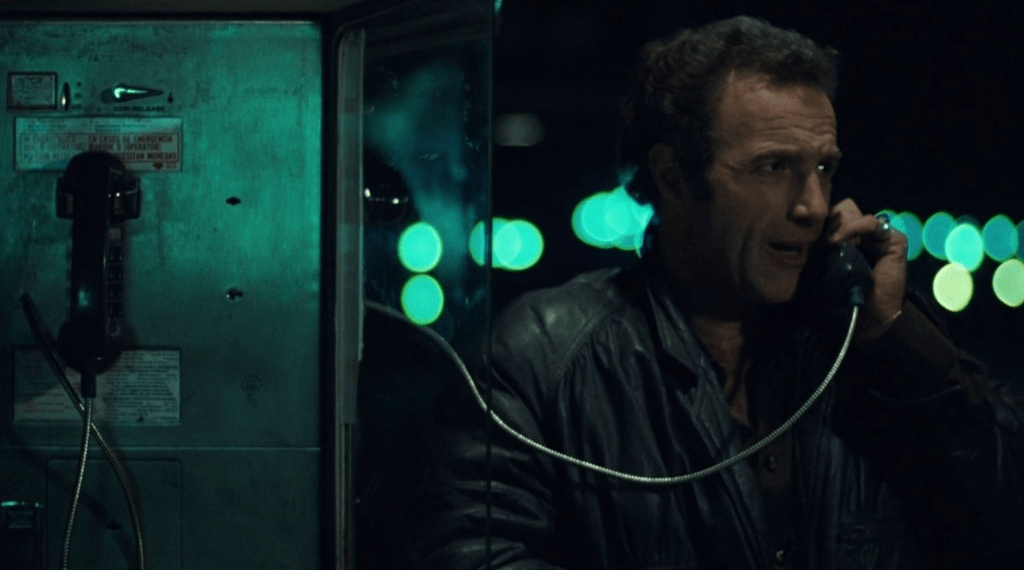
The Chicago-set Thief (1981) doesn’t give us any time to adjust to its shadowy, perilous world. Would that even be possible? The great Michael Mann’s feature debut, arriving years after he’d begun cutting his teeth in the TV business, opens with a jewel heist. The safe containing the trove of diamonds to eventually be sold on the black market for a high price is being broken into by Frank (James Caan), who long ago perfected the illicit trade. Director of photography Donald E. Thorin’s cameras near-fetishistically watch, in close-up, Frank’s tools pierce and then mercilessly weaken inches-thick encasings, which can only respond by sparking and smoking. He and Mann, who also wrote Thief’s screenplay, immediately make a strong visual case for Frank’s work being akin to art.
Before his reinvention as a preternaturally skilled safecracker, Frank did 11 years in prison. Two of them came from stealing $40 as a 19-year-old. Nine were added on after he killed — in self-defense, he says — a couple of guys who would have otherwise done the same to him first. His time behind bars didn’t deter him from a criminal life. It’s made him more cautious, though. He only works freelance so that he’s never beholden, in the long term, to the sorts of power-mad egotists that can get you into trouble. He runs a duo of front businesses — a used-car lot and a dive bar — to mask his illicit activities. To see them in the daytime is always a little jarring. Thief, a visually seductive neo-noir, makes nighttime seem more natural to these characters and the places they haunt than daylight and its inexorable exposure. Pummeling rain is less weather than a mood-sanctioning accessory. A neon sign seems to have been mounted in the first place so that it could be reflected off a shiny black car’s hood.
Thief charts a softening likely not to bode well for someone whose carefulness has, post-prison, been advantageous. Frank falls in love with a waitress named Jessie (Tuesday Weld). She initially doesn’t want to get involved with him — in a former life she lived riskily and itinerantly as the girlfriend of a now-dead drug dealer and much prefers the safe, humdrum routine she’s been living — before changing her mind. She’s convinced by Frank’s not-particularly-sound argument that she has nothing better to do. (The movie’s most poignant scene is an early one in which, at a diner, they lay out all their proverbial cards on the table: what they’re anxious about, where they want to be.)
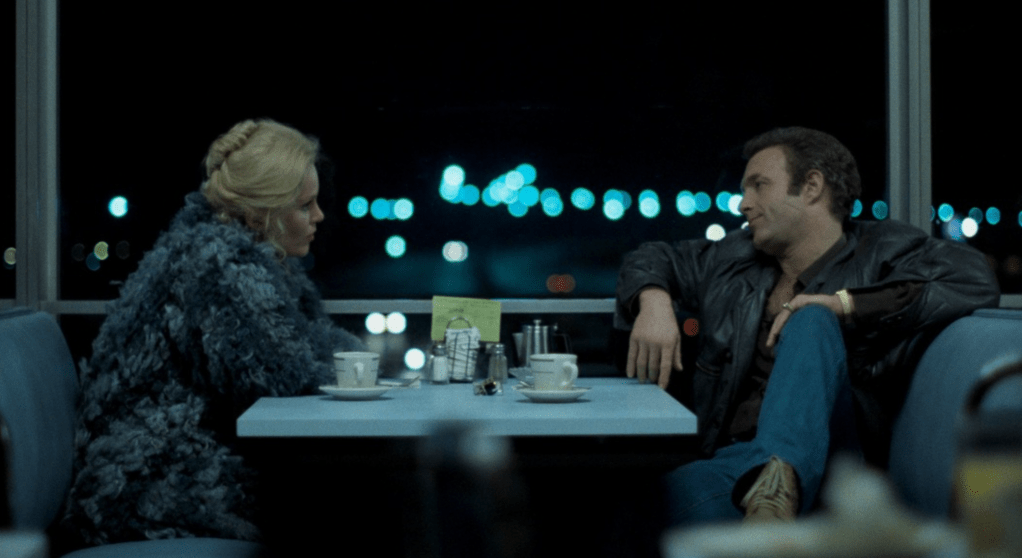
Tuesday Weld and James Caan in Thief.
And Frank decides, thinking the offer is decent enough, to do a job for Leo (Robert Prosky), a ruthless fence and crime boss. Frank is uncharacteristically naïve to believe any promises the beady-eyed Leo makes — whether about money or the time constraints of the commitment he agrees to — but you can understand why his intuitions become unusually muffled. The payday is so good that he could feasibly quit criminal life for good, and Leo has the kinds of connections that can make the adoption of a child — which Frank and Jessie conventionally, and unsuccessfully, attempt — possible.
Thief aims for regretful pathos, dangling the possibility of a domestic, happy next chapter after making a life for oneself that necessitates, to preserve one’s mortality, lone-wolf selfishness. (Frank’s love for Jessie is made clear by his pronouncement that he never told his first wife how he was making money on the side.) But the film’s aforementioned decision to immediately start mid-action — and, in tandem with that, introduce a host of hard-to-keep-track-of characters — you feel, from the start, like you’re playing catch-up, still unclear about Frank as a character as the movie mournfully lurches forward. Little about Thief feels emotionally earned; as personal histories are invoked and future aspirations spoken about, the prescriptiveness makes you, more than anything, aware of what you should be feeling. That quality doesn’t blight the work of Weld, however: She’s excellent, in what in the hands of a lesser actress could have been a mostly-just-symbolic role, as a woman who, like her significant other, craves transcendence from her reality’s fragility but puts on a brave face, her love and empathy for Frank underpinning her loyalty. Weld’s eyes and usually upturned brow betray a woman trying to keep it together.
Mann’s ability to persuasively confer emotion — something I know I’m in the minority about with the fairly universally beloved Thief — drastically improved in the 1990s, particularly with the sprawling police procedural Heat (1995), a movie that in a lot of ways Thief presages. Mann’s well-known deftness with set pieces, though, was swiftly proven with Thief: a music-less late-film heist quakes with pressure, and a climactic shootout Frank doesn’t seem likely to survive at Leo’s plush suburban home is so exciting that it has a way of ameliorating — or making you, at least, more forgiving of — the dramatic shortcomings preceding it. Mann knew how to put on a good show from the jump.

