Euzhan Palcy has only made three narrative features. The two I’ve seen, 1983’s Sugar Cane Alley and 1989’s A Dry White Season, attest to the now-68-year-old Martinican filmmaker’s preternatural tonal authority: coaxing optimism out of viewers without making it feel like a betrayal when she ultimately refuses to whitewash the world’s flighty cruelties. In A Dry White Season, set in 1970s South Africa, a white teacher’s (Donald Sutherland) moral breakthrough around the apartheid with which he’s always lived cannot, by the film’s end, be effectively harnessed as a means for modest societal change because his awakening will be violently suppressed by institutional force. And in Sugar Cane Alley, even the most positive developments in one’s life cannot reverse the difficult realities of a loved one’s fast-declining health and the callous working conditions that have only worsened it.
Made when Palcy was just 24, Sugar Cane Alley remains a linchpin in a career whose mutability in form and subject matter has found some constancy in her devotion to the oppressed — in giving, so the saying goes, voices to the voiceless. Like A Dry White Season, Sugar Cane Alley is a period piece. It travels far into ’30s Martinique, specifically toward a large tract of sugar cane fields and a neighboring, makeshift village where most of the Black people who tirelessly work there live and whose nickname gives the movie its title. As one older character (Douta Seck) puts it to a child who’s visiting him, those who’ve been living there long enough see their situation as about the same as slavery. Its technical abolishment has only made it so that one’s erstwhile “master” has simply become their “boss” — a pitiful change spurred only by the fact that workers are technically paid, albeit so little, and without the sort of legal oversight preventing bogus, payday-docking penalties, that it doesn’t make much material difference.
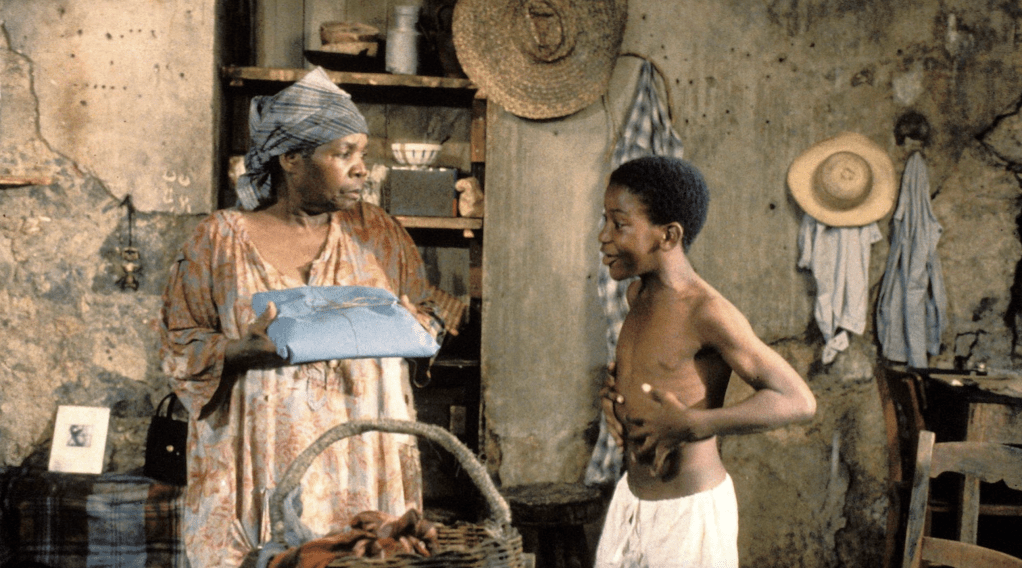
Compassionate without condescending to its appallingly ill-treated ensemble, the affecting Sugar Cane Alley narrows in on 11-year-old José (Garry Cadenat) and his kind, protective grandmother, Ma’Tine (a lovely Darling Légitimus), whom he’s been living with ever since his mom’s tragic death years ago. Determined that her grandson will get the education and life she never got, she’s adamant that he takes his education seriously. José spends many a summer afternoon getting into mischief with neighbors his age: watching snakes and mongooses brawl, getting catastrophically drunk on some pilfered rum. But he doesn’t have to be nudged much to excel in the classroom.
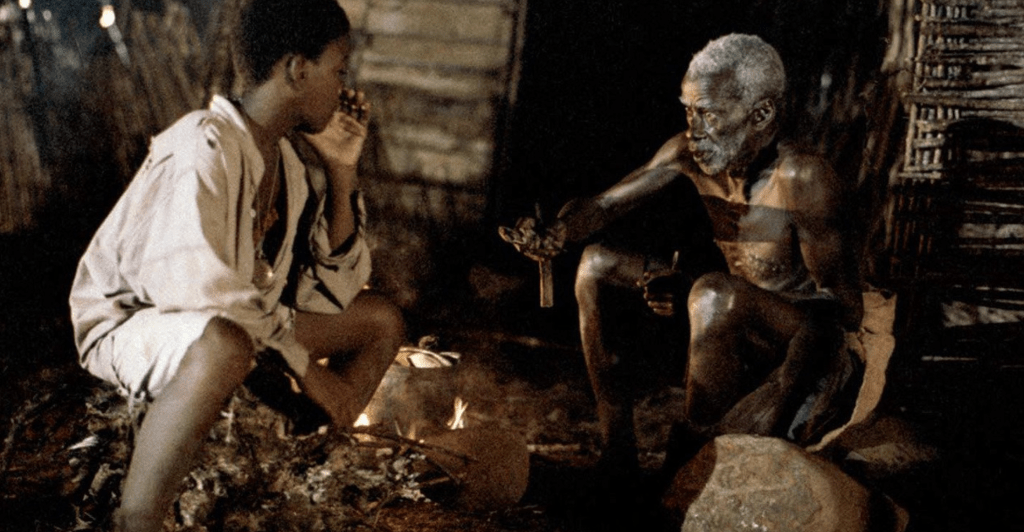
Garry Cadenat and Douta Seck in Sugar Cane Alley.
A keen observer of life, José turns vocabulary lessons into venues to riff on the boundlessness of language. And mid-movie, when he scores a scholarship that gets him into a better school in Port-aux-Français, José pens a beautiful, perceptive essay so beyond his years that his teacher immediately and angrily assumes that his bright new pupil is a sneaky plagiarist. It isn’t until a colleague talks some sense into him that the instructor will even acknowledge the chances of there being a prodigy sitting in front of him. I loved Cadenat’s watchful performance — the way his eyes light up, his voice struggling to keep up with the thoughts quickly forming in his head, when through education he can suddenly see the artistic and existential possibilities before him.
I haven’t read the 1950, homonymous Joseph Zobel novel Sugar Cane Alley was based on. For Palcy, the autobiographically inspired book was so personally transformative that it makes sense that she’d use it as the material for her inaugural foray into feature filmmaking. Fourteen at the time she discovered it, Palcy has rather famously said that the novel was the first she’d read that had been written by a Black man from her country who spoke so directly about the experiences of Black poor people, a demographic that had been and continued to be sorely underrepresented in literature and visual entertainment. (She knew she wanted to be a filmmaker even earlier, determined to do something about the negligent representation of Black people in cinema.)
Palcy’s formative relationship with the book encapsulates great art’s powerful ability to spark something in a consumer that makes them see the world anew. I can also feel, in her instinct not to let it remain a private touchstone but a work worth cinematically building on and sharing more widely with the public, her recurring contention that we should never underestimate, for good or bad, the degree to which the milieu in which we came of age shaped us. Sugar Cane Alley, in book form, added meaningful, vindicating dimension to how Palcy saw her home country. Through cinema, Palcy lays bare how she envisioned the novel and renews the emotional urgency of its period and setting, whose consequences can never fully be extinguished and whose related tragedies shouldn’t be forgotten.

