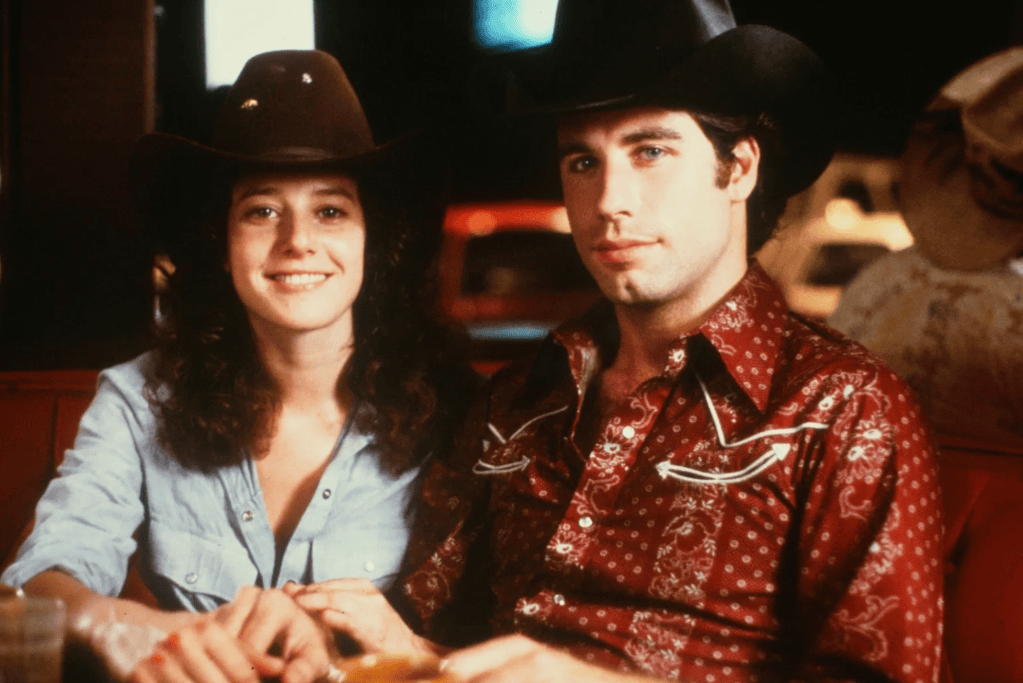
It’s pretty unbelievable, while reading “The Ballad of the Urban Cowboy: America’s Search for True Grit,” that it became the basis of a movie. Published in Esquire in 1978, the Aaron Latham-penned feature story is an entertaining snapshot of small-town American life — an outsiders-looking-in group portrait of 20-something-year-old working-class Texans whose lives and relationships are given purpose by their many evenings spent at the Pasadena honky-tonk Gilley’s, whose size Latham compares to the MGM Grand Hotel and whose main attraction is a mechanical bull. But its stakes are also not very high, and its drama — mostly having to do with some marital troubles arising from jealous, mechanical-bull-related resentment (a household cannot have two skilled riders, it seems) — has an unsmoothable wrinkle of silliness.
It’s simultaneously not that difficult to see how “The Ballad of the Urban Cowboy” could become a movie. The subhead of the story, which made Esquire’s cover, trumpeted the piece as a cowboy analog to the just-released hit Saturday Night Fever (1977). It’s not false advertising. Baldly in common between the story and the disco-forward movie are young, discontented, and noxious white male protagonists who feel on top of an indifferent world when in a niche club setting where they can be a main-character figure. I’d venture to guess that Esquire’s editors were probably thinking as much about Fever-pilled readers as trend-hopping movie executives looking for a fresh catch. “The Ballad of the Urban Cowboy” was the magazine’s sacrificial worm on a hook.
The gesture worked. “When the piece came out, I was vacationing on Nantucket, and the phone started ringing instantly with people trying to buy it,” Latham recalled to Texas Monthly about a decade ago. “I’d had movie interest on stories before, but this was 100 people calling.” Some cultural positives came from Fever’s and Cowboy’s parachute-style storytelling. Saturday Night Fever’s utmost legacy arguably remains its popularization of the disco genre in the mainstream. Co-written by Latham, Urban Cowboy achieved, albeit on a far more modest scale, something similar with country music. Six of the soundtrack’s songs made the top five of Billboard’s Hot Country Songs chart at the time. Country-themed bars across the U.S. erected good-for-business mechanical bulls on account of the movie’s popularity.
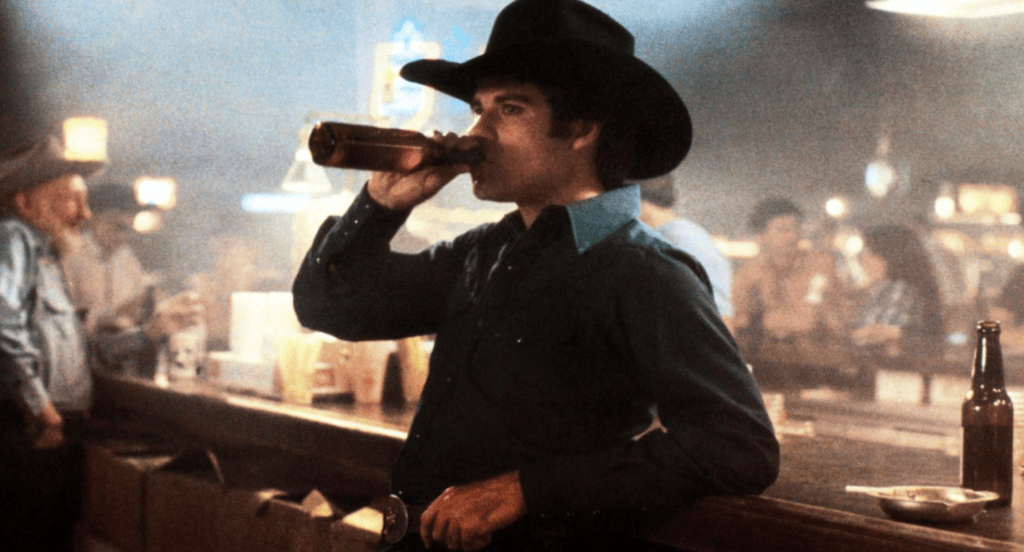
John Travolta in Urban Cowboy.
But the film, though superbly shot on location by cinematographer Reynaldo Villalobos — he makes visual poetry out of boots scraping against scratched and sweat-dotted dance floors and small talk over budget beers in the honky-tonk’s shadow-shrouded dining area — never waves away the notion of mostly being made to capitalize on Fever fervor. It stylishly brings forth the look and feel of its milieu but is jinxed by the genericism with which its subject matter is presented. Nominally about the alienation of frustrated blue-collar white men harried by their inabilities to achieve the American dream and aspired-to masculine ideals, Urban Cowboy is likelier to induce derisive laughter and symphonies of tiny violins than a tender heart for its self-pitying title character.
His name is Buford — though he just goes by Bud — and he’s played, just like the lead of Saturday Night Fever, by John Travolta. Giving a roiling, one-note performance, the New Jersey-raised Travolta’s work practically screams that he was not reared in the same region his character was; I’d have liked to see the version of the film with co-writer and director James Bridges’ first choice, Dennis Quaid. Bud is, when we first meet him, en route to what he’s thinking will be bigger and better things. He’s leaving behind his diminutive Texas town for the slightly bigger one of Pasadena so that he can work at his uncle’s oil refinery. Indicators of his rural innocence — a thick beard and his mom’s parting gift of homemade chicken and family-grown heaps of peas — are quickly traded for the maturing indignities of back-breaking work (he gets a stingily paying gig as a gofer). But he also becomes life-changingly starry-eyed when he’s invited to Gilley’s for the first time, which he marvels seems bigger than his hometown.
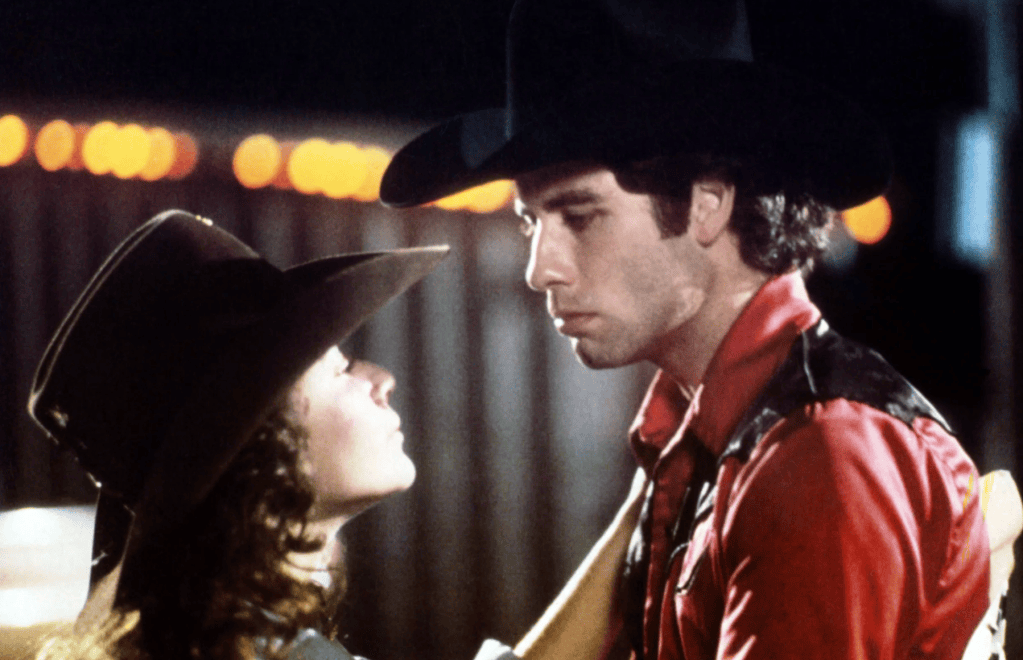
Debra Winger and John Travolta in Urban Cowboy.
Bud finds a community there. He finds love with a girl about his age named Sissy (better-than-the-movie then-newcomer Debra Winger), too. He marries her as if in a rush, proposing in the front seat of his truck after a lovers’ spat that escalates into some tussling in a pond-like parking-lot puddle. (The movie plays it for misplaced laughs; the music behind it is weirdly high-spirited.) They move into a red bow-wrapped trailer immediately after their Gilley’s-set wedding; the marital bliss lasts until the honky-tonk they both subconsciously consider a key part of themselves installs a mechanical bull. Bud becomes childishly obsessed with mastering its herky-jerk movements — a handed-on-a-plate metaphor for his desperation to seize some control over a life where he has very little.
Bud forbids Sissy from straddling it herself; he decides it isn’t safe for women. But the temptation to take it for a whirl proves too great. A (probably) not-meant-to-be-funny juxtaposition comes when we watch, one night, Sissy exult in her mechanical-bull finesse — she rides it sideways, backward, and, most amazingly, while standing on top of it, gripping nothing — while Bud fumes on the periphery. That’s mostly all he ever does in Urban Cowboy. He’s a collection of surface-level, tiresome man-child characteristics. The movie seems condescendingly conclusive about him not having much else beneath them. “He comes across as a hurt little kid of about 14,” Pauline Kael wrote in her review at the time of the film’s release.
Such makes up most of Urban Cowboy’s drama, which is, despite its certainly true-to-life fragile-male-ego underpinning, essentially absurd. But it’s all played unbearably straight by Bridges, who seems ultimately unsure whether his audience should constructively resent Bud or see him as an anti-hero whom we can trust will eventually understand how much his anguished masculinity is getting in the way of his own happiness. Deviating from the Esquire article’s unsentimental shrug of a conclusion, the ending seems to suggest the latter. I’d probably have been more willing to accept it if Sissy, physically abused both by Bud and Wes (Scott Glenn) — the wiry, mesh-shirt-owning man she retaliatively takes up with later — got to be more than a much-suffering barometer of Bud’s personal growth. He has the space to evolve; she has to absorb the damage incurred by him long-windedly figuring things out. Her urban cowgirl deserves better.

